


Molybdenum element (Mo): molybdenum periodic table facts
Molybdenum periodic table facts: molybdenum (Mo) is element 42, a transition metal in group 6, period 5. If you have ever used a drill bit, a stainless kitchen sink or a furnace that runs white-hot, you have probably relied on molybdenum (Mo) without knowing it. This silvery-white, lustrous chemical element was confused for centuries with lead and graphite, because molybdenum minerals look so much like them. Fuel cells, hydrides and the Haber process all trace back to the hydrogen molecule and its chemical properties.
Today it gives steel its strength at high heat, keeps rifle barrels from softening, and powers enzymes working in your liver and kidneys. Below you get its properties, history, sources, uses and role in your diet in one place.
Rotate the 3D Bohr model of molybdenum
Drag to orbit, scroll to zoom.
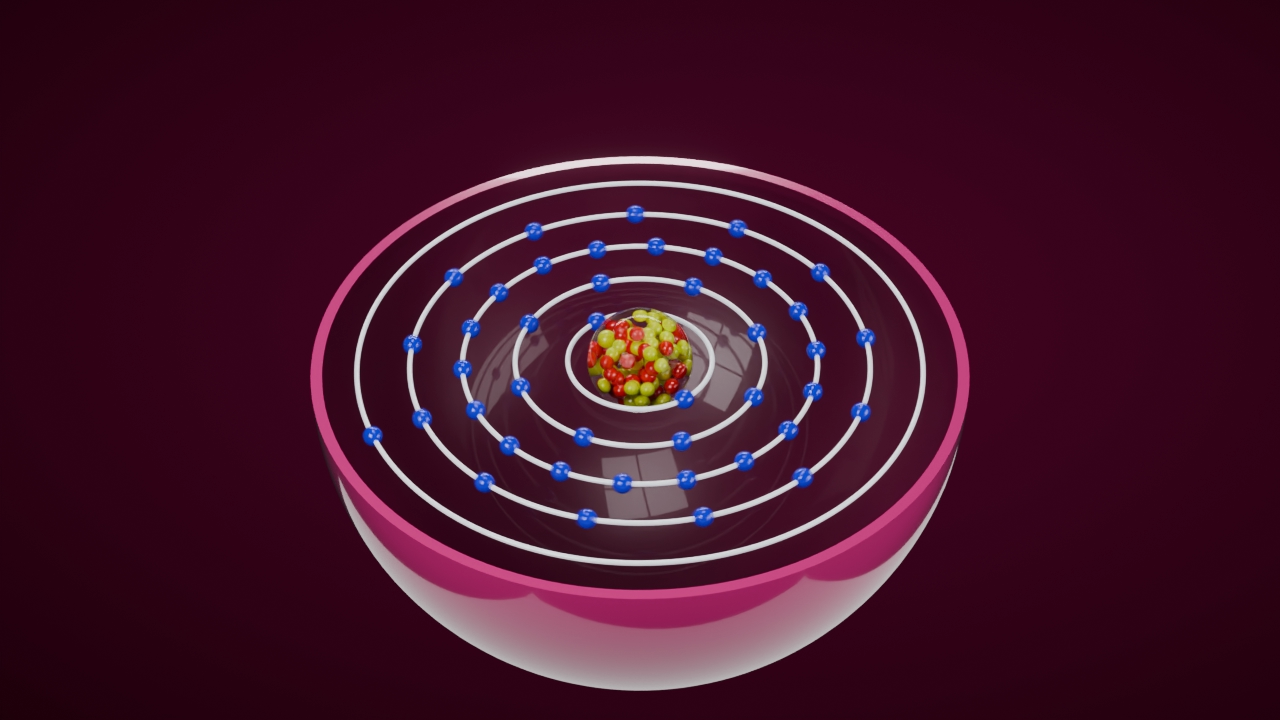
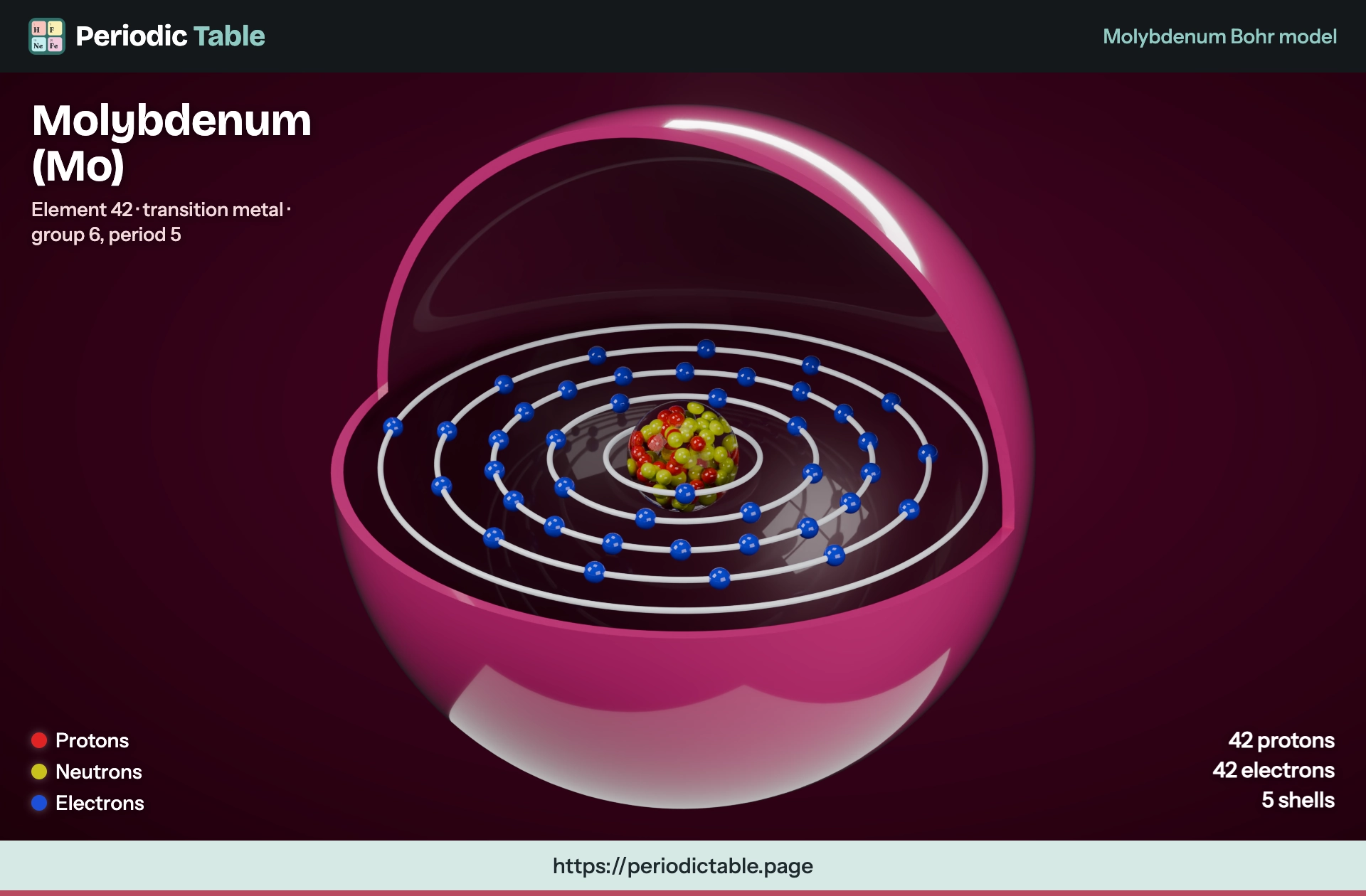
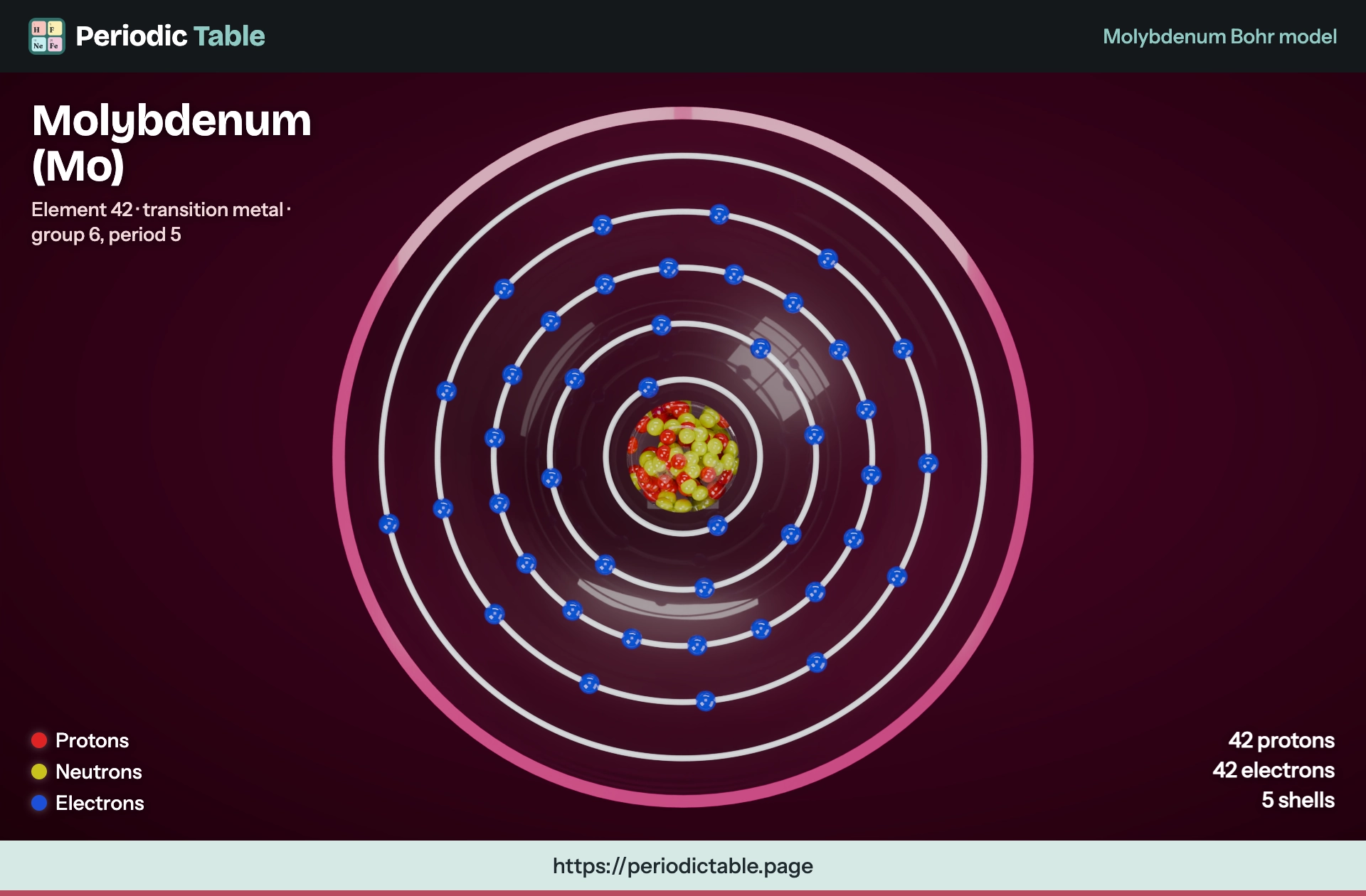
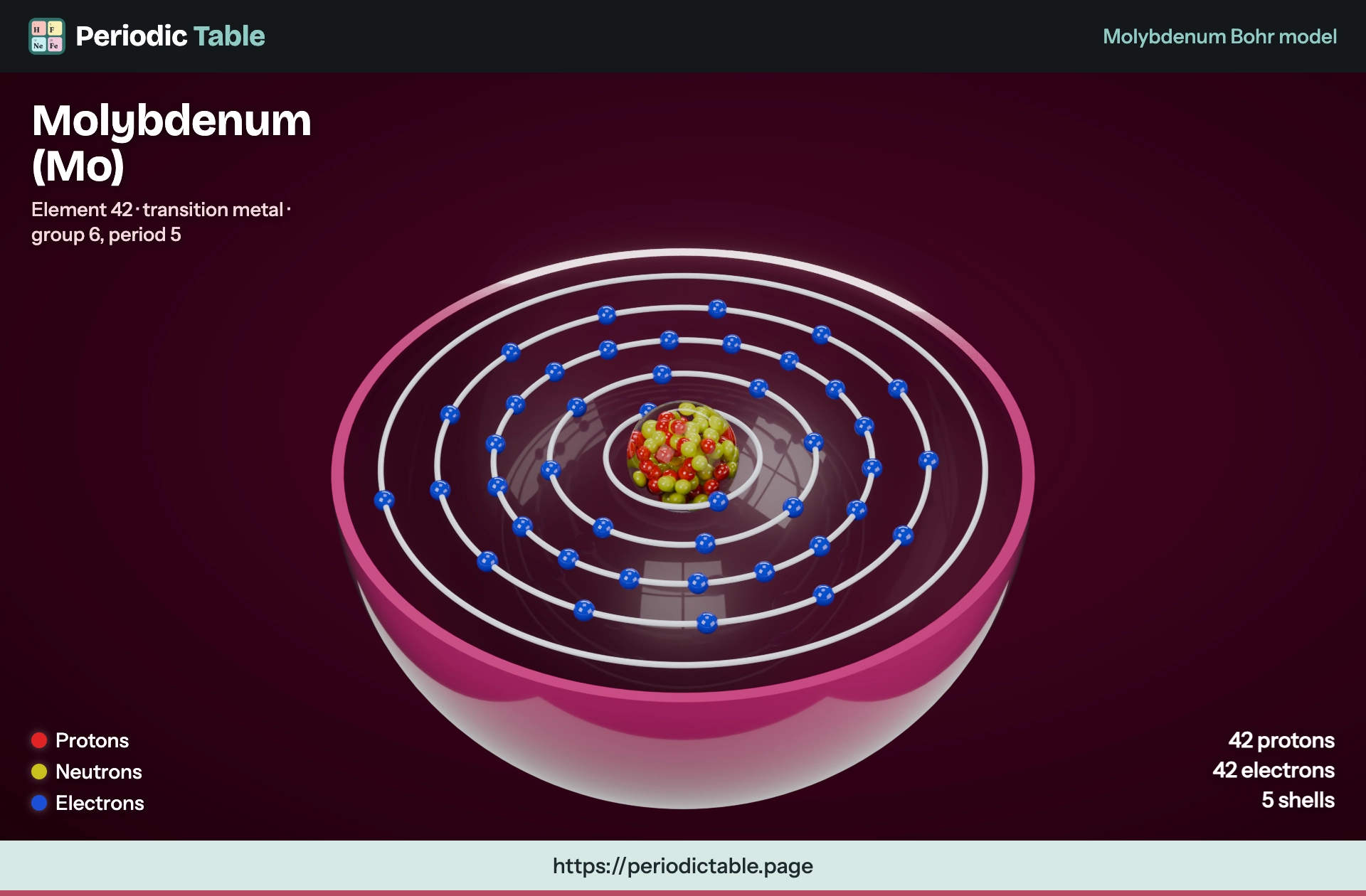
This is a Bohr model of molybdenum (Mo), a simplified picture of a single molybdenum atom. Its nucleus holds 42 protons, and a neutral molybdenum atom has 42 electrons, arranged around it in 5 shells (2 in shell K, 8 in shell L, 18 in shell M, 13 in shell N and 1 in shell O).
Molybdenum periodic table electron configuration
- Shorthand
- [Kr] 4d5 5s1
- Full
- 1s2 2s2 2p6 3s2 3p6 4s2 3d10 4p6 5s1 4d5
- Electrons per shell
- 2, 8, 18, 13, 1
Molybdenum element properties and atomic data
- Atomic number
- 42
- Atomic mass
- 95.951 u
- Phase at STP
- Solid
- Melting point
- 2622.85°C (2896 K)
- Boiling point
- 4638.85°C (4912 K)
- Density
- 10.28 g/cm³
- Electronegativity (Pauling)
- 2.16
- Period
- 5
- Group
- 6
- Block
- d-block
- Appearance
- Gray metallic
- Discovery date
- 1778
- Discovered by
- Carl Wilhelm Scheele
- Named by
- —
Molybdenum element facts: atomic number, atomic weight and group 6
Molybdenum sits in period 5 of the periodic table, in the d-block, with niobium on its left, chromium directly above it and its heavier twin directly below. The table below collects the core data you will see quoted most often. If you are curious about high-k dielectrics in microprocessors, you can start with the hafnium electron configuration for the full background.
| Property | Value |
|---|---|
| Symbol | Mo |
| Atomic number | 42 |
| Atomic weight | 95.95 |
| Group, period, block | Group 6, period 5, d-block |
| Electron configuration | [Kr] 4d5 5s1 |
| Appearance | Gray metallic, with a silvery sheen when polished |
| State at 20 °C | Solid |
| Melting point | 2,623 °C (4,753 °F) |
| Boiling point | 4,639 °C (8,382 °F) |
| Density | 10.22 g/cm3 |
| Electronegativity (Pauling scale) | 2.16 |
| Covalent radius | 154 pm |
| CAS number | 7439-98-7 |
| Recognized as new | 1778, by Carl Wilhelm Scheele |
| First isolated | 1781, by Peter Jacob Hjelm |
The outer shell is unusual. Instead of the 4d4 5s2 arrangement you might predict, molybdenum moves one electron into the d subshell to leave it exactly half full, which is a more stable layout. A handy use of the molar mass is turning a weight into an atom count:
$$N = \frac{m}{M} \times N_A$$For a 250 g molybdenum sputtering disc, that gives \(250 \div 95.95 = 2.606\) mol, or about 1.57 × 1024 atoms.
Physical and chemical properties of molybdenum metal
In its pure molybdenum form the element is a silvery metal with a faint grey cast. As a fine molybdenum metal dust it looks dark grey to black instead, which is how most people in industry actually handle it before it is pressed and sintered. In emission control and optics workshops, catalytic converters, glass polishing and ceria slurries are uses described in the cerium element page for readers.
Melting point, boiling point and density
Molybdenum melts at 2,623 °C, the sixth-highest figure of any naturally occurring element; only carbon and four other heavy metals stay solid longer. It weighs about 10.2 g per cubic centimetre, roughly 30% more than iron. The atoms pack in a body-centered cubic lattice, giving a Mohs hardness of 5.5, so it is hard but still workable.
Two numbers matter most to engineers: very low thermal expansion (about 5 × 10⁻⁶ per kelvin) and high thermal conductivity (138 W/m·K). Parts made from it barely change shape and shed heat quickly, even at high temperatures.
A transition metal that resists oxidation
Molybdenum is a transition metal with an electronegativity of 2.16. It does not visibly react with oxygen or water at room temperature, though halogens and hydrogen peroxide attack it. Slow oxidation starts around 300 °C, and above roughly 600 °C the surface turns into molybdenum trioxide, which evaporates instead of forming a protective skin.
That is why heater parts made from it run in a vacuum or inert gas. In the gas phase, two Mo atoms pair up through a sextuple bond, one of the highest bond orders known in chemistry.
Molybdenum isotopes and oxidation states
Natural molybdenum is a blend of seven isotopes. Six are stable, and molybdenum-98 is the most common at just over 24%.
| Nuclide | Natural abundance (%) | Stability |
|---|---|---|
| Mo-92 | 14.65 | Stable |
| Mo-94 | 9.19 | Stable |
| Mo-95 | 15.87 | Stable |
| Mo-96 | 16.67 | Stable |
| Mo-97 | 9.58 | Stable |
| Mo-98 | 24.29 | Stable |
| Mo-100 | 9.74 | About 7 × 10¹⁸ years |
Molybdenum-100 is technically radioactive, but it decays by double beta decay to ruthenium-100 with a half-life roughly a billion times the age of the universe. The synthetic molybdenum-99, made in nuclear reactors from uranium fission, matters far more in practice: within days it decays into technetium-99m, the tracer behind tens of millions of hospital scans a year.
The oxidation states of the element span −4 to +6, with +4 and +6 the most stable:
- +6
- Mo(VI) in MoO3, MoF6 and MoO42−
- +4
- Mo(IV) in MoS2, the main commercial mineral
- +2 to +5
- Chlorides and cluster compounds
- 0 and below
- Only with ligands such as carbon monoxide, as in Mo(CO)6
Molybdenum compounds and their chemistry
Most molybdenum compounds dissolve poorly in water. The two that matter commercially are the black disulfide, MoS2, and the trioxide, MoO3, which is the starting point for nearly every other compound and alloy.
Dissolve the trioxide in strong alkali and you get the molybdate ion, MoO42−. At lower pH these ions link into large cage-like clusters called polyoxometalates; a phosphorus-containing one turns deep blue and is the basis of a standard lab test for phosphate.
The element's chemistry closely mirrors its heavier neighbour below, but differs from chromium above it: the +3 state so common for its lighter neighbour is rare for molybdenum. It also forms quadruple bonds between two metal centres, as in the acetate dimer Mo2(O2CCH3)4. Its chlorides show how wide the range of states is:
- MoCl2, which exists as a six-metal cluster
- MoCl3, a dark red solid
- MoCl4, a black polymeric solid
- MoCl5, a dark green dimer
- MoCl6, a black solid that slowly loses chlorine at room temperature
Sulfides are the other big family, because the element is usually found bonded to sulfur in nature.
History of molybdenum, from molybdena to moly steel
The name comes from the Greek molybdos, meaning lead. Early miners lumped the soft black mineral they called molybdena together with lead ore, which we now call galena, and with graphite, since all three leave a dark mark on paper.
In 1778 the Swedish chemist Carl Wilhelm Scheele showed it was neither and had to contain a new element. In 1781 Peter Jacob Hjelm reduced it with charcoal and linseed oil and named the metal he got molybdaenum.
For about a century the metal had almost no use: it was scarce, difficult to purify and made brittle steel. In 1906 William D. Coolidge patented a way to make it ductile, which opened the way to supports for the filaments in light bulbs and windings for high-heat furnaces. World War I made it strategic.
British tanks swapped 75 mm manganese plates for 25 mm molybdenum steel armor that was lighter and stopped more rounds, and Germany's Big Bertha howitzer relied on molybdenum-doped gun tubes. During the Second World War it again stood in for scarce tungsten, and engineers settled on the nickname moly that you still hear today.
Where molybdenum comes from: molybdenite ore and mining
Molybdenum never occurs as a free metal on Earth. The crust holds roughly 1 to 1.5 parts per million, concentrated in sulfide deposits. The main commercial mineral is molybdenite (MoS2).
Wulfenite (PbMoO4) and powellite (CaMoO4) are minor sources, and ferrimolybdite and ilsemannite form where those deposits weather. Roughly half of world supply is a byproduct of copper mining in large porphyry deposits; the rest comes from primary mines such as Climax and Henderson in Colorado.
Molybdenum production by country
China leads molybdenum production by a wide margin and also holds the largest reserves, followed by Chile, the United States and Peru. Because one country supplies about 40% of output, the metal rates as a moderate supply risk. Refining follows a short chain:
- Crushed rock is concentrated by froth flotation.
- The concentrate is roasted in air at about 700 °C.
- The oxide is leached with ammonia to give ammonium molybdate, which also removes copper impurities.
- The purified oxide is reduced with hydrogen to a fine grey sponge.
Most oxide headed for steelworks skips that last step and is converted to ferromolybdenum, an iron alloy with about 60% molybdenum.
Molybdenum traces in seawater
Dissolved as the MoO42− anion, molybdenum is the most abundant transition element in the oceans, at about 10 parts per billion. It stays in solution for around 80,000 years before settling out, far longer than the oceans take to mix, so its concentration is almost the same everywhere. Geochemists read molybdenum in old seafloor sediments as a record of how much oxygen the early environment held.
Uses of molybdenum in steel and industry
Around 80 to 86% of output ends up in metallurgy. The rough split of global use looks like this:
| End use | Share of world use |
|---|---|
| Structural and engineering steel | 35% |
| Stainless steel | 25% |
| Chemicals and catalysts | 14% |
| Tool steels | 9% |
| Cast iron | 6% |
| Mill products (sheet, wire, rod) | 6% |
| Superalloys | 5% |
Steel alloys, stainless steel and superalloys
A fraction of a percent changes steel dramatically. Molybdenum forms hard, stable carbides and slows grain growth, so most high-strength steel alloys carry it. A common chromoly grade such as 4140 contains about 0.20% Mo, so a 12 kg crankshaft blank holds only 24 g of it.
In type 316 stainless, 2 to 3% molybdenum adds corrosion resistance against chloride pitting, which is why it is specified for desalination plants, seawater pipelines and coastal bridges; it also helps weldability. The alloy TZM, about 99% molybdenum with titanium and zirconium, keeps its stiffness above 1,300 °C and goes into rocket nozzles, aircraft engine parts and torpedo valve bodies.
High-speed steels and heat-resistant parts
Because it is about half as dense as tungsten and steadier in price, molybdenum replaces it in the M-series of high-speed steels such as M2 and M42, the grades most drill bits and taps are cut from. Pressed and sintered powder becomes furnace trays, glass-melting electrodes and radiation shields, and molybdenum disilicide (MoSi2) heating elements run in open air above 1,500 °C.
Molybdenum disulfide as a lubricant and catalyst
MoS2 shears into slippery layers, making it a solid lubricant for joints and greases that would burn or squeeze out under heavy loads. Promoted with cobalt, it is the catalyst in hydrodesulfurization, the refinery step that strips sulfur from petroleum before it can poison other catalysts.
Molybdenum oxides also drive the production of acrylonitrile and formaldehyde, and molybdenum orange pigments colour plastics and ceramics. Newer uses lean on the same chemistry: a thin molybdenum film is the back contact in copper indium gallium selenide solar cells, single-layer MoS2 is studied for semiconductors thinner than silicon, and molybdenum-based cathodes are being tested in lithium-ion batteries for energy storage.
Medical imaging and mammography
X-ray tubes for mammography often use a molybdenum anode, because its characteristic emission near 17 to 20 keV gives sharp contrast in soft breast tissue at a low dose; a standard x-ray tube with a tungsten target cannot match it there. Hospitals also keep Mo-99 generators, nicknamed moly cows, to produce the short-lived tracer it decays into for medical imaging every morning.
Biological role of molybdenum enzymes
Living things need only traces of this element, yet molybdenum enzymes sit at the centre of biology. More than 50 are known in bacteria, plants and animals, and they handle the oxidation and reduction of small molecules that move nitrogen, sulfur and carbon through cells, and ultimately into the proteins you eat.
Nitrogen fixation in plants
Bacteria living in the root nodules of beans and peas, along with free-living cyanobacteria, use an enzyme called nitrogenase to split the very stable N2 molecule from air into ammonia. Its active site, the FeMoco cluster, holds one Mo atom inside a cluster of seven iron atoms and nine sulfurs.
Without it, biological nitrogen fixation would slow to a trickle and plants would run short of usable nitrogen. Molybdenum-poor, acidic soil causes "whiptail" in cauliflower, and a molybdenum fertilizer applied at just tens of grams per hectare fixes it.
The molybdenum cofactor in humans
In your body the metal is held by molybdopterin, forming the pterin-based molybdenum cofactor. Four human enzymes depend on it:
- Xanthine oxidase, which turns purines into uric acid
- Sulfite oxidase, which converts toxic sulfite into sulfate
- Aldehyde oxidase, which breaks down aldehydes and many drugs
- Mitochondrial amidoxime reducing component (mARC)
An adult carries about 0.07 mg per kilogram of body weight, mostly in the liver and bone. For someone weighing 68 kg that works out to only about 4.8 mg in the whole body.
Molybdenum in your diet: foods, deficiency and toxicity
Most dietary molybdenum comes from legumes such as lentils, beans and peas, plus whole grains, nuts and organ meats. How much a crop carries depends heavily on the soil it grew in, so the same food can vary several-fold between regions. Good nutrition rarely needs a supplement, and the US recommended dietary allowance is small:
| Life stage | Dietary allowance (µg/day) |
|---|---|
| Children 1–3 years | 17 |
| Children 4–8 years | 22 |
| Children 9–13 years | 34 |
| Teens 14–18 years | 43 |
| Adults 19 and older | 45 |
| Pregnancy and breastfeeding | 50 |
An essential trace element for adults
Molybdenum counts as an essential trace element: you need it, but in micrograms, not milligrams. Your gut absorbs most of what you eat, and your kidneys then excrete the surplus in urine, which is how the body keeps its small store steady across very different diets. Typical Western intakes already land above the adult allowance.
Molybdenum deficiency and excess exposure
Ordinary molybdenum deficiency is almost unknown. It has appeared in people on long-term intravenous feeding without added molybdenum, and in a rare inherited inability to build that enzyme helper, where unprocessed sulfites damage the brain. At the other end, the toxicity of a compound depends strongly on its chemical form.
Animal studies link intakes above 10 mg a day to diarrhea, slowed growth and gout-like symptoms, and very high intake ties up copper, which is why grazing cattle on molybdenum-rich pasture can develop copper deficiency. Workplace dust and fumes are the main occupational exposure route; US health authorities list the respiratory and renal systems as the organs most affected.