Cerium element (Ce): cerium periodic table facts
Cerium periodic table facts: cerium (Ce) is element 58, a lanthanide in period 6 of the f-block. If you have ever struck a lighter flint, you have already put cerium to work. Cavendish and Lavoisier appear in the history told by the hydrogen gas, from inflammable air to modern rocket fuel.
This chemical element, symbol Ce, is a soft, ductile, silvery-white solid and the second member of the lanthanide series, and it is the most abundant of the rare-earth metals. Below you get its key data, how it behaves, where it comes from and why modern technology leans on it so heavily.
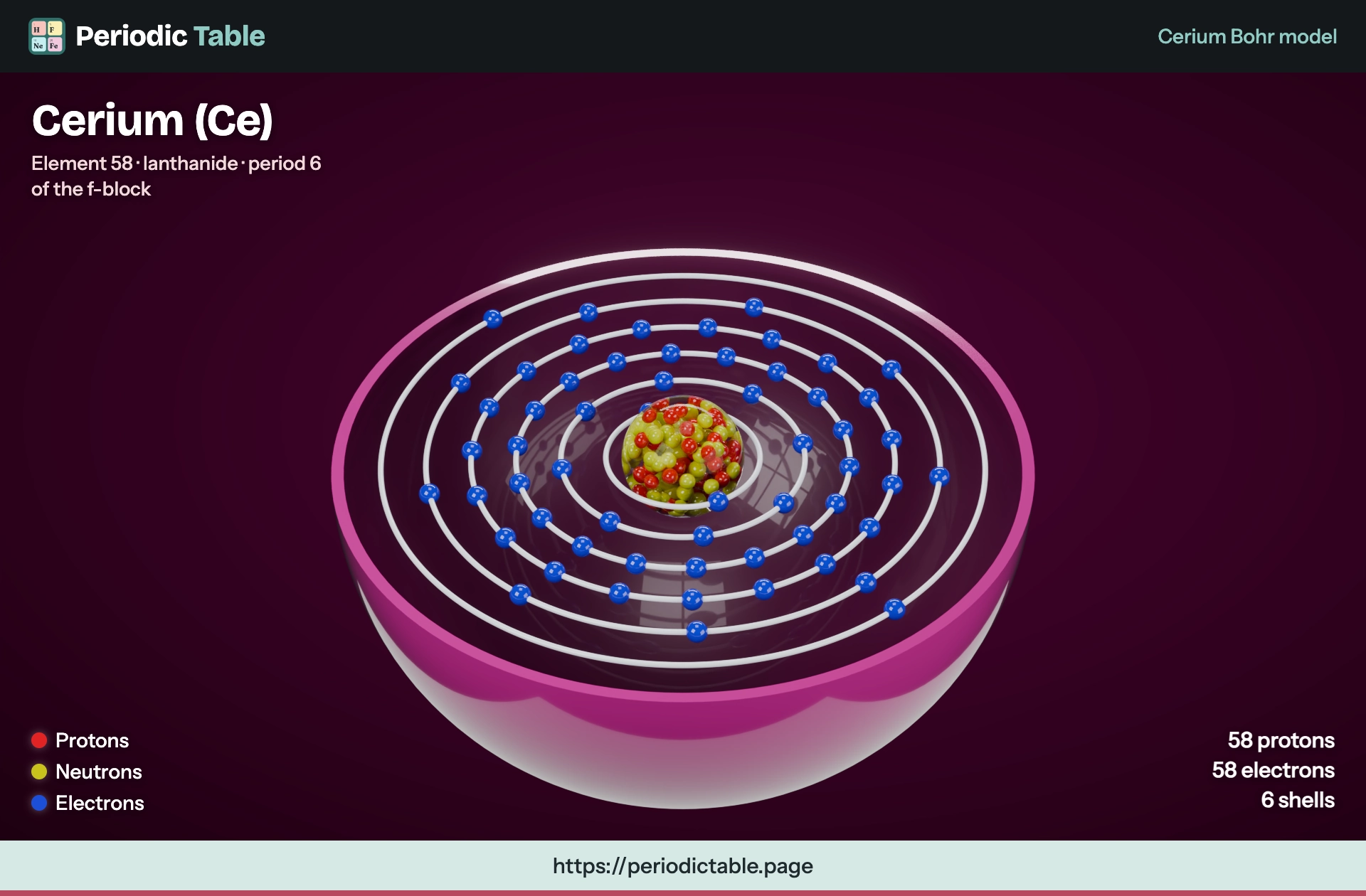
Rotate the 3D Bohr model of cerium
Drag to orbit, scroll to zoom.
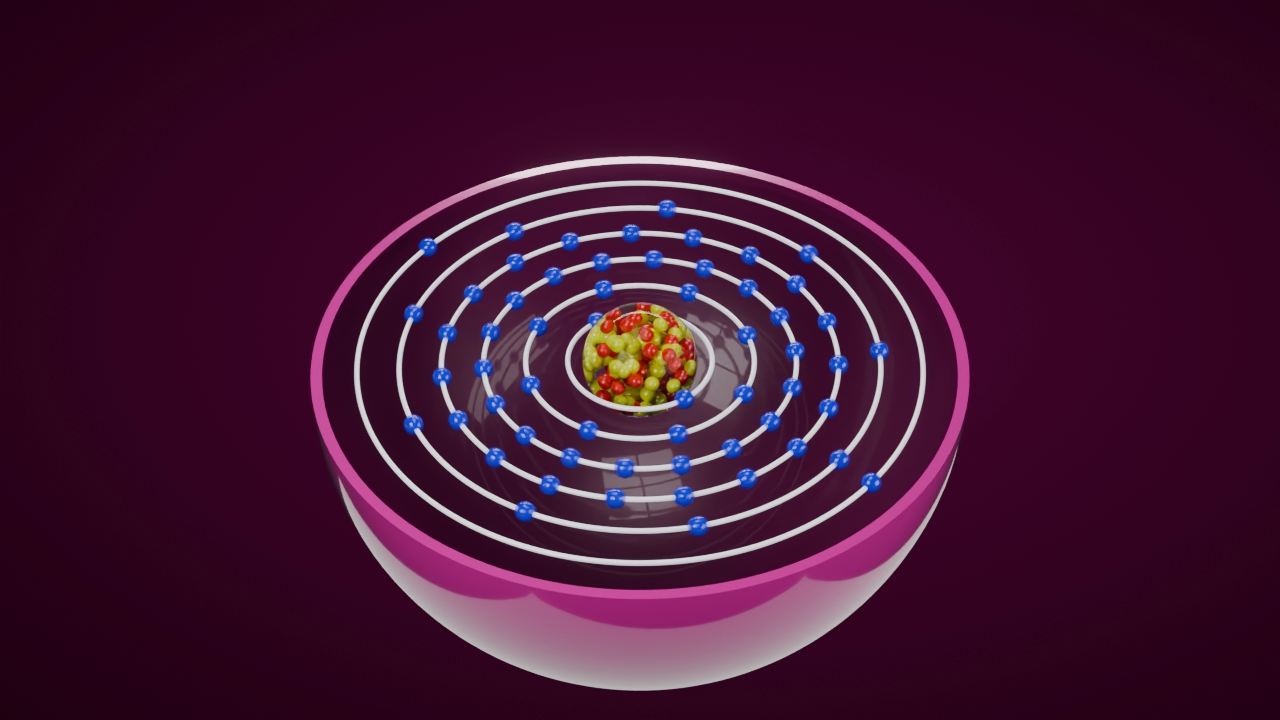
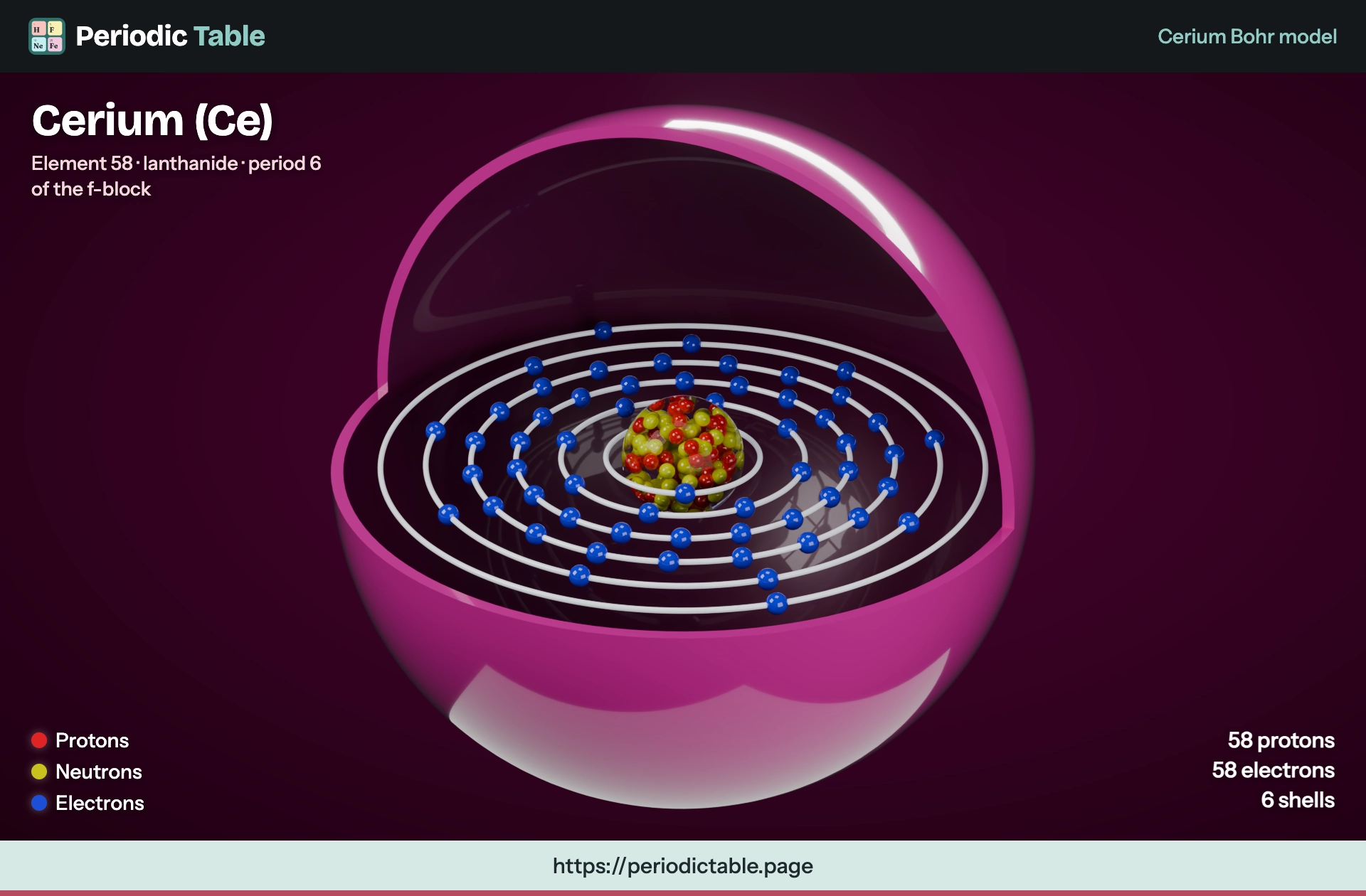
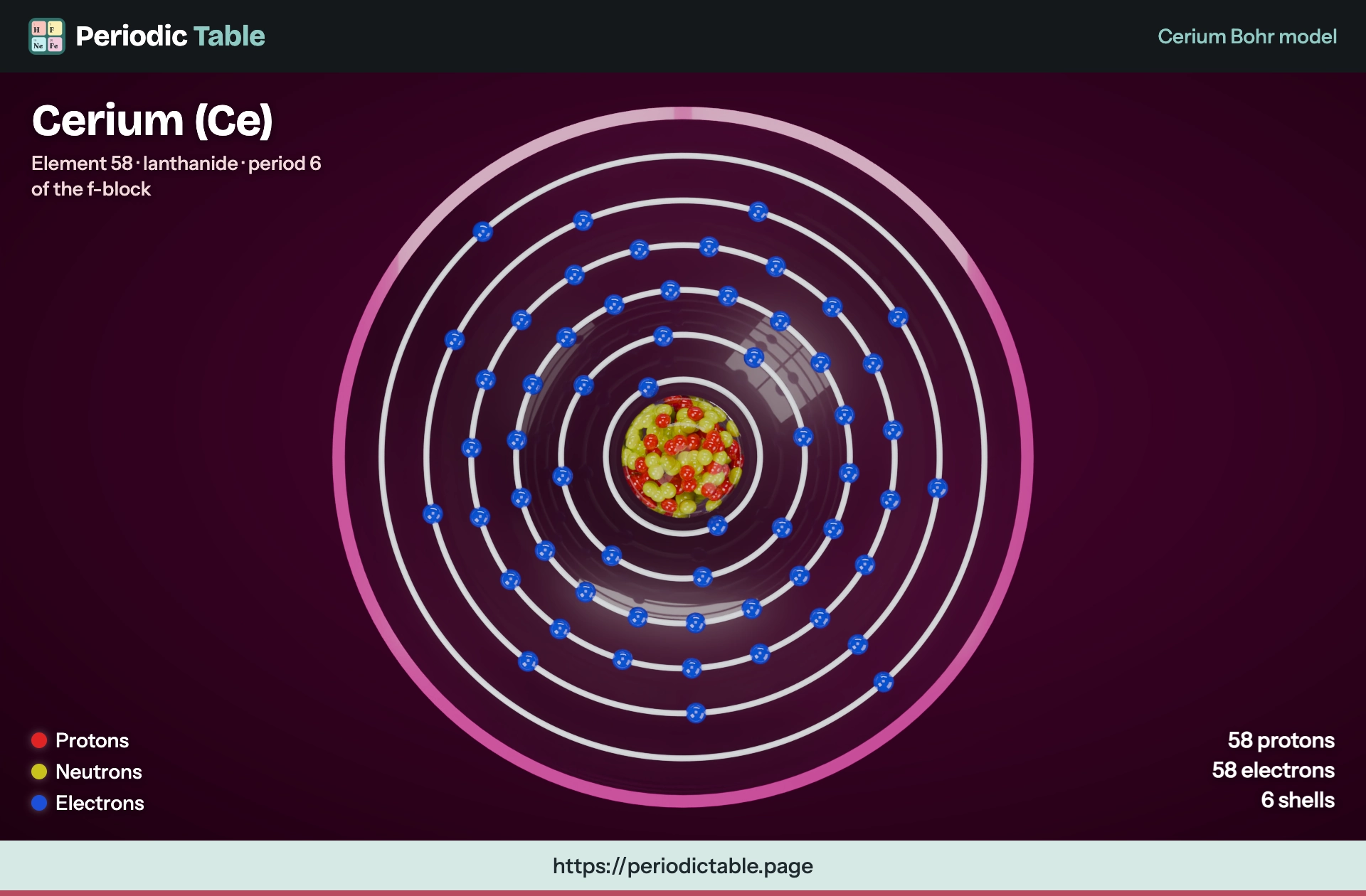
This is a Bohr model of cerium (Ce), a simplified picture of a single cerium atom. Its nucleus holds 58 protons, and a neutral cerium atom has 58 electrons, arranged around it in 6 shells (2 in shell K, 8 in shell L, 18 in shell M, 19 in shell N, 9 in shell O and 2 in shell P).
Cerium periodic table electron configuration
- Shorthand
- [Xe] 4f1 5d1 6s2
- Full
- 1s2 2s2 2p6 3s2 3p6 4s2 3d10 4p6 5s2 4d10 5p6 6s2 5d1 4f1
- Electrons per shell
- 2, 8, 18, 19, 9, 2
Cerium element properties and atomic data
- Atomic number
- 58
- Atomic mass
- 140.1161 u
- Phase at STP
- Solid
- Melting point
- 794.85°C (1068 K)
- Boiling point
- 3442.85°C (3716 K)
- Density
- 6.77 g/cm³
- Electronegativity (Pauling)
- 1.12
- Period
- 6
- Group
- —
- Block
- f-block
- Appearance
- Silvery white
- Discovery date
- 1803
- Discovered by
- Martin Heinrich Klaproth
- Named by
- —
Cerium element at a glance: key data
The table gathers the cerium element's core values in one place. These are standard reference figures, so you can use them to place it in the periodic table quickly: it sits in period 6 of the f-block, between lanthanum on its left and praseodymium on its right, with thorium directly below. For readers linking steel and alloy production with proteins and nutrition in living cells, the molybdenum on the periodic table entry covers both sides.
| Property | Value |
|---|---|
| Symbol | Ce |
| Atomic number | 58 |
| Standard atomic weight | 140.116 |
| Block and group | f-block, lanthanides |
| Electron configuration | [Xe] 4f1 5d1 6s2 |
| Appearance | Silvery white, iron-grey in commercial grades |
| State at 20 °C | Solid |
| Melting point | 795 °C (1,068 K) |
| Boiling point | 3,443 °C (3,716 K) |
| Density | 6.77 g/cm3 (room-temperature form) |
| Oxidation states | +3, +4 (rarely +2) |
| Electronegativity (Pauling scale) | 1.12 |
| First ionization energy | 534.4 kJ/mol |
| CAS number | 7440-45-1 |
| Abundance in the crust | About 60–68 ppm |
Its relative atomic mass of 140.116 sits just above its left-hand neighbour's, and the boiling point is far above the melting point, which gives it one of the widest liquid ranges of any metal.
Atomic number, atomic weight and electron configuration
Element 58 carries 58 protons, and a neutral atom balances them with the same number of electrons. Its weight figure is an average over the natural isotopes, weighted by how common each one is.
The configuration [Xe] 4f1 5d1 6s2 gives four valence electrons: the lone 4f electron plus the 5d and two 6s ones. Because the 4f, 5d and 6s levels sit so close in energy, a small nudge can push the 4f electron into the bonding band, and that is the root of the element's unusual chemistry.
Electronegativity and ionization energies
A score of 1.12 on the Pauling scale marks element 58 as strongly electropositive: it gives up its outer shell easily. Its first three ionization energies (534, 1,050 and 1,949 kJ/mol) climb gently, and even the fourth, near 3,547 kJ/mol, stays low enough for ordinary chemistry to reach Ce(IV). Few of its neighbours can manage that.
Physical properties of cerium
Among the properties of cerium, the first you notice is how workable it is. The pure metal is about as hard as silver and ductile enough to draw into wire, yet it is never left bare for long: a freshly cut surface tarnishes in air within hours as a dull film builds up. If you ask why poor metals have lower melting points than iron and copper, read properties of post-transition metals for the explanation.
Magnetically, it is paramagnetic at room temperature (a moderately strong paramagnet) and turns antiferromagnetic below about 13 K. Above roughly 20 kbar it even becomes superconducting at millikelvin temperatures.
It also behaves oddly when it melts: the liquid is denser than the solid. Squeezing or deep cooling produces a volume change of around 10% as the f electron shifts from a localized to a shared state.
Allotropes and the phase diagram
At ordinary pressure the element has four allotropes, and its phase diagram adds more at high pressure:
- δ-Ce: body-centered cubic, stable from 726 °C up to melting.
- γ-Ce: face-centered cubic, the familiar room-temperature form.
- β-Ce: double hexagonal close-packed, which forms slowly just below room temperature.
- α-Ce: a collapsed face-centered cubic phase below about −150 °C, noticeably denser than γ.
The changes between them are sluggish and show strong hysteresis, so a sample's thermal history matters as much as its current temperature.
Chemical behaviour of metallic cerium
Metallic cerium is a strong reducing agent, with a standard potential of about −2.34 V for the Ce(III)/Ce couple. It reacts slowly with cold water and faster with hot water, releasing hydrogen gas:
$$2\,\mathrm{Ce} + 6\,\mathrm{H_2O} \rightarrow 2\,\mathrm{Ce(OH)_3} + 3\,\mathrm{H_2}$$
It dissolves quickly in dilute acids except hydrofluoric acid, which seals the surface under a protective fluoride layer. It is also pyrophoric: filings and turnings can self-ignite in air at 65–80 °C and burn white-hot.
$$\mathrm{Ce} + \mathrm{O_2} \rightarrow \mathrm{CeO_2}$$
That burn releases a lot of energy because the dioxide it forms is so stable, and this chemistry is exactly why it ends up in fire starters.
Why cerium has two oxidation states
Most lanthanides stop at +3. Cerium can go to +4 because losing a fourth electron leaves an empty, stable f shell, and it is the only one of the lanthanides that holds a +4 oxidation state in aqueous solution.
Ce(III) behaves like a typical rare earth. Ce(IV) is a powerful but stable oxidizing agent (around +1.72 V), strong enough to turn hydrochloric acid into chlorine, and its orange-yellow colour makes the switch to colourless Ce(III) easy to see in a flask.
Cerium isotopes and natural abundance
Natural cerium is a blend of four cerium isotopes, and one of them dominates:
| Isotope | Natural share | Status |
|---|---|---|
| Ce-136 | 0.19% | Observationally stable |
| Ce-138 | 0.25% | Observationally stable |
| Ce-140 | 88.45% | Stable |
| Ce-142 | 11.11% | Observationally stable |
That leaves cerium-140 as the only truly stable isotope in a strict theoretical sense. Cerium-136 and cerium-138 are predicted to undergo double electron capture to barium, and cerium-142 should turn into neodymium by double beta decay, but none of these has been observed; the lower limits on their half-lives run from about 1017 to 1018 years.
Beyond the natural four, around 35 radioactive isotopes have been made. The longest-lived, Ce-144, has a half-life of roughly 285 days, followed by Ce-139 at about 138 days and Ce-141 at about 33 days; most others vanish in minutes.
Lighter ones decay mainly to lanthanum, heavier ones to praseodymium. The isotopes from mass 140 to 144 also turn up among the fission products of uranium, so spent reactor fuel contains measurable amounts of them.
Cerium compounds and their chemistry
Most cerium compounds fall into two families that mirror its two common charges, Ce(III) and Ce(IV). Cerium(III) oxide (Ce2O3) forms when cerium(IV) oxide is heated with hydrogen, and the ease of moving between these two is what drives almost every industrial use.
Ceria: cerium dioxide (CeO2)
Ceria, the long-standing name for cerium dioxide, adopts the fluorite structure. It is nonstoichiometric: the real formula is closer to CeO2−x, with x near 0.2, because the lattice tolerates missing oxygen atoms.
Those vacancies let it store oxygen and give it back on demand, a trick very few oxides do so reversibly. It is also hard and chemically inert, which suits it to abrasive work.
Halides, sulfides and Ce(IV) reagents
Beyond the oxides, a handful of salts and complexes do most of the practical work, each tied to one of the two charges.
Cerium halides
The element forms all four trihalides (fluoride, chloride, bromide and iodide), pale, moisture-hungry solids. Unusually for a lanthanide, it also forms a white tetrafluoride, a rare example of a stable Ce(IV) halide.
Cerium sulfide
Its sesquisulfide, Ce2S3, is a vivid red solid that stays chemically inert at high temperature, which makes it useful well beyond the lab.
Cerium(IV) reagents in the lab
Ceric ammonium nitrate is the workhorse Ce(IV) reagent, a cheap, air-stable oxidant for organic synthesis, while cerium(IV) sulfate is the standard titrant in cerimetric titrations.
Cerium nitrate in medicine
At the Ce(III) end, cerium nitrate has a medical role as a topical antimicrobial for severe burns.
Uses of cerium in industry and everyday products
The two largest uses of cerium both rely on ceria. The rest exploit either the pure element's eagerness to burn or the way its trivalent ions emit light.
Glass polishing and decolorizing
Dioxide slurry is the standard abrasive for glass polishing, from spectacle lenses and telescope mirrors to the chemical-mechanical planarization of silicon wafers, which is why the optics industry buys so much of it. As a decolorizer it turns green-tinted ferrous iron impurities into near-colourless ferric iron, and cerium oxide additions also help glass absorb ultraviolet light. Ceriated tungsten electrodes for arc welding do the job once done by radioactive thoriated ones.
Catalytic converters and cleaner exhaust
In catalytic converters, the dioxide acts as an oxygen buffer. It releases oxygen when the engine runs rich and soaks it back up when it runs lean, so the platinum-group catalyst can keep oxidizing carbon monoxide and unburnt fuel in the exhaust gases and cutting emissions. Nano-sized dioxide particles dosed into diesel fuel reduces soot, and cerium-bearing catalysts also serve in petroleum cracking.
Mischmetal, ferrocerium and lighter flints
Cerium's first commercial job was in gas mantles: Carl Auer von Welsbach found that thorium oxide with about 1% ceria glowed a bright white. The leftover rare earths from that trade became mischmetal (also written misch metal), roughly half cerium, a quarter lanthanum, plus neodymium and praseodymium. Add iron and you get ferrocerium, the pyrophoric alloy that throws sparks in lighters and fire steels.
Cerium in iron and aluminium alloys
The element also improves other alloys: it nodulizes cast iron, raises the oxidation resistance of superalloys, and gives castable aluminium alloys containing 6–16% cerium for hot engine parts.
Phosphors, pigments and white LEDs
Ce(III) ions emit light efficiently, which is why the Ce:YAG phosphor turns the blue glow of a white LED into the warm white you see. Cerium-doped phosphors also lit cathode-ray tube screens and fluorescent lamps.
In pigments, the red sulfide stands in for toxic cadmium reds, and small cerium additions stop clear plastics yellowing in sunlight. During the Manhattan Project, sulfide crucibles were tested for casting plutonium, and cerium has since been alloyed with it in experimental nuclear fuel.
Where the cerium metal supply comes from
Despite belonging to the rare-earth elements, cerium is not rare at all. At roughly 60–68 ppm of the Earth's crust, it is about as common as copper and several times more common than lead or tin, and it is the most abundant of the lanthanides. It is never found free; it occurs in minerals such as monazite, allanite, cerite and even zircon, where Ce(IV) can replace zirconium.
China dominates mining and refining, with deposits also worked in the USA, Brazil, India and Australia. Pure cerium metal is then made by electrolysis of molten halides or by reducing them with calcium.
Monazite and Bastnäsite processing
Bastnäsite (also spelled bastnasite) is the easier ore. After a dilute acid wash, roasting in air oxidizes cerium to the dioxide while its neighbours form sesquioxides, and a weak acid leach then carries the other lanthanides away.
Monazite also holds thorium, so it needs hot sulfuric acid, removal of that thorium as hydroxide, oxalate precipitation and roasting before cerium separates out of nitric acid. Either way, the +4 state does the sorting, which is why cerium is the simplest rare earth to isolate.
History of the element cerium
The element cerium was the first lanthanide ever discovered. In 1803, Jöns Jakob Berzelius and Wilhelm Hisinger identified a new "earth" in a heavy mineral from the Bastnäs mine in Sweden, a rock Hisinger had hoped would contain tungsten and which was later named cerite. Working independently, Martin Heinrich Klaproth reported the same oxide in Germany within months, and the two camps argued over priority before credit settled on the Swedish pair.
Berzelius named the element after Ceres, found in 1801 and then counted as a planet. Ceres is now classed as a dwarf planet, the largest body in the asteroid belt, and it takes its own name from the Roman goddess of agriculture.
That first sample was far from pure. In the late 1830s Carl Gustaf Mosander separated lanthana and "didymia" from it, revealing several more elements hiding in the same powder.
The pure element had to wait until 1875, when William Francis Hillebrand and Thomas Norton finally isolated it by passing current through molten cerium chloride. During the Second World War, Ames Laboratory refined some of the purest cerium yet made for casting work on the bomb project.
Cerium toxicity, biological role and safe handling
Cerium has no known biological role in humans, although a few methane-eating bacteria in volcanic mud pools rely on early lanthanides for an enzyme. Its toxicity is low to moderate: it does not build up in food chains, small amounts settle harmlessly in bone, and creams such as Flammacerium use it to treat burns. Large injected doses are still toxic to animals, and workers exposed to its dust have reported itching, heat sensitivity and skin lesions.
Handling the pure metal is mostly a fire question. Elemental cerium (Ce) is classed as a flammable solid, so keep it under an inert atmosphere or in vacuum, and keep turnings away from heat. Because burning cerium reacts with water to make hydrogen, only a class D dry-powder extinguisher will put it out.