


Samarium element (Sm): samarium periodic table facts
Samarium periodic table facts: samarium (Sm) is element 62, a lanthanide in period 6 of the f-block. If you have ever held a pair of high-end headphones or read about guided missiles, you have probably met samarium without knowing it. For a nonflammable, nontoxic and tasteless gas with a full outer shell, the guide at uses of argon gives a full description.
Samarium (symbol Sm) is a rare earth element that sits in the lanthanide row of the periodic table, and its real value comes from a few unusual tricks: a magnet alloy that keeps working when hot, an isotope that soaks up neutrons, and another that treats bone pain from cancer. Here is what the element is, how it behaves and where it ends up.
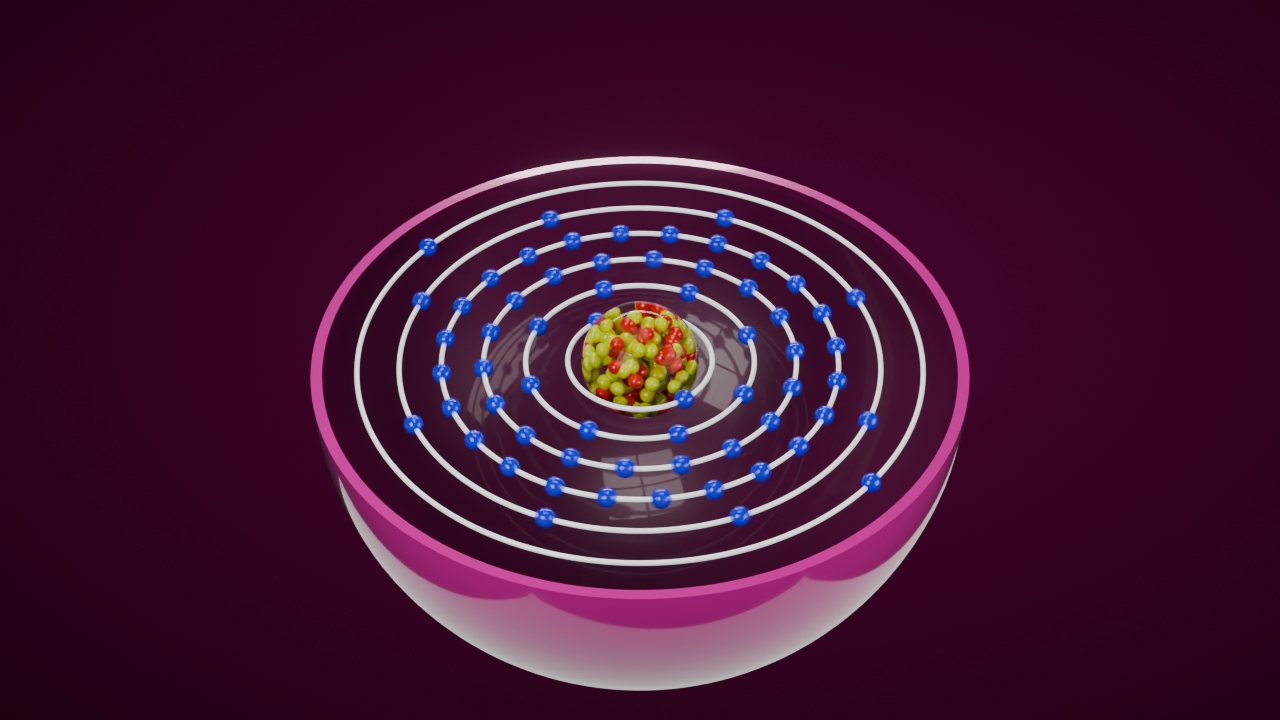
Rotate the 3D Bohr model of samarium
Drag to orbit, scroll to zoom.
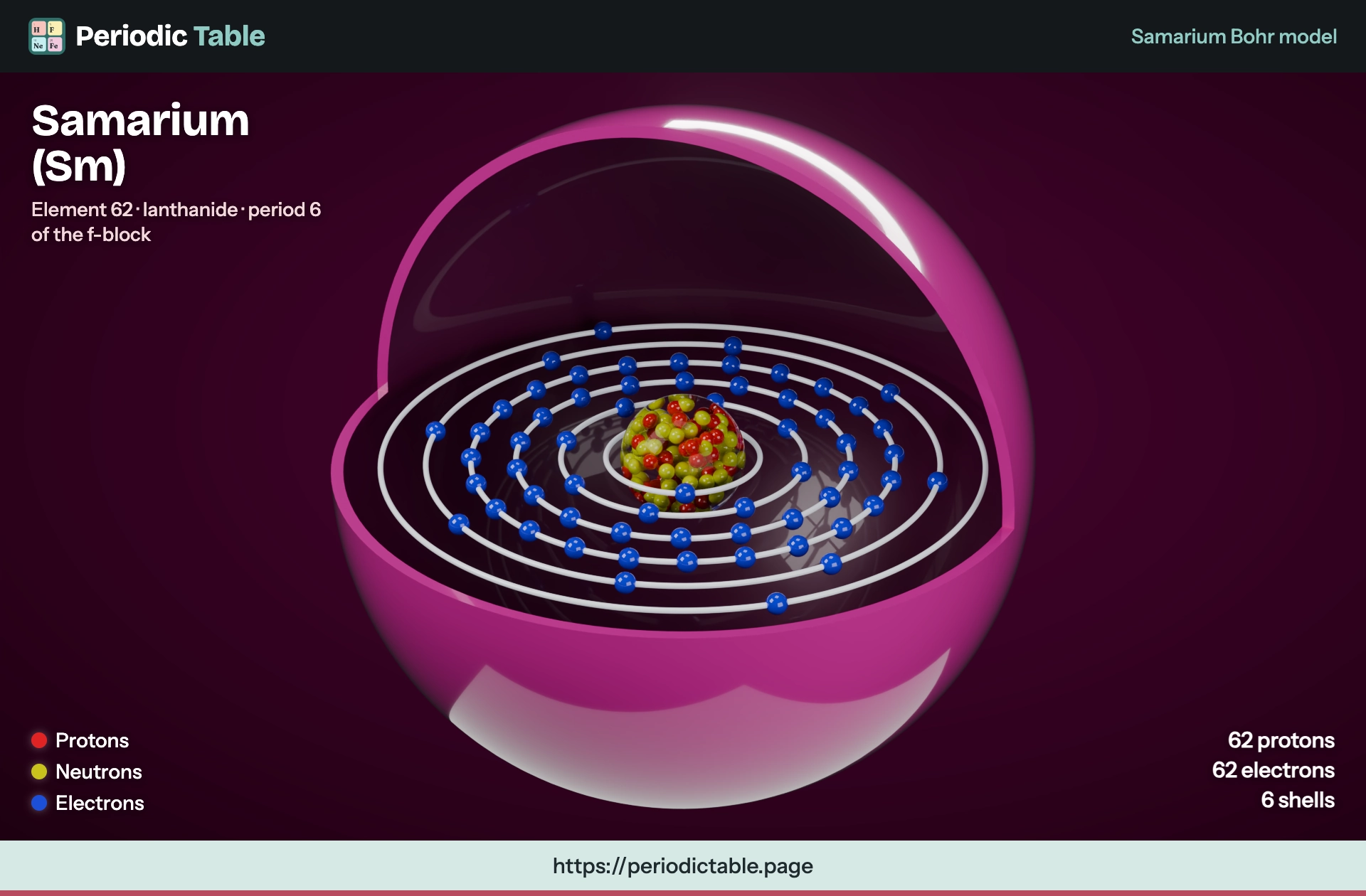
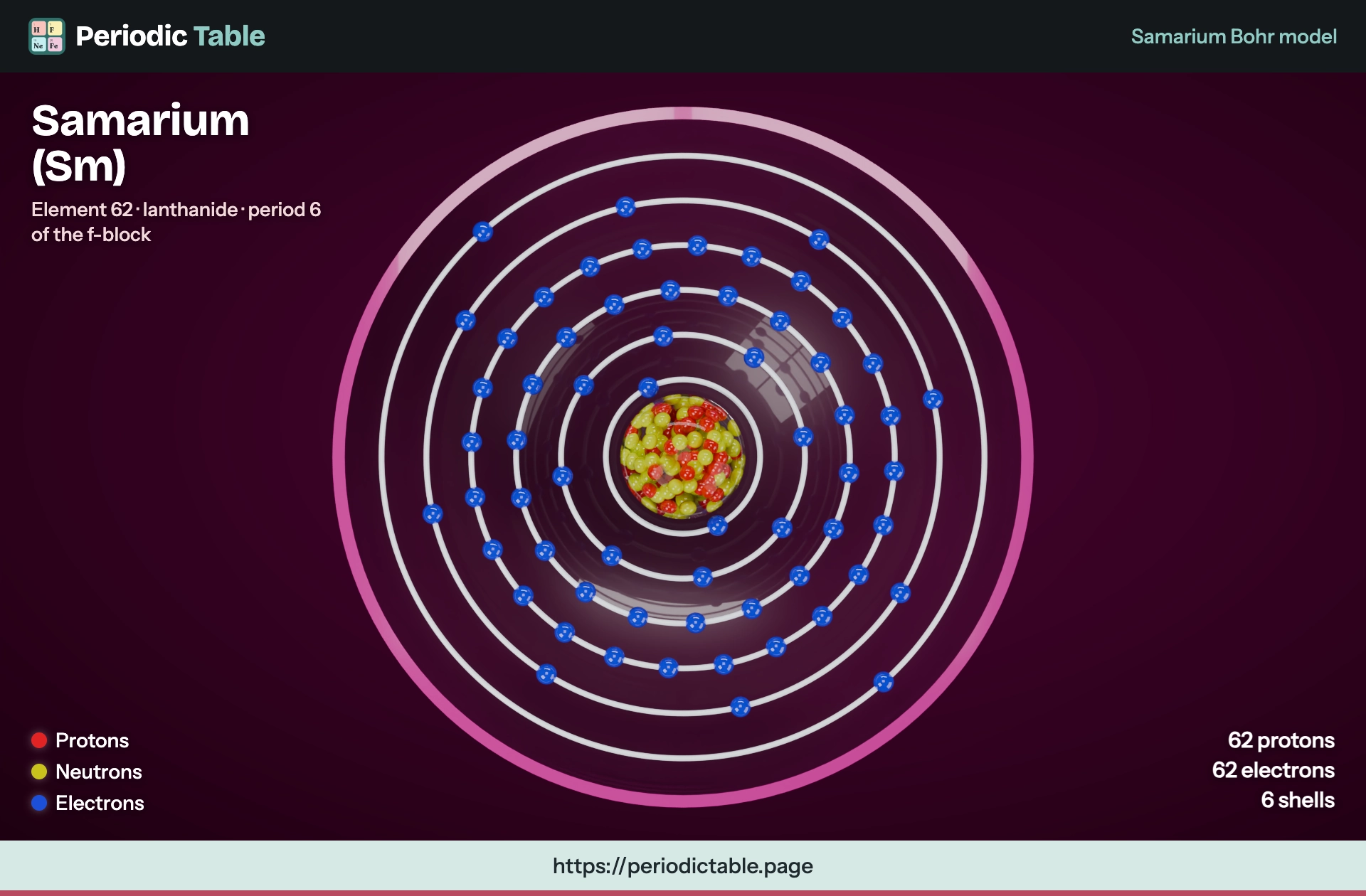
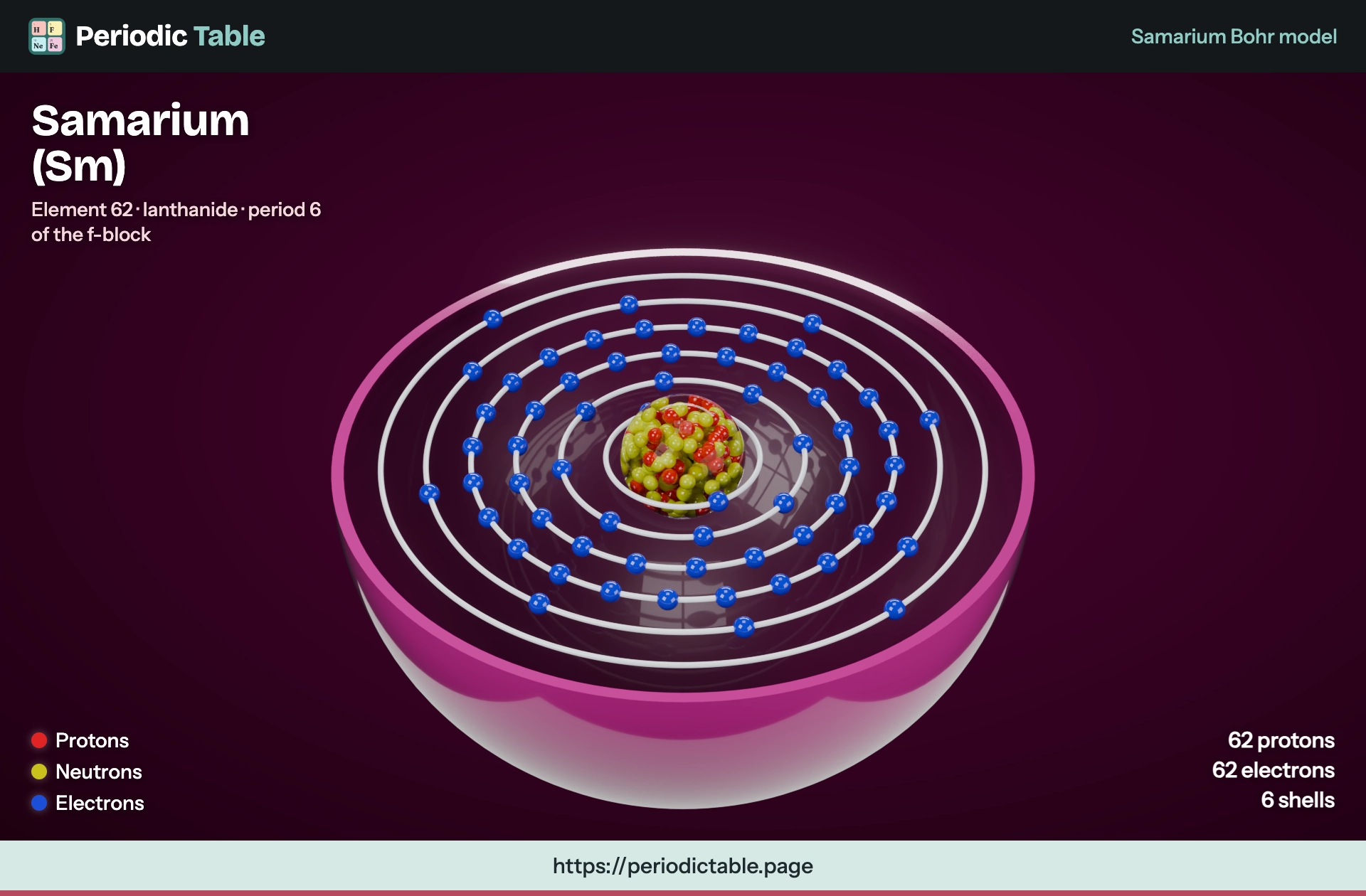
This is a Bohr model of samarium (Sm), a simplified picture of a single samarium atom. Its nucleus holds 62 protons, and a neutral samarium atom has 62 electrons, arranged around it in 6 shells (2 in shell K, 8 in shell L, 18 in shell M, 24 in shell N, 8 in shell O and 2 in shell P).
Samarium periodic table electron configuration
- Shorthand
- [Xe] 4f6 6s2
- Full
- 1s2 2s2 2p6 3s2 3p6 4s2 3d10 4p6 5s2 4d10 5p6 6s2 4f6
- Electrons per shell
- 2, 8, 18, 24, 8, 2
Samarium element properties and atomic data
- Atomic number
- 62
- Atomic mass
- 150.362 u
- Phase at STP
- Solid
- Melting point
- 1071.85°C (1345 K)
- Boiling point
- 1899.85°C (2173 K)
- Density
- 7.52 g/cm³
- Electronegativity (Pauling)
- 1.17
- Period
- 6
- Group
- —
- Block
- f-block
- Appearance
- Silvery white
- Discovery date
- 1879
- Discovered by
- Lecoq de Boisbaudran
- Named by
- —
Samarium (Sm) at a glance: key element facts
Samarium carries atomic number 62, which places it between promethium and europium in the f-block of period 6. Like the other lanthanides, it fills its 4f shell as you move along the row, and that partly filled shell explains most of its magnetic and optical behaviour. The table below collects the reference values you are most likely to need. Readers interested in zinc carbonate ores and smelting can open cadmium properties for the refining route.
| Property | Value |
|---|---|
| Symbol | Sm |
| Atomic number | 62 |
| Standard atomic weight | 150.36 |
| Group / block | Lanthanides, f-block |
| Electron configuration | [Xe] 4f6 6s2 |
| Density at 20 °C | 7.52 g/cm3 |
| Melting point | 1072 °C (1345 K) |
| Boiling point | about 1794–1900 °C, depending on source |
| Common oxidation states | +3, +2 |
| Electronegativity (Pauling) | 1.17 |
| State at 20 °C | Solid |
Two numbers are worth remembering. The electron configuration ends in six 4f electrons, one short of a half-filled shell, which is why the element can give up only two electrons in some compounds. And the density of 7.52 g/cm3 is close to that of zinc or tin, so a small ingot feels heavier than you might expect from a "light" rare earth.
Physical properties of samarium metal
Freshly cut samarium metal is silvery-white with a bright lustre that dulls as a thin oxide film forms. It is moderately hard, roughly comparable to zinc, and soft enough to be sawn or turned on a lathe under oil. If beta decay, half-life and the long-lived 176 isotope are your focus, see the notes under element 71 for each value.
Among its physical properties, its volatility stands out: it has a comparatively low boiling point, which ranks it among the most volatile members of the series. Refiners exploit this, because it lets them distil it away from less volatile partners.
Magnetically, the pure element is paramagnetic at room temperature, meaning it is only weakly drawn into a magnetic field. Cool it to about 14.8 K and it turns antiferromagnetic, with neighbouring atomic moments lining up in opposite directions.
That weak behaviour surprises many readers, since its SmCo alloy is one of the strongest permanent-magnet materials in use. The strength comes from the alloy's structure, not from the bare element.
Other bulk values include a specific heat capacity near 196 J/(kg·K), a Young's modulus of about 49.7 GPa and a thermal conductivity of roughly 13 W/(m·K), so the element is a poor heat conductor next to copper or aluminium.
Crystal structure under heat and pressure
Under everyday conditions the element adopts an unusual rhombohedral lattice often called the "samarium-type" structure. Its crystal structure shifts as conditions change: heating past roughly 731 °C converts it to hexagonal close-packed, and above about 922 °C it becomes body-centred cubic.
Squeezing it changes the picture again. Under high pressure a double-hexagonal form appears, and at hundreds of kilobars further phases follow, including a tetragonal one.
Chemical properties: how Sm reacts
The chemical properties of samarium are typical of its group, and its chemistry is dominated by the Sm3+ ion. In dry air it is fairly stable, but in moist air it oxidizes slowly, building up a yellowish oxide-hydroxide crust even when stored under mineral oil. Heated to about 150 °C, the powder spontaneously ignites, so filings and turnings need to be handled under argon or another inert gas.
Cold water attacks it slowly and hot water quickly, producing samarium hydroxide and hydrogen gas:
$$2\,\text{Sm}_{(s)} + 6\,\text{H}_2\text{O}_{(l)} \rightarrow 2\,\text{Sm(OH)}_3 + 3\,\text{H}_{2(g)}$$
It dissolves readily in dilute sulfuric acid, giving pale yellow-green solutions of the Sm3+ ion, and it burns in oxygen to form the sesquioxide. With an electronegativity of 1.17 on the Pauling scale, Sm is strongly electropositive. Its first three ionization energies (about 544.5, 1068 and 2258 kJ/mol) rise steeply at the third step, which is what makes the +2 state reachable at all.
The +2 oxidation state and its reducing power
Most lanthanides show only +3 in solution, but samarium is one of three, alongside europium and ytterbium, with an accessible +2 oxidation state. Sm2+ ions are blood-red in solution and eager to lose that extra electron, which makes samarium(II) iodide, SmI2, a widely used reducing agent in organic chemistry. Chemists use it to join carbon fragments and remove functional groups under mild conditions, often in reactions that cruder reductants would wreck.
Samarium compounds and their uses
Most samarium compounds contain the +3 ion, and the workhorse among them is samarium oxide (Sm2O3), a pale yellow powder that melts at about 2345 °C. Older texts call it samaria, by analogy with alumina and zirconia. The oxide is the form in which the element is usually traded, and it is the starting point for making the metal, the halides and most other derivatives.
The element reacts with all four common halogens to give trihalides such as SmF3 and SmCl3; reducing these further at 700–900 °C yields the dihalides, a corner of rare-earth chemistry where the +2 ion is unusually easy to isolate. It also forms hydrides, carbides, nitrides, phosphides and organometallic sandwich compounds with cyclopentadienyl rings. A few of these are scientifically striking rather than commercially important, and they are covered below.
Monoxide, sulfide and the pressure colour change
Few of its neighbours form a monoxide, but samarium does: golden-yellow SmO, made by heating the sesquioxide with extra Sm under tens of kilobars. The related samarium(II) sulfide is a black semiconductor that flips to a golden, metallic conductor when you scratch or polish it, because only a few kilobars are enough to push it across the transition.
Samarium hexaboride, a Kondo insulator
Samarium hexaboride, SmB6, holds the element in a mixed-valence state of roughly three Sm2+ ions for every seven Sm3+. Above about 50 K it conducts electricity well; cooled further, it opens a tiny band gap and behaves as a Kondo insulator. Physicists study it as a candidate topological insulator, with a conducting surface wrapped around an insulating interior.
Samarium isotopes and their half-life values
Natural samarium is a mixture of seven nuclides. Five are counted as stable isotopes, and two are extremely long-lived radioisotopes that decay so slowly they behave almost as stable ones. The table summarises the natural mix.
| Isotope | Share of natural samarium | Half-lives | Decay |
|---|---|---|---|
| Sm-144 | 3.07% | stable | — |
| Sm-147 | 14.99% | 1.06 × 10¹¹ years | alpha to Nd-143 |
| Sm-148 | 11.24% | about 7 × 10¹⁵ years | alpha to Nd-144 |
| Sm-149 | 13.82% | observationally stable | — |
| Sm-150 | 7.38% | stable | — |
| Sm-152 | 26.75% | stable | — |
| Sm-154 | 22.75% | stable | — |
The long-lived nuclides all undergo alpha decay to neodymium. Lighter synthetic samarium isotopes mostly decay by electron capture to promethium, while heavier ones undergo beta decay. More than 30 artificial nuclides are known; among them Sm-151 has a half-life of about 94.6 years, and Sm-146, which needs about 92 million years to lose half its atoms, is an extinct nuclide used to date events in the early solar system.
Sm-147 and radiometric dating of rocks
Sm-147 takes roughly seven times the age of the universe to halve, yet it is one of geology's most valued clocks. In samarium–neodymium radiometric dating, you measure how much Nd-143 has built up relative to Sm-147 in a rock's minerals. Because both are rare earths with near-identical chemistry, heat and pressure rarely separate them, so the clock survives metamorphism that resets uranium–lead or rubidium–strontium systems.
History: how the lanthanide samarium was discovered
The history of this element starts with a mixture rather than a pure substance. In 1839 Carl Gustaf Mosander extracted "didymium" from cerium ore, and for decades chemists treated it as one element.
Spectroscopy later suggested otherwise. Jean Charles Galissard de Marignac saw unfamiliar absorption lines in it in 1853, and in 1879 the French chemist Paul-Émile Lecoq de Boisbaudran, working in Paris, separated a new oxide from didymium taken from the mineral samarskite.
He named the element after that mineral, which in turn honoured Vasili Samarsky-Bykhovets, chief of staff of the Russian Corps of Mining Engineers, who had let the German mineralogists Gustav and Heinrich Rose study samples from the Ural Mountains. That makes samarium the first element named, even indirectly, after a person. Samarskite had first been found in Russia, though by the late 1870s deposits elsewhere, including North Carolina, gave more chemists access to it.
Boisbaudran's material still carried traces of a neighbouring rare earth. Eugène-Anatole Demarçay produced a pure oxide in 1901, and Wilhelm Muthmann isolated the metal in 1903. For years the symbol Sa competed with Sm, and only in the 1920s did Sm win out.
Occurrence: where the rare earth element is found
Samarium never occurs free in nature. Its occurrence is tied to the same minerals that host the other light lanthanides, chiefly monazite and bastnäsite, which supply nearly all commercial production, plus cerite, gadolinite and samarskite.
Monazite can contain up to about 2.8% of the element. Its abundance in Earth's crust is about 7 ppm, making it roughly the 40th most common element and far more plentiful than silver or gold.
Known resources sit mainly in China, the United States, Brazil, India, Sri Lanka and Australia, with global mining output of the element itself on the order of 700 tonnes a year. Getting it out of the ore is the hard part: the rare earths are so chemically alike that separation runs through dozens of steps of solvent extraction or ion exchange. Pure Sm is then made by electrolysis of molten samarium chloride mixed with sodium or calcium chloride, or by heating the oxide with lanthanum and distilling off the more volatile samarium.
Supply risk and the geopolitics of samarium
Because almost all refining now happens in China, the Royal Society of Chemistry rates samarium's supply risk at 9.5 out of 10. That matters for defence technology: SmCo parts go into aircraft and missiles, and Western militaries once relied on a single plant in France that closed in 1994. Export limits during recent trade disputes have renewed efforts to rebuild refining capacity elsewhere.
Samarium magnets: the leading industrial application
By tonnage, the most important of samarium's applications is the permanent magnet. Alloyed with cobalt in two main grades, SmCo5 and Sm2Co17, it forms magnet alloys whose field is thousands of times that of magnetised iron. Only NdFeB is stronger at room temperature, but SmCo has two advantages: outstanding heat resistance and very high resistance to demagnetization.
That combination decides where the material goes. You find samarium magnets in precision servo motors, aerospace actuators, travelling-wave tubes, guitar pickups and premium headphones, anywhere a magnetic field must stay steady while the part runs hot or sits beside other strong fields. Military hardware is a big user, since jet engines and guidance systems combine heat with zero tolerance for drift.
Samarium-cobalt vs neodymium magnets
The comparison below uses typical published grade ranges, so treat the figures as a guide rather than a specification for any one product.
| Property | SmCo | NdFeB |
|---|---|---|
| Maximum energy product | about 16–32 MGOe | about 30–55 MGOe |
| Typical maximum working temperature | about 250–350 °C | about 80–200 °C |
| Curie temperature | about 700–850 °C | about 310–400 °C |
| Corrosion | good without coating | needs a coating |
| Relative cost | higher | lower |
For a cool, cost-sensitive design, neodymium magnets usually win; once the operating temperature passes about 150 °C, the samarium alloy is often the safer choice.
Samarium-149 as a neutron absorber in nuclear reactors
Samarium-149 captures thermal neutrons extremely well, with a cross-section of about 41,000 barns, which makes Sm a useful neutron absorber in the control rods of nuclear reactors. Long before pure samarium was commercially available, a by-product mixture of samarium and gadolinium known as Lindsay Mix was sold for exactly this purpose. Today a similar samarium-europium-gadolinium (SEG) concentrate fills the same niche.
The same isotope is also a headache for reactor operators. It forms during fission as short-lived parents in the mass-149 decay chain break down, and because it is not radioactive it only disappears by absorbing neutrons.
After a fresh core starts up, its concentration climbs to an equilibrium over roughly three weeks, and after a shutdown it keeps building as its Pm-149 parent decays. Only xenon-135 matters more as a "poison" in reactor design.
Samarium-153 in medicine and other Sm uses
In medicine, the short-lived beta emitter samarium-153 (it loses half its activity in about 46 hours) is bound to a phosphonate called EDTMP and injected into a vein. The complex homes in on areas of active bone growth, delivering radiation where cancer has spread to the skeleton. Sold as Quadramet (Sm-153 lexidronam), it is used to relieve pain from bone cancer metastases in people with prostate, breast and lung tumours, and the dose fades within days.
The element also works as a catalyst. Samarium salts help dehydrate and dehydrogenate ethanol, break down plastics and strip chlorine from pollutants such as PCBs, while samarium(III) triflate is one of the most efficient Lewis-acid catalysts for certain organic reactions.
Lasers, infrared glass and ceramics
Calcium fluoride crystals doped with Sm2+ were among the earliest solid-state lasers, and samarium plasma has been used in X-ray laser research. Samarium oxide is added to optical glass to absorb infrared light and to some ceramics and dielectric components. Film studios once relied on carbon-arc lamps whose electrode cores carried Sm-bearing rare-earth fluorides to produce bright, daylight-like light.
Is samarium toxic? safety and handling
Samarium has no known biological role, and the body handles it poorly; most of what is absorbed ends up in the liver and bones. Soluble samarium salts are mildly toxic if swallowed and can irritate skin and eyes, while insoluble forms pass through with little effect. In practice the bigger hazard is fire: fine Sm powder can ignite in air, so store it under inert gas, keep it dry, and wear gloves, eye protection and a dust mask when cutting or grinding it.