


Lutetium element (Lu): lutetium periodic table facts
Lutetium periodic table facts: lutetium (Lu) is element 71, a lanthanide in period 6 of the f-block. Want the essential facts on lutetium without wading through a dozen tabs? To see how electron capture in potassium-40 builds the radiogenic isotope, check element 18 for details and examples.
It is the chemical element that closes the lanthanide series: element 71, a silvery white metal and the heaviest, hardest and densest of the rare earth elements. Below you will find its key data, how its atoms are built, how it reacts, where it comes from, and why a radioactive form of it is now an approved treatment for certain tumours.
Rotate the 3D Bohr model of lutetium
Drag to orbit, scroll to zoom.
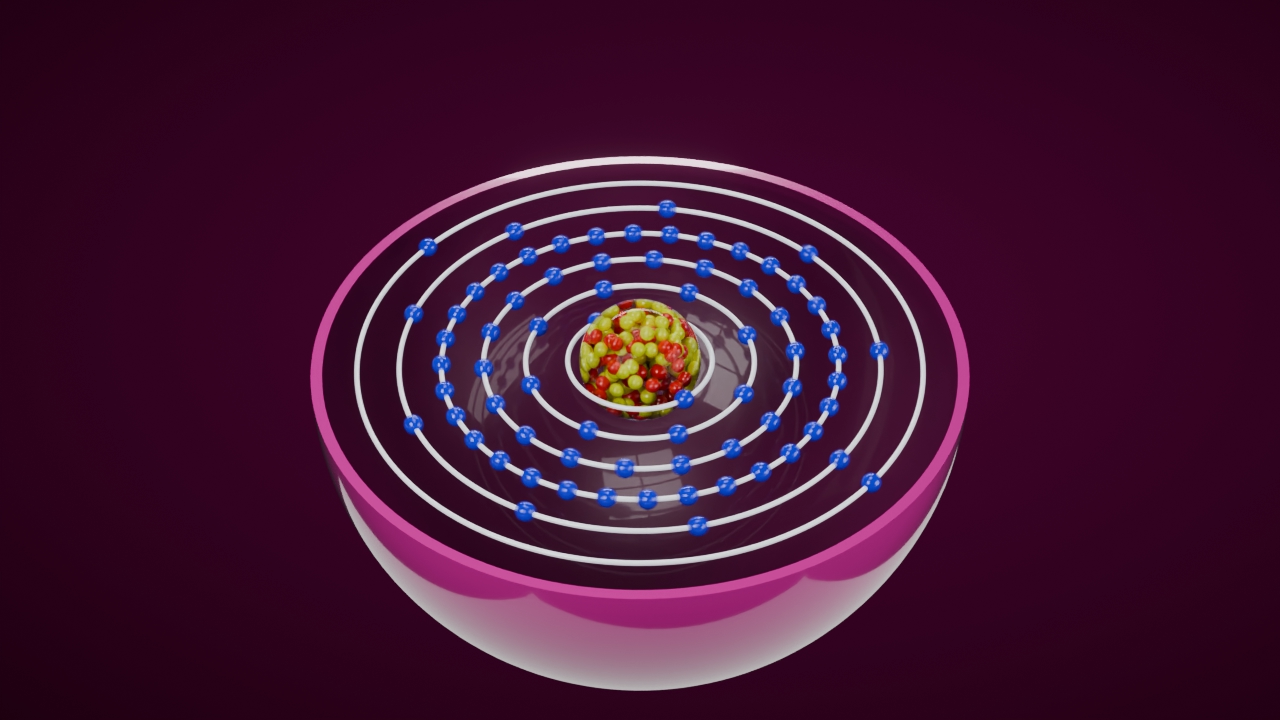
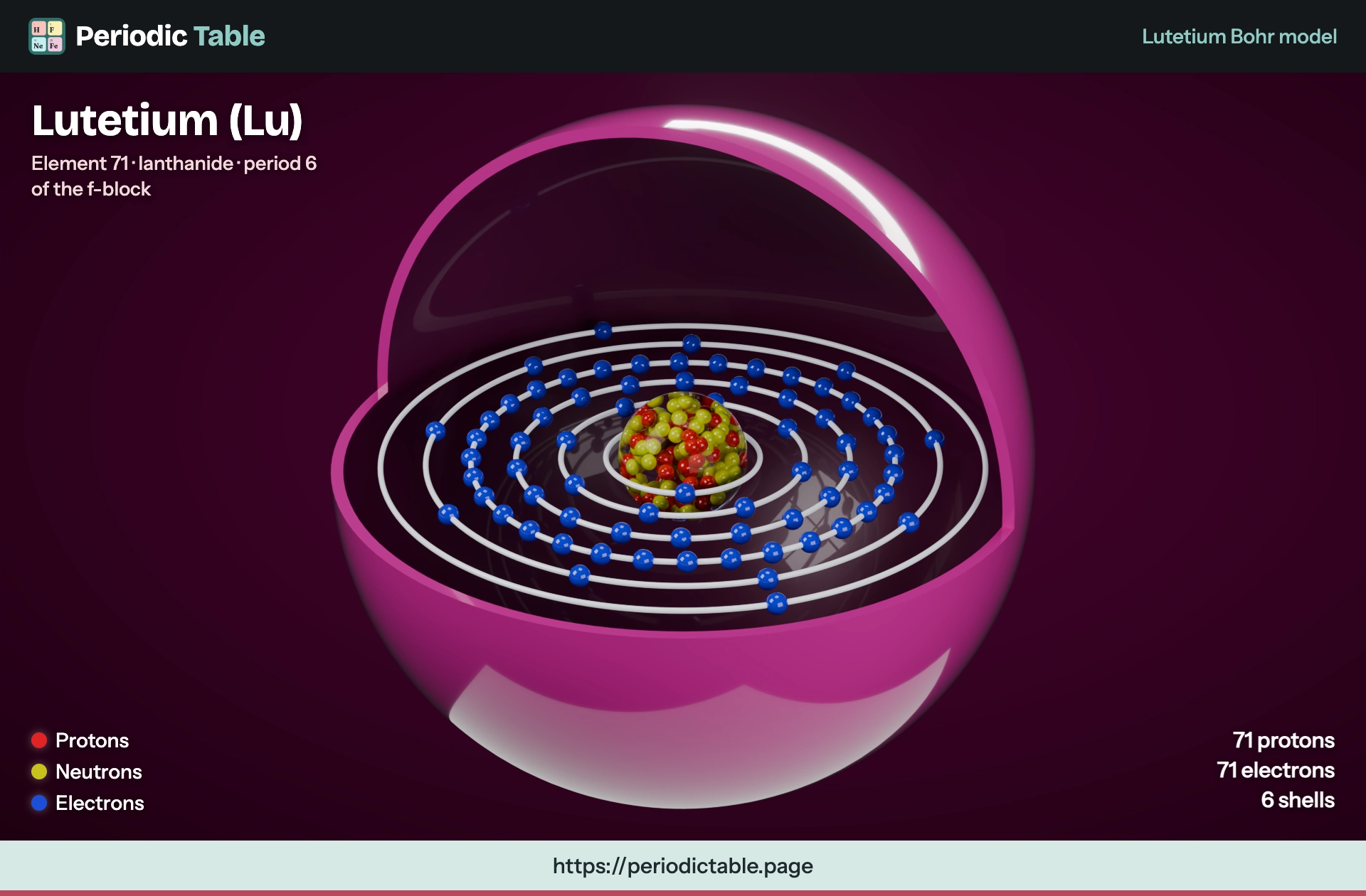
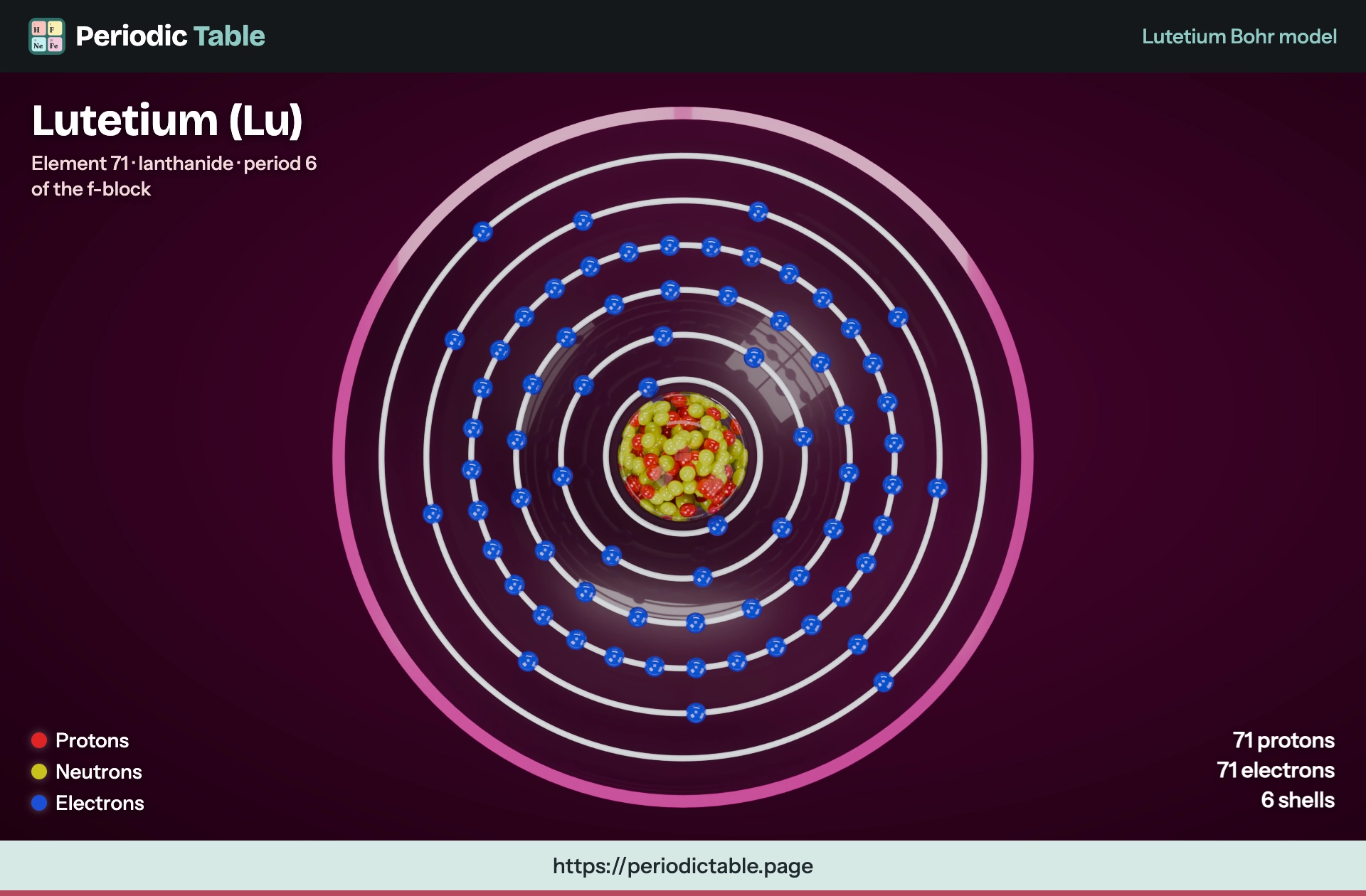
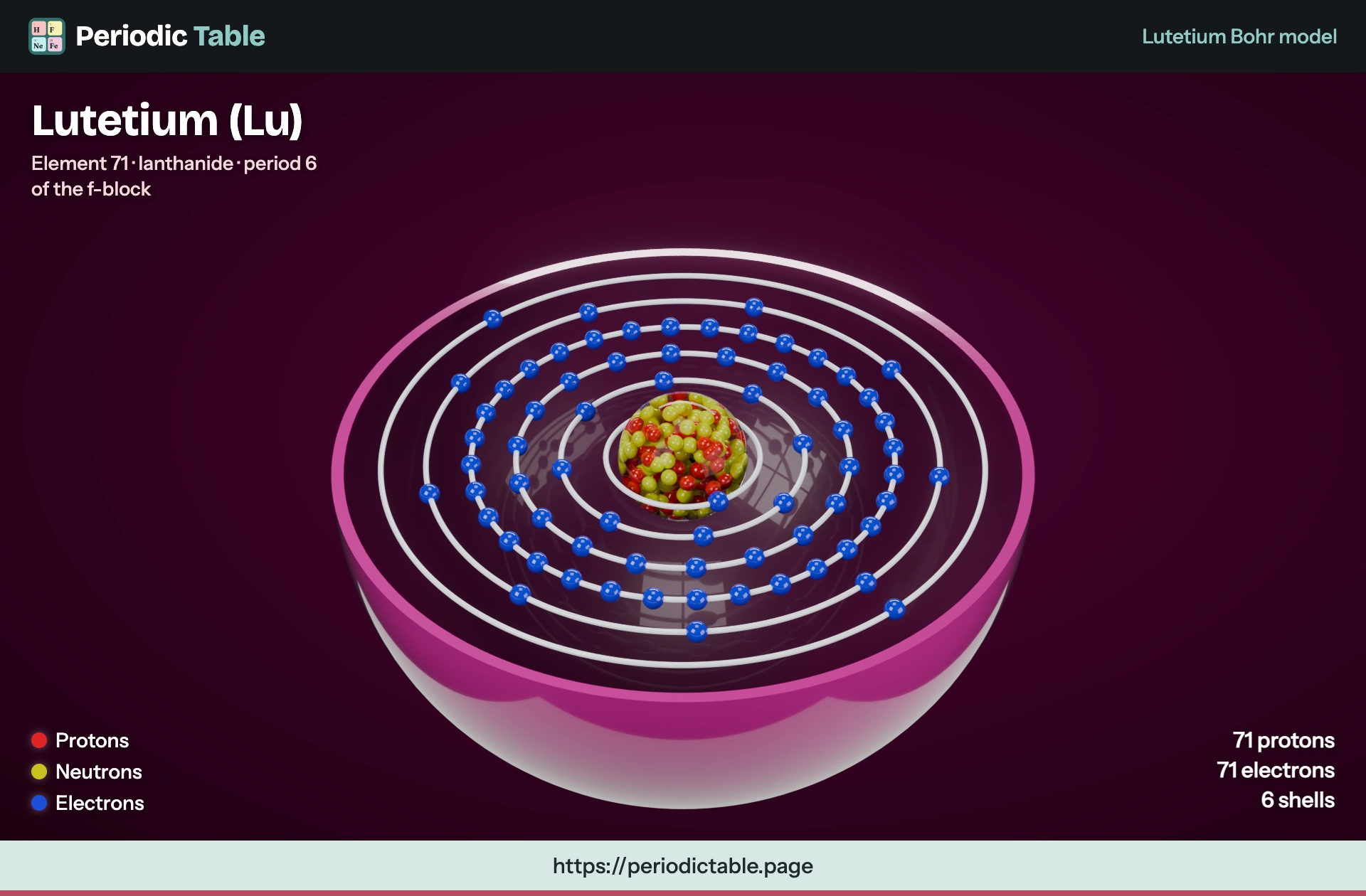
This is a Bohr model of lutetium (Lu), a simplified picture of a single lutetium atom. Its nucleus holds 71 protons, and a neutral lutetium atom has 71 electrons, arranged around it in 6 shells (2 in shell K, 8 in shell L, 18 in shell M, 32 in shell N, 9 in shell O and 2 in shell P).
Lutetium periodic table electron configuration
- Shorthand
- [Xe] 4f14 5d1 6s2
- Full
- 1s2 2s2 2p6 3s2 3p6 4s2 3d10 4p6 5s2 4d10 5p6 6s2 4f14 5d1
- Electrons per shell
- 2, 8, 18, 32, 9, 2
Lutetium element properties and atomic data
- Atomic number
- 71
- Atomic mass
- 174.9668 u
- Phase at STP
- Solid
- Melting point
- 1651.85°C (1925 K)
- Boiling point
- 3401.85°C (3675 K)
- Density
- 9.841 g/cm³
- Electronegativity (Pauling)
- 1.27
- Period
- 6
- Group
- —
- Block
- d-block
- Appearance
- Silvery white
- Discovery date
- 1907
- Discovered by
- Georges Urbain
- Named by
- —
Lutetium element facts: atomic number, atomic weight and density
Every reference sheet for the lutetium element opens with the same handful of numbers. The table collects them in one place, with temperatures given in both kelvin and degrees Celsius so you can compare them with other data sources. For the medicine side, from bone cancer radiopharmaceuticals to magnetic technology, the samarium element covers it all.
| Property | Value |
|---|---|
| Symbol | Lu |
| Atomic number | 71 |
| Atomic weight | 174.967 u |
| Position | Group 3, period 6; f-block on most charts, d-block on some |
| Electron configuration | [Xe] 4f14 5d1 6s2 |
| Melting point | 1925 K (1652 °C) |
| Boiling point | 3675 K (3402 °C) |
| Density at 20 °C | 9.84 g/cm3 |
| Crystal structure | Hexagonal close-packed (hcp) |
| Usual charge in compounds | +3 |
| CAS number | 7439-94-3 |
| State at room temperature | Solid |
Two of those values deserve a second look. No other lanthanide melts at a higher temperature, and none packs more mass into each cubic centimetre. Both records trace back to the same cause, which the next section explains.
Its place on the periodic table
Most printed charts park the element at the right-hand end of the lanthanide row that floats below the main grid, which makes it an f-block element. Its 4f shell is already full, though, so only the 5d and 6s orbitals take part in bonding. That is the same outer arrangement as scandium and yttrium, the two members of group 3 above it, so many chemists place it directly under them as a d-block element instead, and an IUPAC working group has backed that layout.
Size points the same way. Across the lanthanides, each extra proton pulls the electron cloud a little tighter, an effect called the lanthanide contraction. By the end of the row the contraction is strong enough that lutetium ends up closer in size to yttrium than to lanthanum, and in textbook chemistry it often behaves like the first transition metal of period 6 rather than the last of the lanthanides.
Physical properties of the element lutetium
A freshly cut piece of lutetium metal is bright and silvery, slowly dulling as a thin oxide film forms. What sets it apart from its neighbours is mechanical strength: it is the hardest member of the lanthanide row and, after the contraction squeezes 71 protons' worth of mass into the smallest lanthanide, the densest as well. Chemistry students can use the pure manganese to see how a transition metal in alloys, glass and iron production behaves.
| Mechanical or thermal property | Value |
|---|---|
| Brinell hardness | 890–1300 MPa |
| Vickers hardness | 755–1160 MPa |
| Young's modulus | 68.6 GPa |
| Shear modulus | 27.2 GPa |
| Bulk modulus | 47.6 GPa |
| Thermal conductivity | 16.4 W/(m·K) |
| Magnetic behaviour | Paramagnetic |
A Brinell figure topping 1000 MPa is comparable to mild steel, which is unusual for a rare earth; most of its relatives are soft enough to scratch easily. The element is also hard to boil away.
Its vapour pressure only reaches about 1 Pa near 1906 K, a few hundred degrees above its melting temperature, so the molten element loses very little material to evaporation during processing. Because it is paramagnetic rather than ferromagnetic, it is only weakly drawn into a magnetic field and keeps no magnetism of its own once the field is gone.
Lu electron configuration and atomic structure
The shells fill as 2, 8, 18, 32, 9, 2. The filled f subshell is buried deep inside and stays out of chemistry, which leaves the two 6s and the single 5d electron as the only ones that come away easily. The ionization energies show this plainly, in kJ/mol:
- First: 523.5
- Second: 1340
- Third: 2022.3
- Fourth: about 4366, more than double the third
That sudden jump after the third step is why the element almost always gives up exactly three. Other atomic values round out the picture: an electronegativity of 1.27 on the Pauling scale, an empirical atomic radius of 174 pm and a covalent radius of about 187 pm.
Protons, neutrons and electrons in a lutetium atom
Every nucleus of this element holds 71 protons, and a neutral atom carries 71 electrons to balance them. The neutron count depends on the isotope: the stable mass-175 form has 104 neutrons, the mass-176 form has 105. In the triply charged ion found in nearly all its compounds, 68 remain.
Chemical properties and lutetium compounds
The chemical properties follow directly from those three outer shells. The element resists corrosion in dry air but slowly tarnishes in moist air, and it burns readily once heated to about 150 °C, forming lutetium oxide:
$$4\,\text{Lu} + 3\,\text{O}_2 \rightarrow 2\,\text{Lu}_2\text{O}_3$$
The white oxide soaks up moisture and carbon dioxide, so it can scrub those vapours from a sealed space. Cold water attacks the element slowly and hot water quickly, producing lutetium hydroxide and hydrogen gas. It dissolves fast in dilute acids, giving colourless trivalent ions that each hold on to roughly eight surrounding solvent molecules.
Almost every compound it forms shows the +3 oxidation state. Some patterns worth knowing:
- It reacts with the four lightest halogens to give trihalides; all dissolve except lutetium fluoride.
- Most of its salts are colourless and crystallise as white solids; the iodide is the brown exception.
- Nitrate, sulfate and acetate form hydrates as they crystallise, while the oxide, carbonate, phosphate and oxalate stay insoluble.
Because the filled inner f shell absorbs almost no visible light, the compounds lack the colours that make neighbours like erbium and neodymium easy to spot. That invisibility is part of why its aqueous chemistry was overlooked for so long.
Lutetium isotopes and half-life
Nature supplies just two isotopes of lutetium, and dozens more have been made in reactors and accelerators. The table lists the ones you are most likely to meet.
| Mass number | Natural abundance | Half-life | Decay |
|---|---|---|---|
| 173 | Synthetic | 1.37 years | Electron capture to Yb-173 |
| 174 | Synthetic | 3.31 years | Positron emission to Yb-174 |
| 175 | 97.4% | Stable | None |
| 176 | 2.6% | 3.70 × 10¹⁰ years | Beta minus to Hf-176 |
| 177 | Synthetic | 6.64 days | Beta minus to Hf-177 |
Natural isotopes: lutetium-175 and lutetium-176
Lutetium-175 is the only stable form, so the element counts as monoisotopic in the sense that a single isotope carries almost all of its mass. Lutetium-176 is radioactive but decays so slowly, by beta decay into hafnium-176, that it has survived since the Earth formed. The amount left after time t follows the standard decay law:
$$\frac{N}{N_0} = \left(\tfrac{1}{2}\right)^{t / T_{1/2}}$$
Plug in the 4.567-billion-year age of the solar system and the 37.0-billion-year value for \(T_{1/2}\): \(0.5^{4.567/37.01} \approx 0.918\). In other words, roughly 8.2% of the mass-176 isotope present when the planets formed has since decayed away. That small but measurable shift is exactly what geologists exploit to date ancient rocks.
Synthetic radioisotopes and nuclear isomers
About 40 artificial radioisotopes have been characterised, spanning mass numbers 149 to 188, and a mass-190 nucleus has been reported from fragmentation experiments. Apart from the mass-173 and mass-174 forms in the table, almost all of them last under nine days, and most under half an hour.
The light ones decay mainly by electron capture, turning into ytterbium; the heavy ones emit beta particles and become hafnium. The element also has around 43 known nuclear isomers, excited nuclear states that linger: the 177m3 isomer persists for about 160 days, far longer than the 6.6-day ground state.
Discovery of lutetium and its history
Lutetium was the last naturally occurring lanthanide to be found, and it was found three times at once. In 1907, three scientists working apart — Georges Urbain in Paris, the Austrian mineralogist Carl Auer von Welsbach, and the American chemist Charles James in New Hampshire — each showed that ytterbia, the oxide Jean Charles Galissard de Marignac had believed held only ytterbium, actually contained two elements.
Urbain published first. He called the two components neoytterbium and lutecium, the second after the old Roman name of his home city.
James, who had the largest supply of the new oxide, learned of Urbain's paper and quietly dropped his own claim. Welsbach did not, and the discovery turned into one of the longest priority quarrels in chemistry.
Lutecium vs cassiopeium: the naming dispute
Welsbach proposed aldebaranium for the other component and cassiopeium for the new element. In 1909 the International Commission on Atomic Weights sided with Urbain, who had published 44 days earlier but also sat on that commission. In 1923, physicists in Copenhagen found that Welsbach's 1907 samples had been purer than Urbain's, and German-speaking chemists kept using Welsbach's name into the 1950s.
The matter was settled in 1949, when IUPAC kept Urbain's name but changed its spelling, deriving it from Latin Lutetia instead of the French Lutèce, while stressing that this was not a ruling on who found it first. Even then, pure lutetium was not produced as a bulk sample until 1953.
Where element 71 is found: monazite and other ores
You will never find it alone. It always travels with the other rare earths, and no mineral is known in which it is the dominant metallic element.
The main commercial source is monazite, a rare-earth phosphate, along with xenotime; in that ore it makes up only about 0.0001%. Mining is concentrated in China, which handles the vast majority of global rare-earth production, with Russia and Malaysia trailing well behind.
Abundance in Earth's crust and price
The element averages about 0.5 mg per kg of the Earth's crust. That puts it among the scarcest stable lanthanides, yet still more common than silver. Two rules explain the shortage: heavier elements are generally rarer, and elements with odd atomic numbers are rarer than their even-numbered neighbours, so number 71 loses on both counts to ytterbium at 70.
World output is only around 10 tonnes a year, measured as oxide, and separating it from near-identical neighbours is slow. The result is one of the most expensive rare earths, with a price in the thousands of US dollars per kilogram for the refined product, though still far below gold.
How Lu is extracted by ion exchange
Getting a clean sample means pulling it away from a dozen chemically similar elements. A typical route from crushed ore to finished product runs like this:
- Treat the ground ore with hot concentrated sulfuric acid to turn the rare earths into soluble sulfates.
- Adjust the solution so thorium drops out as its hydroxide, then filter it off.
- Add ammonium oxalate to precipitate the rare earths as insoluble oxalates, and heat these to convert them into oxides.
- Dissolve the oxides in nitric acid, which leaves cerium oxide behind.
- Pass the solution through an ion exchange resin column; a complexing agent washes the rare earths off one at a time, and the number-71 fraction is collected on its own. Solvent extraction can do the same job at larger scale.
- Reduce the anhydrous fluoride or chloride with an alkali or alkaline earth metal such as calcium.
$$2\,\text{LuF}_3 + 3\,\text{Ca} \rightarrow 2\,\text{Lu} + 3\,\text{CaF}_2$$
The last step needs an inert atmosphere and high temperature, and the resulting ingot is usually remelted to drive out the leftover reducing agent.
What Lu is used for
The natural element has only a handful of industrial uses, all involving small amounts. Its man-made isotope 177 is a different story.
Lutetium-177 in nuclear medicine and radionuclide therapy
Lutetium-177 is made by neutron activation, either directly from the mass-176 isotope or by irradiating ytterbium-176, which then beta-decays into it. It emits low-energy beta particles that destroy cells within a few millimetres, plus a few gamma rays that let doctors image where the dose went. Attached to a molecule that seeks out tumour cells, it becomes targeted radionuclide therapy:
- 177Lu-DOTA-TATE, which uses octreotate to reach neuroendocrine tumors.
- Lutetium Lu 177 vipivotide tetraxetan, approved by the FDA in 2022 for advanced prostate cancer.
- Compounds that palliate bone pain from cancer that has spread to the skeleton.
The isotope halves every 6.64 days, a timescale that suits logistics. Applying the decay law above, a dose that spends 3 days in transit still keeps 73.1% of its activity, while after 14 days only 23.2% is left. That window is long enough to ship from a reactor to a hospital and short enough that the patient does not stay a radiation source for long.
PET scanners, phosphors and LEDs
Being so heavy makes it excellent at stopping gamma photons. Cerium-doped lutetium oxyorthosilicate and its mixed-crystal cousin LYSO are the crystals of choice in positron emission tomography (PET) detectors, converting each photon into a flash of visible light. Lutetium aluminium garnet (LuAG) serves as a phosphor in white LED bulbs, and lutetium tantalate, one of the heaviest white materials known at 9.81 g/cm3, hosts x-ray phosphors.
Catalysts, electronics and dating meteorites
Refineries use small amounts of the stable element as a catalyst for cracking hydrocarbons, and it also speeds up alkylation, hydrogenation and polymerisation reactions. A tiny dopant addition to gadolinium gallium garnet once made magnetic bubble memory chips, a storage technology hard drives later replaced.
Current research suggests its singly charged ions could anchor atomic clocks more stable than today's best. And the slow decay of the mass-176 isotope into Hf-176 underpins Lu-Hf dating of meteorites and the planet's oldest rocks.
Lu toxicity and safe handling
Like the other rare earths, the element has low toxicity and no known biological role. Traces still reach your body through food absorbed by plants, collecting mainly in bone and to a lesser degree in the liver and kidneys; it is the least abundant lanthanide in human tissue. A few compounds call for care:
- Inhaled fluoride dust is dangerous, and the compound irritates skin.
- Lutetium nitrate can explode or burn when heated, as nitrates often do.
- Fine oxide powder is harmful if inhaled or swallowed.
- Soluble salts are mildly toxic; insoluble ones are not.
Drugs built on isotope 177 are the exception that needs radiation-safety controls, but those are handled by nuclear-pharmacy staff, not by anyone working with the stable element.
Why Lu stands out among the rare earth elements
For an element with so few everyday uses, this element holds a surprising number of records and roles in chemistry:
- The last, smallest, hardest and highest-melting of the lanthanides.
- A strong case for sitting in the third column, below scandium.
- A slow natural clock in its mass-176 isotope, and a fast medical one in mass 177.
- A name that took 42 years of argument to settle.