


Manganese element (Mn): manganese periodic table facts
Manganese periodic table facts: manganese (Mn) is element 25, a transition metal in group 7, period 4. Pick up a steel rail clip, a flashlight cell or a bowl of brown rice and you are holding manganese. For dating rocks by potassium-argon dating, radioactive decay and argon-40, the argon atomic radius covers the method.
This chemical element, symbol Mn and element 25, is a hard, brittle metal that improves the workability and wear resistance of steels, colours glass and ceramics, and helps your own enzymes run. Below you will find its key properties, its chemistry, where it is mined, how it is used and how much your body needs.
Rotate the 3D Bohr model of manganese
Drag to orbit, scroll to zoom.
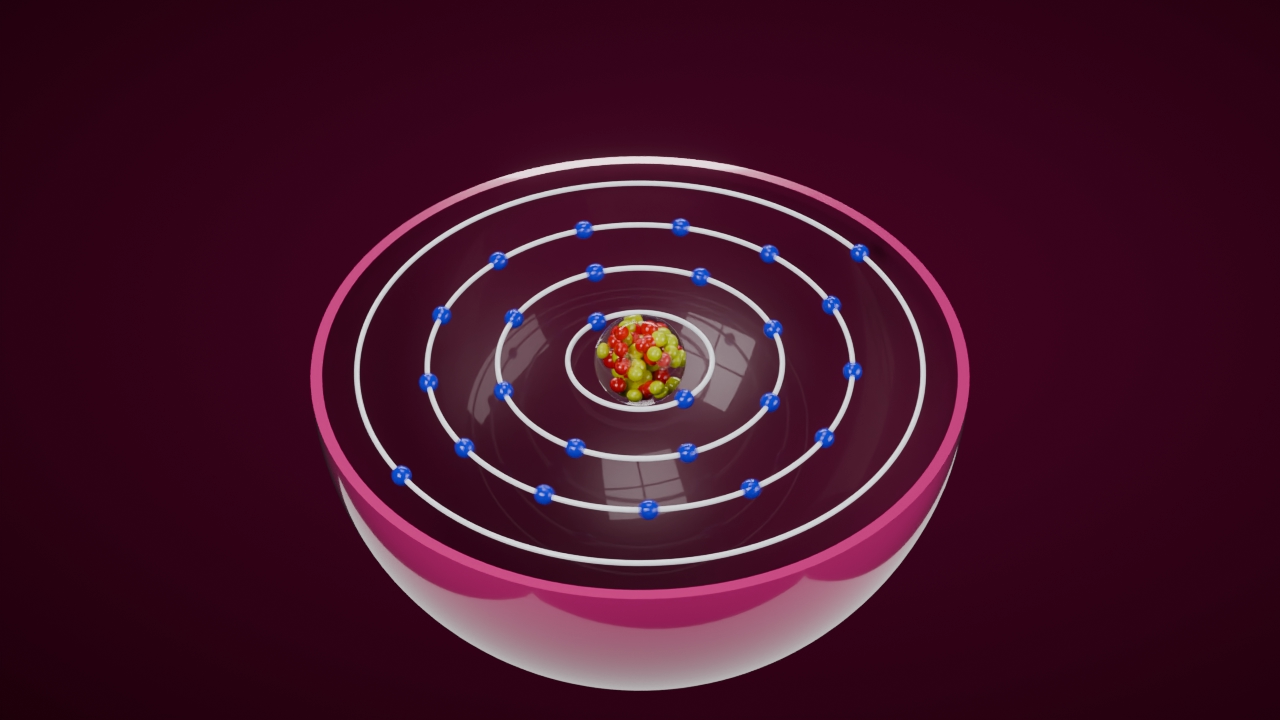
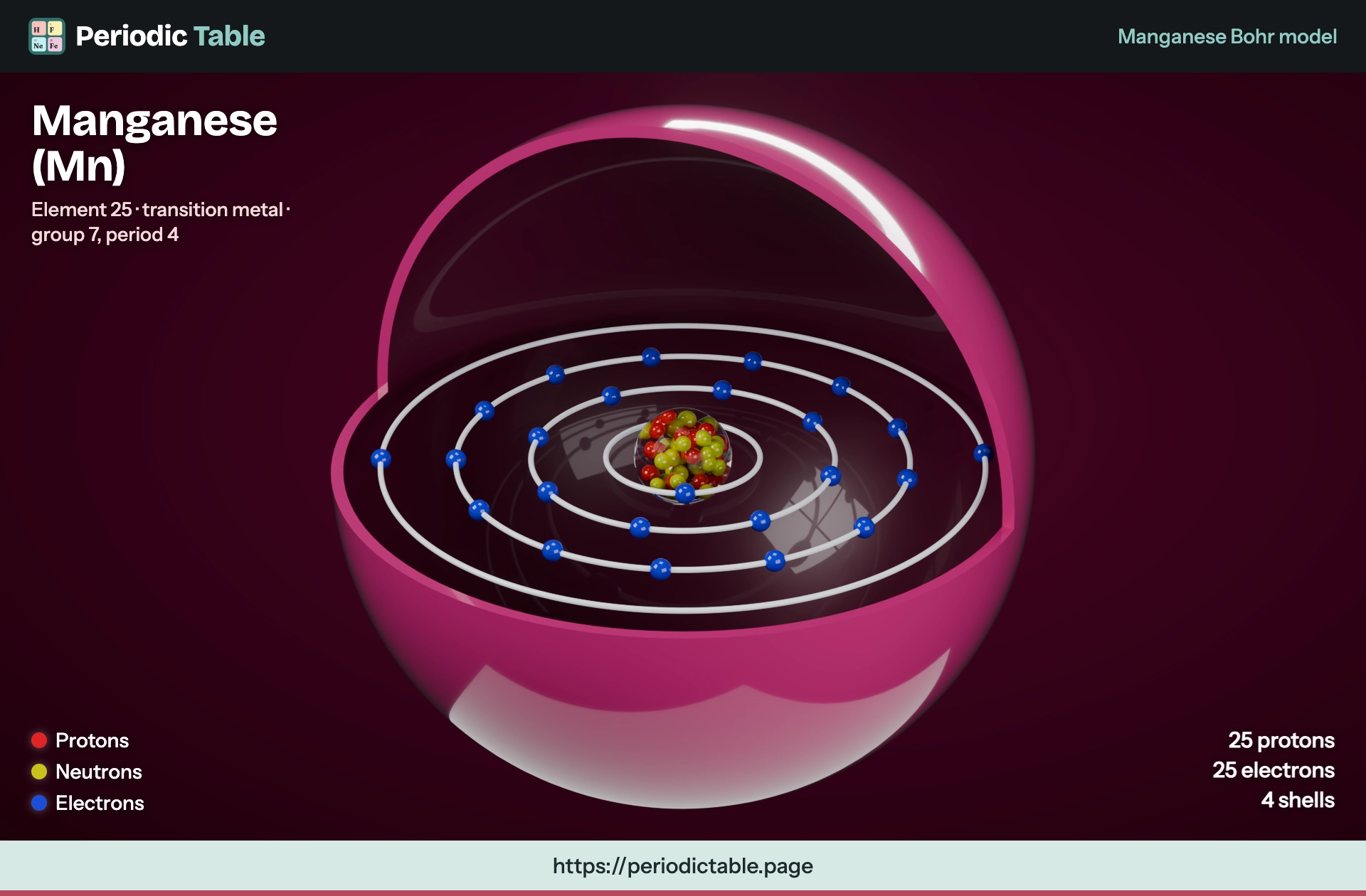
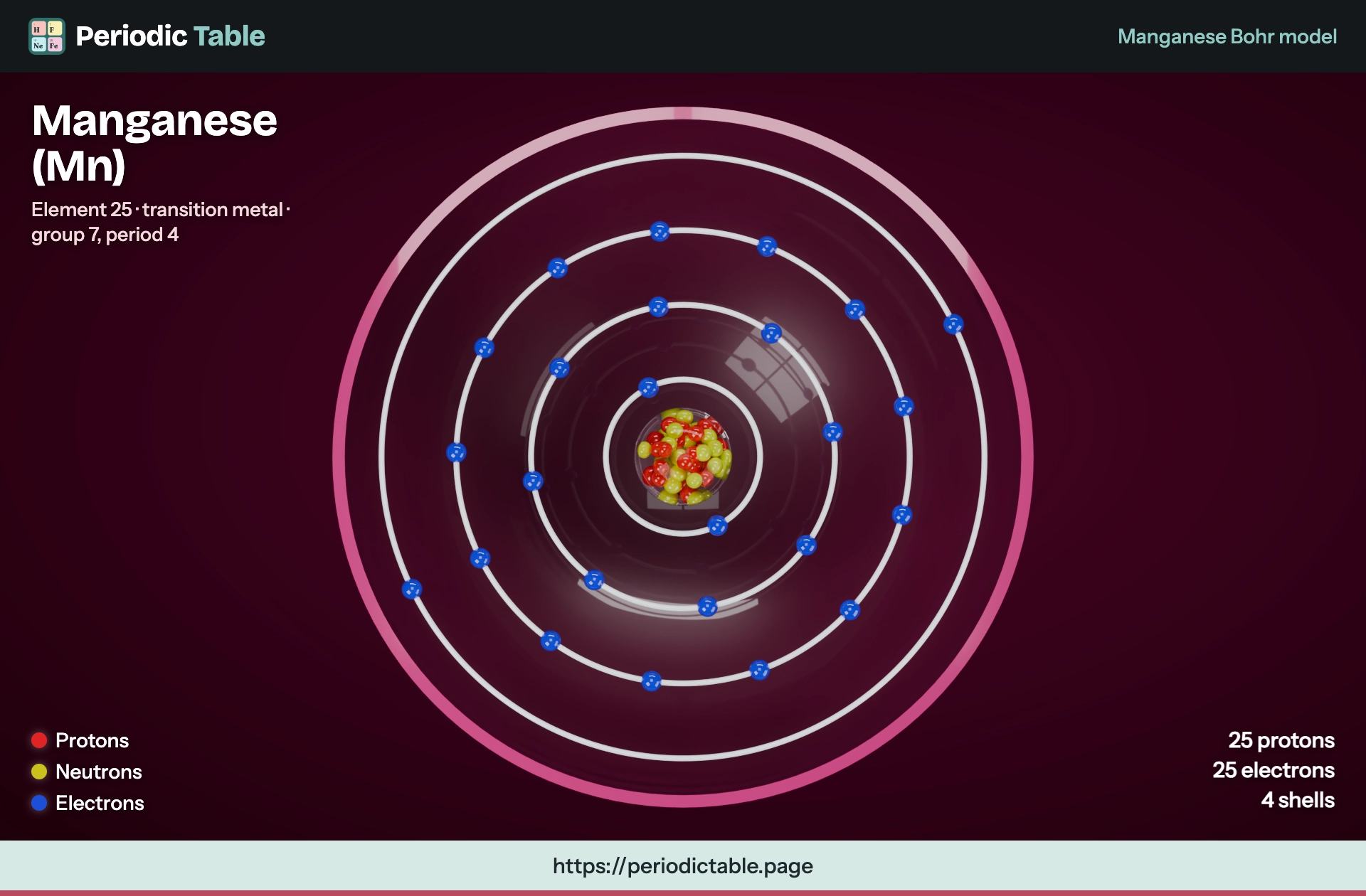
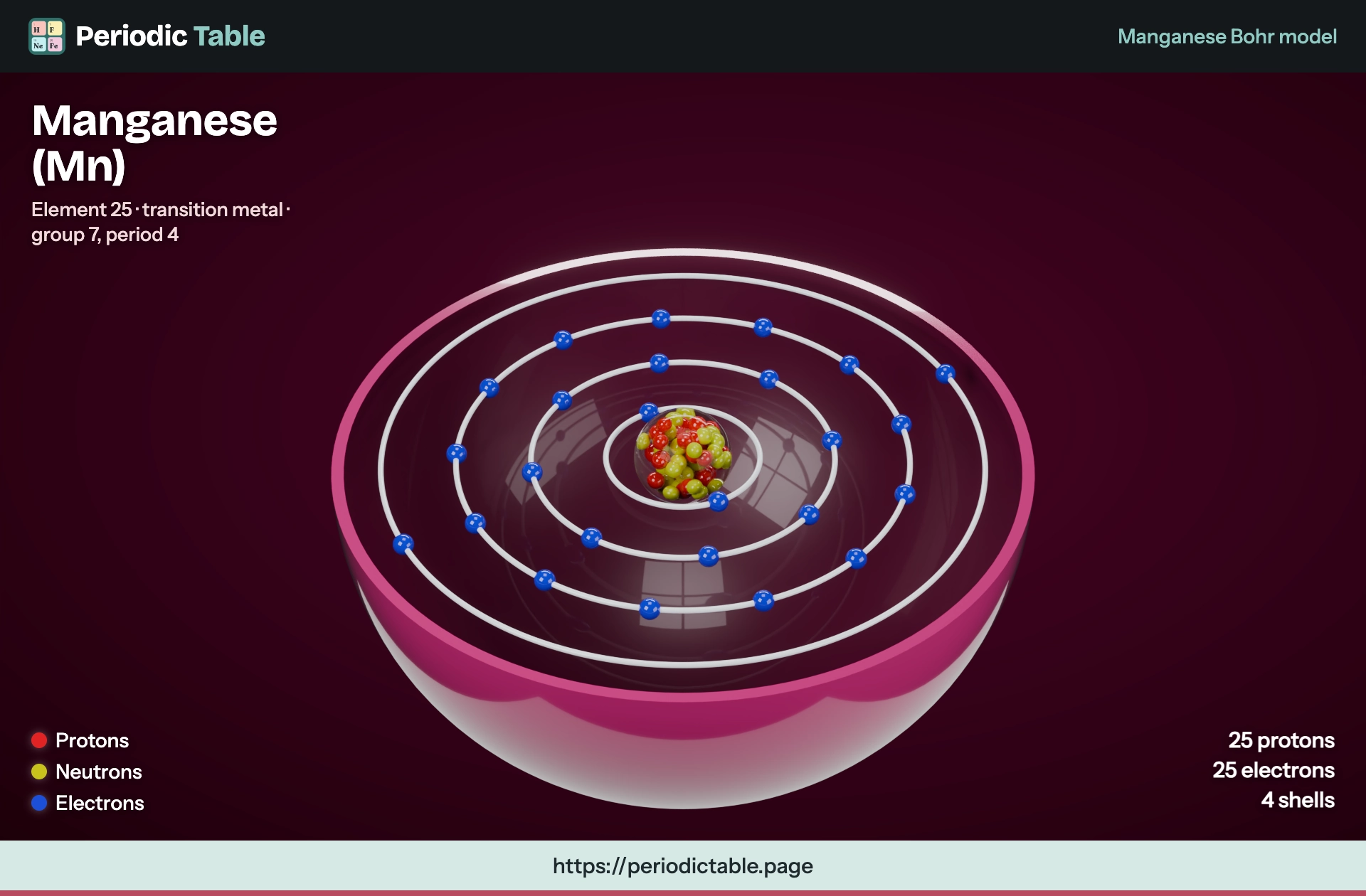
This is a Bohr model of manganese (Mn), a simplified picture of a single manganese atom. Its nucleus holds 25 protons, and a neutral manganese atom has 25 electrons, arranged around it in 4 shells (2 in shell K, 8 in shell L, 13 in shell M and 2 in shell N).
Manganese periodic table electron configuration
- Shorthand
- [Ar] 3d5 4s2
- Full
- 1s2 2s2 2p6 3s2 3p6 4s2 3d5
- Electrons per shell
- 2, 8, 13, 2
Manganese element properties and atomic data
- Atomic number
- 25
- Atomic mass
- 54.938 u
- Phase at STP
- Solid
- Melting point
- 1245.85°C (1519 K)
- Boiling point
- 2060.85°C (2334 K)
- Density
- 7.21 g/cm³
- Electronegativity (Pauling)
- 1.55
- Period
- 4
- Group
- 7
- Block
- d-block
- Appearance
- Silvery metallic
- Discovery date
- 1774
- Discovered by
- Torbern Olof Bergman
- Named by
- —
Manganese element at a glance: atomic number, group 7 and electron configuration
Element 25 sits in the middle of the first row of the d-block, between chromium and iron, which explains much of its behaviour. It is a transition metal with five unpaired 3d electrons in its ground state, and that half-filled shell is why it can give up anywhere from two to seven electrons. People reading about Lu-177 for prostate cancer therapy and other medicine uses can begin with the lutetium melting point on this site.
On the periodic table it heads the column that also holds technetium and rhenium, and it lies in period 4. The table below collects the identifiers and atomic data you are most likely to need.
| Property | Value |
|---|---|
| Chemical symbol | Mn |
| Atomic number | 25 |
| Standard atomic weight | 54.938 |
| Group / period / block | Group 7 / period 4 / d-block |
| Electron configuration | [Ar] 3d5 4s2 |
| Electrons per shell | 2, 8, 13, 2 |
| Atomic radius (empirical) | 127 pm |
| Covalent radius | 139 pm (low spin), 161 pm (high spin) |
| CAS number | 7439-96-5 |
Because it shares so much with its neighbour iron, Mn turns up in the same ore deposits, the same furnaces and even the same proteins, a theme that runs through the chemistry and the uses covered below.
Ionization energies and electronegativity of Mn
It has an electronegativity of 1.55 on the Pauling scale, similar to aluminium, so it readily forms ionic bonds with oxygen and the halogens. Its first three ionization energies are about 717, 1,509 and 3,248 kJ/mol. The jump between the second and third value shows why the +2 ion is so stable: removing the third electron means breaking into the half-filled 3d5 set.
Physical properties of manganese: melting point, boiling point and density
In bulk, the element is a silvery-gray, very hard solid that looks like iron but is far too brittle to roll or draw on its own. It tarnishes slowly in air and rusts in oxygenated water, and in its common room-temperature form it is paramagnetic. Its high melting temperature and hardness are part of why it survives in molten steel and adds strength rather than burning off. If your research involves nuclear work or chemistry with sulfur or phosphorus, basic facts can be found in rhenium alloys for quick review.
| Physical property | Value |
|---|---|
| Melting point | 1,246 °C (1,519 K) |
| Boiling point | 2,061 °C (2,334 K) |
| Density at 20 °C | about 7.47 g/cm3 |
| Hardness | 6.0 on the Mohs scale |
| Specific heat capacity | 479 J/(kg·K) |
| Bulk modulus | about 120 GPa |
| Phase at room temperature | Solid |
Allotropes of manganese metal from alpha to delta
Solid manganese metal has four allotropes, each stable over its own temperature band:
- α-Mn, the room-temperature form: body-centered cubic, with an unusually complex unit cell of 58 atoms. It turns antiferromagnetic below about −178 °C.
- β-Mn, stable from about 700 °C, has a primitive cubic cell of 20 atoms and can be kept at room temperature by quenching.
- γ-Mn, from about 1,100 °C, is face-centred cubic. This is the softer form that alloying with nickel or copper can stabilise.
- δ-Mn, from about 1,130 °C up to melting, returns to a body-centred lattice with two atoms per cell.
Manganese isotopes and Mn–Cr dating
Natural Mn is made of one stable isotope, manganese-55, so its atomic weight is known with unusual precision. Over two dozen radioisotopes have been made, and three last long enough to matter.
Mn-53 has a half-life of about 3.7 million years and decays by electron capture to chromium-53. Mn-54 (312 days) and Mn-52 (5.6 days) are made in reactors and cyclotrons, while the heavier short-lived isotopes mostly undergo beta decay.
That long-lived isotope is the useful one. It no longer survives from the formation of the Solar System, but meteorites still carry the chromium-53 it decayed into. Comparing Mn/Cr ratios with the excess chromium-53 lets geochemists date events in the first few million years of the Solar System, and cosmic-ray-made Mn-53 in surface rocks helps date exposure ages on Earth.
Oxidation states and chemistry of the element manganese
The chemistry of the element manganese is built around its range of oxidation states: every value from −3 to +7 has been observed, with +2, +4 and +7 the most common. Each oxidation state has a characteristic colour, which makes it one of the easiest elements to follow by eye in a test tube.
- Mn(II)
- Pale pink salts and solutions; the most stable state in water, with five unpaired electrons.
- Mn(III)
- Red-purple solids; unstable in plain water but useful as an oxidant in organic synthesis.
- Mn(IV)
- Brown-black manganese dioxide, the state found in most natural manganese oxides.
- Mn(VI)
- Green manganate, an intermediate when ore is fused with alkali.
- Mn(VII)
- Deep purple permanganate, the strongest and best-known oxidizer of the series.
It dissolves in dilute acids to give Mn(II) salts and hydrogen. Higher states such as Mn2O7 and the oxyhalides are powerful oxidising agents, and Mn(IV) compounds work as catalysts that break down hydrogen peroxide.
Potassium permanganate and other manganese compounds
Of all manganese compounds, KMnO4 is the one you are most likely to have seen: it is a laboratory titrant, a disinfectant, and a stain once used to prepare cells for electron microscopy. Manganese sulfate (MnSO4) feeds fertilizer, animal feed and battery chemistry, and also acts as a fungicide in some crop sprays.
Manganese(II) carbonate occurs naturally as a pink mineral, and manganese(II) chloride is a common starting material in the lab. Many of these salts also serve as a catalyst in oxidation and polymer drying reactions.
Mn mass fraction in common compounds
When you compare manganese ores or chemicals, the useful number is how much of the mass is actually manganese. You can work it out from atomic weights:
$$w_{\text{Mn}} = \frac{n_{\text{Mn}} \times 54.938}{M_{\text{compound}}} \times 100\%$$
For manganese dioxide, \(w_{\text{Mn}} = \frac{54.938}{86.936} \times 100\% = 63.19\%\). The same calculation for the other common compounds gives:
| Compound | Formula | Molar mass (g/mol) | Mn by mass |
|---|---|---|---|
| Hausmannite | Mn3O4 | 228.81 | 72.03% |
| Manganese dioxide | MnO2 | 86.94 | 63.19% |
| Manganese(II) carbonate | MnCO3 | 114.95 | 47.79% |
| Manganese(II) sulfate | MnSO4 | 150.99 | 36.38% |
| Potassium manganate(VII) | KMnO4 | 158.03 | 34.76% |
This is why oxide ores are preferred feedstock: a tonne of pure MnO2 carries almost twice the manganese of a tonne of KMnO4.
Organomanganese compounds and MMT in gasoline
The element also forms many compounds with direct carbon bonds, usually in low oxidation states. The best known is methylcyclopentadienyl manganese tricarbonyl (MMT), an anti-knock additive that raises the octane rating of gasoline. It was developed as a replacement for lead additives, but only a few countries still allow it, partly because burning it releases manganese particles into air, soil and water.
Manganese history: from magnesia nigra to Johan Gottlieb Gahn
People used this element long before anyone knew it was an element. Black manganese oxide pigment appears in the cave paintings at Lascaux and other Stone Age sites, and Egyptian and Roman glassmakers added it to decolorize glass with a green tint. Glassmaking remained its main use through the Middle Ages, when Venetian makers relied on it for their clear cristallo.
The name comes from Magnesia, a district of Greece that supplied two black minerals. One attracted iron and became our word magnet; that ore is magnetite.
The other did not, and it became known as magnesia nigra, the mineral we now call pyrolusite. A white mineral from the same region later lent its name to magnesium, which is why the two names are still so easily confused.
In the 1770s a group of Swedish chemists around Torbern Bergman argued that the black mineral hid a new element. Carl Wilhelm Scheele used it to make chlorine from hydrochloric acid in 1774, and that same year Johan Gottlieb Gahn produced the first impure sample by heating the dioxide with carbon. Its value in steelmaking was recognised in 1856, when Robert Mushet showed that adding the element cured the hot brittleness of the Bessemer process.
Where manganese ore is found: pyrolusite and rhodochrosite
Manganese makes up about 0.1% of the Earth's crust, making it the twelfth most abundant element and, after iron, the second most common transition element. It occurs in more than 300 minerals, but the manganese ore that is mined is mostly the dioxide (MnO2), with braunite, psilomelane and pink rhodochrosite (MnCO3) behind it.
Land deposits are large but unevenly spread. South Africa holds most known reserves, concentrated in the Kalahari field of the Northern Cape, and leads world output alongside Australia, Gabon and China.
Brazil, India, Ukraine, Ghana and Kazakhstan are the other important sources. Because production is so concentrated, it is often flagged as a supply-risk mineral, even though it is plentiful overall.
Manganese nodules on the ocean floor
The largest untapped resource lies on the deep ocean floor. Manganese nodules, potato-sized lumps that grow a few millimetres per million years, cover vast areas of the Pacific at depths of four to six kilometres and contain roughly a quarter to a third manganese, along with nickel, copper and cobalt.
Dissolved manganese in seawater comes mostly from hydrothermal vents along mid-ocean ridges. No nodule harvesting project has yet reached commercial production, and its impact on deep-sea ecosystems is still debated.
Mn in soils and how soil pH controls it
In soil, the element switches between the soluble Mn2+ ion and brown-black Mn(III,IV) oxides. Soil pH decides which wins: below about pH 6, or in waterlogged soil, the soluble form dominates, while alkaline, well-aired soils lock it up as oxides. That is why plants on chalky ground often show manganese shortage even when the soil holds plenty of it.
How pure manganese and ferromanganese are produced
About 85-90% of mined output ends up in iron and steel, so most of it is never refined to the pure element. Instead, ore is smelted with iron ore and coke in a blast furnace or an electric arc furnace to make a master alloy, ferromanganese, that steelmakers add to the melt. High-carbon grades carry about 78% Mn, and a related product, silicomanganese, adds silicon as well.
The main steps from mine to metal are:
- Mining and concentrating the ore, usually from open pits.
- Smelting with carbon to make master alloys for steelmakers.
- For pure manganese, leaching the reduced ore in sulfuric acid to make a sulfate solution.
- Purifying that solution and plating it out by electrowinning, which gives flakes of 99.7% or better.
Ore grade drives the economics. Using the mass fraction from the compound table above, a tonne of ore holding 46.5% MnO2 contains 1,000 × 0.465 × 0.6319 ≈ 294 kg of manganese, before any processing losses.
Manganese alloys and their industrial uses
Most manganese uses come down to one job: making other metals stronger, cleaner or more resistant, which is why the metals industry takes nearly all of it.
Steel production and mangalloy
Manganese has no satisfactory substitute in steelmaking. It is deoxidizing, it ties up sulfur as high-melting manganese sulphide instead of letting it form low-melting iron sulfide at grain boundaries (which makes hot steel crack when rolled), and it adds hardenability. Almost every grade carries some, typically 0.3-1.5%.
Above about 4% it causes embrittlement, but at 11-14% the picture changes. That is Hadfield steel, or mangalloy, discovered by Robert Hadfield in 1882: tough, with high tensile strength, and it work-hardens under impact. It is used for rail crossings, rock crushers, excavator teeth and First World War helmets.
In 200-series stainless steel, manganese stands in for part of the nickel. The early spiegeleisen used by Bessemer-era metallurgy was a manganese-rich ferroalloy with about 15% Mn.
Aluminium alloys in beverage cans
Adding about 1% manganese to aluminium gives the 3xxx-series aluminium alloys. These have better strength and corrosion resistance than pure aluminium, and they are the standard for beverage cans, roofing sheet and cookware.
Dry cell and alkaline batteries
Since the Leclanché cell of 1866, manganese dioxide has been the cathode of the ordinary dry cell. In zinc–carbon and alkaline batteries it accepts electrons from the zinc anode:
$$\text{MnO}_2 + \text{H}_2\text{O} + e^- \rightarrow \text{MnO(OH)} + \text{OH}^-$$
The element is also part of lithium-ion cathodes such as lithium manganese oxide and nickel-manganese-cobalt (NMC). These cathodes are now a fast-growing use of high-purity sulfate feedstock.
Fertilizers, pigments and water treatment
Manganese sulfate and oxide are added to fertilizers and animal feed to correct deficiencies in crops such as wheat, soybeans and citrus. Manganese browns and violets have long coloured paints, bricks and pottery, and in 2009 chemists at Oregon State University found YInMn Blue, the first new inorganic blue pigment in about two centuries. In water treatment, permanganate oxidises dissolved iron, manganese and hydrogen sulfide so that they can be filtered out.
Resistors, coins and other niche uses
Manganin, a copper-manganese-nickel alloy, barely changes resistance with temperature, so it is the standard choice for precision shunt resistors. Manganese brass gives US dollar coins their golden colour, and the wartime US nickel of 1942-1945 contained 9% manganese. Other uses include phosphate coatings that protect firearms from rust, and red phosphors in warm-white LEDs.
Biological role of Mn in enzymes and photosynthesis
This element is essential for nearly all life because many enzymes need it as a cofactor, an ion that must be bound before the enzyme can work. The most important is the oxygen-evolving complex of photosystem II, a cluster of four manganese atoms and one calcium inside the chloroplasts.
It splits water during photosynthesis and releases the oxygen we breathe. Without manganese there would be no oxygen-rich atmosphere.
In animals, manganese superoxide dismutase (Mn-SOD) is the main antioxidant enzyme inside mitochondria, where it converts the superoxide radical produced during energy metabolism into hydrogen peroxide. Arginase uses two manganese ions to run the urea cycle, and glutamine synthetase in brain astrocytes depends on it too. Microbes that store large amounts of Mn-based antioxidants survive radiation remarkably well, and researchers studying life on Mars treat this manganese defence as a sign of how hardy an organism is.
Manganese in human health and nutrition
For human health, manganese is a true dietary element. An adult body holds roughly 10-20 mg, most of it in the bones, with the rest in the liver, kidneys, pancreas and brain. It supports bone formation, the metabolism of carbohydrates, amino acids and cholesterol, and antioxidant defence.
The body controls how much it absorbs from the gut, which keeps tissue levels steady across a wide range of intakes. US adequate intakes and the tolerable upper limit are:
| Group | Adequate intake (mg/day) |
|---|---|
| Men 19+ | 2.3 |
| Women 19+ | 1.8 |
| Pregnancy | 2.0 |
| Breastfeeding | 2.6 |
| Adult upper limit (all sources) | 11 |
Dietary element sources: foods high in manganese
Most people get enough from ordinary food. Good sources include:
- Whole grain foods such as brown rice, oatmeal and wholemeal bread
- Shellfish, especially mussels, clams and oysters
- Nuts, including pecans and hazelnuts
- Legumes such as chickpeas, lentils and soybeans
- Pineapple, blueberries and spinach
- Tea and spices such as black pepper
Manganese deficiency
True manganese deficiency is rare in people. In animals it causes skeletal deformities and slows the collagen formation needed for wound healing. In crops it shows up as yellowing between the leaf veins.
Manganese exposure, toxicity and safety
The same element that your enzymes need becomes harmful at high doses. Manganese exposure from food is well regulated by the gut, but inhaled metal bypasses that control, so fumes and dust from welding, mining, smelting and battery plants carry the greatest risk. Manganese compounds are less toxic than nickel or copper compounds when swallowed, though the element is absorbed more easily from water than from food.
US guidance sets a 0.05 mg/L aesthetic limit for drinking water, and long-term exposure to higher levels has been linked to lower test scores in children. Most of the toxicity comes from oxidative stress and mitochondrial damage in nerve cells.
Manganism and Parkinson's disease
Chronic overexposure causes manganism, a neurological disorder first described by John Couper in 1837 in workers who ground the black oxide. Early signs are mood changes and irritability, and later ones are tremor, slowed speech, a mask-like face and a distinctive gait.
It resembles Parkinson's disease, but it does not respond well to L-DOPA, lacks Lewy bodies and can keep getting worse after exposure stops. The element builds up in the basal ganglia, and a faulty SLC30A10 transporter gene can cause a similar condition without any workplace exposure.
Workplace limits set by OSHA and NIOSH
In the United States, OSHA sets a permissible exposure limit of 5 mg/m3 as a ceiling for manganese fume and compounds. NIOSH recommends a stricter 1 mg/m3 averaged over a work shift, with a 3 mg/m3 short-term limit, and treats 500 mg/m3 as immediately dangerous to life and health. Good ventilation, fume extraction and respirators during welding or ore handling keep inhalation well below these values.