Rhenium element (Re): rhenium periodic table facts
Rhenium periodic table facts: rhenium (Re) is element 75, a transition metal in group 7, period 6. Rhenium (Re) is element 75 on the periodic table, a dense, silvery-white solid that fills one of the two gaps Mendeleev left below manganese in 1869. For dating rocks by potassium-argon dating, radioactive decay and argon-40, the argon atomic number covers the method.
You will rarely meet it outside a lab or a turbine shop: it is one of the rarest elements in the Earths crust and is only ever recovered as a trace element from other ores. Yet rhenium has the heat tolerance that modern turbine blades and refinery reactors cannot do without.
Rotate the 3D Bohr model of rhenium
Drag to orbit, scroll to zoom.
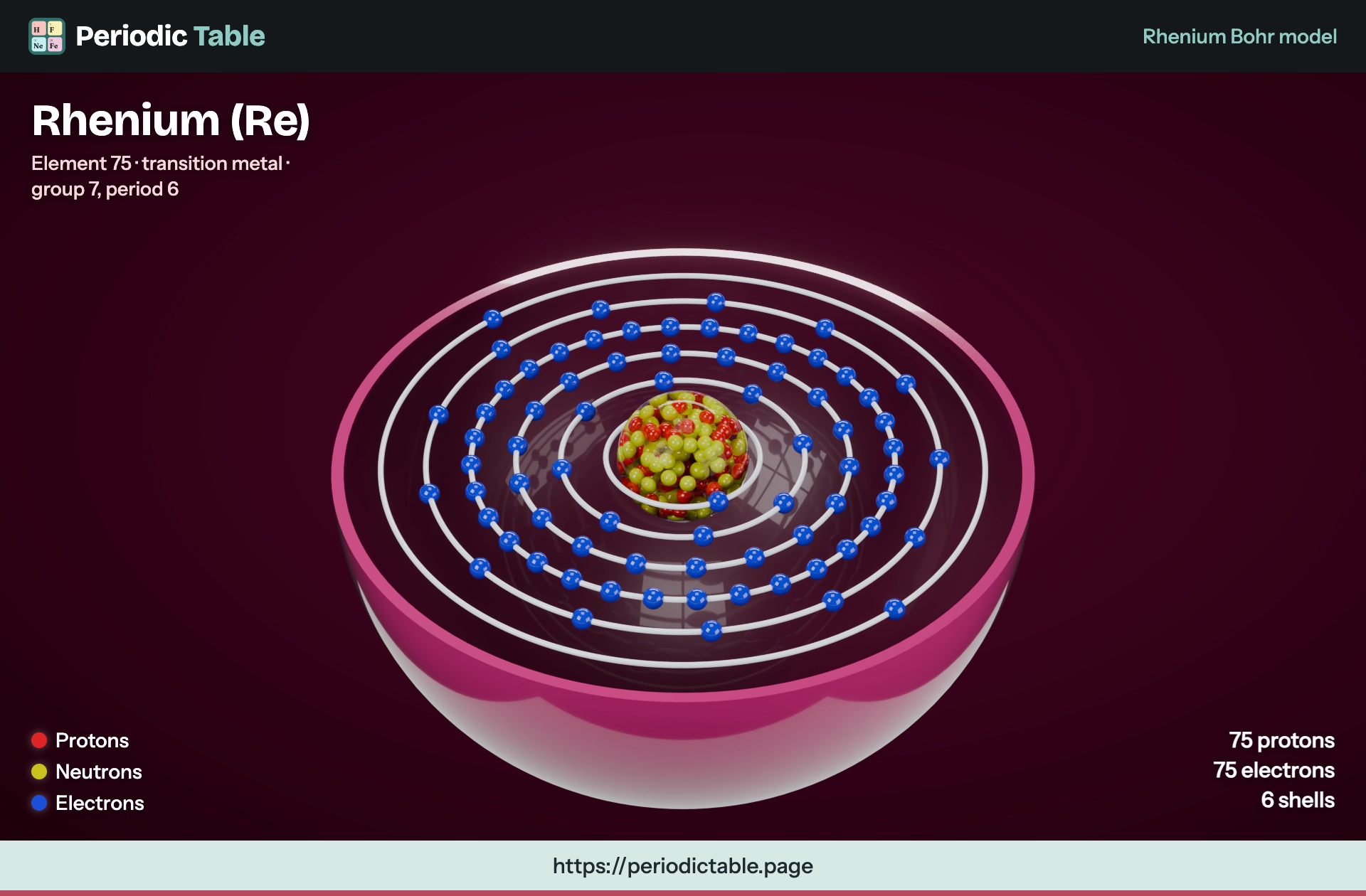
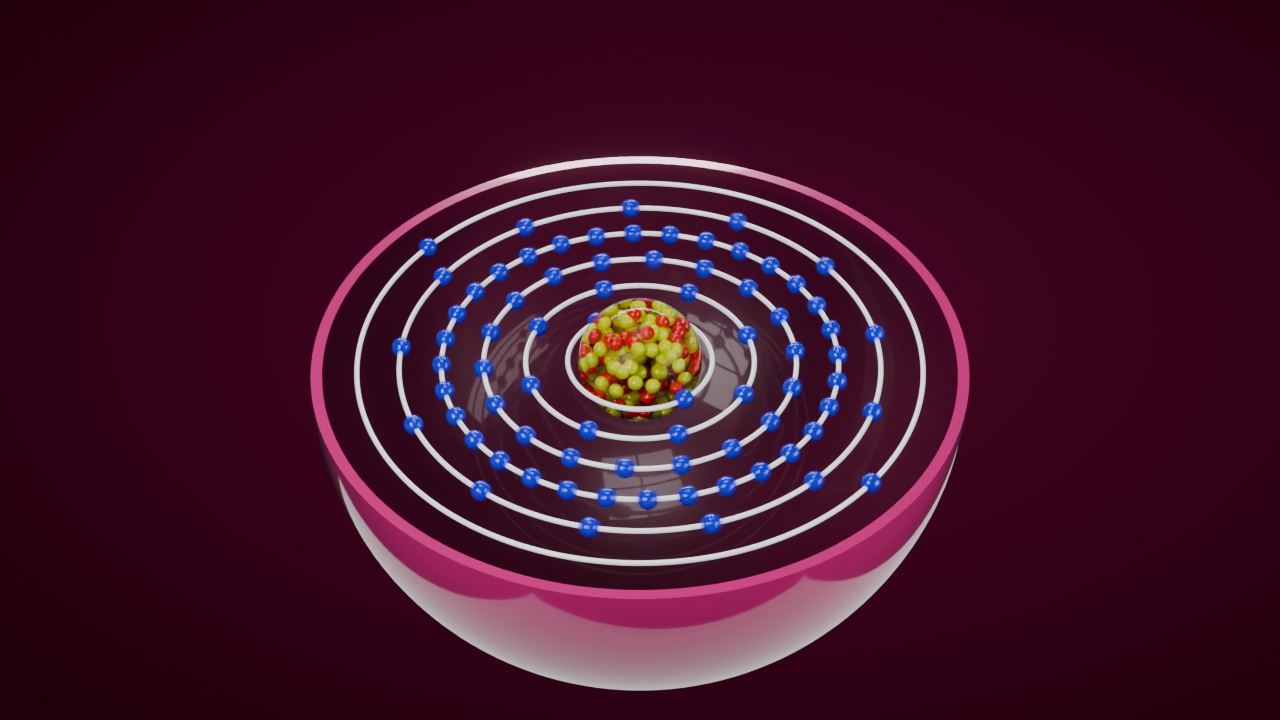
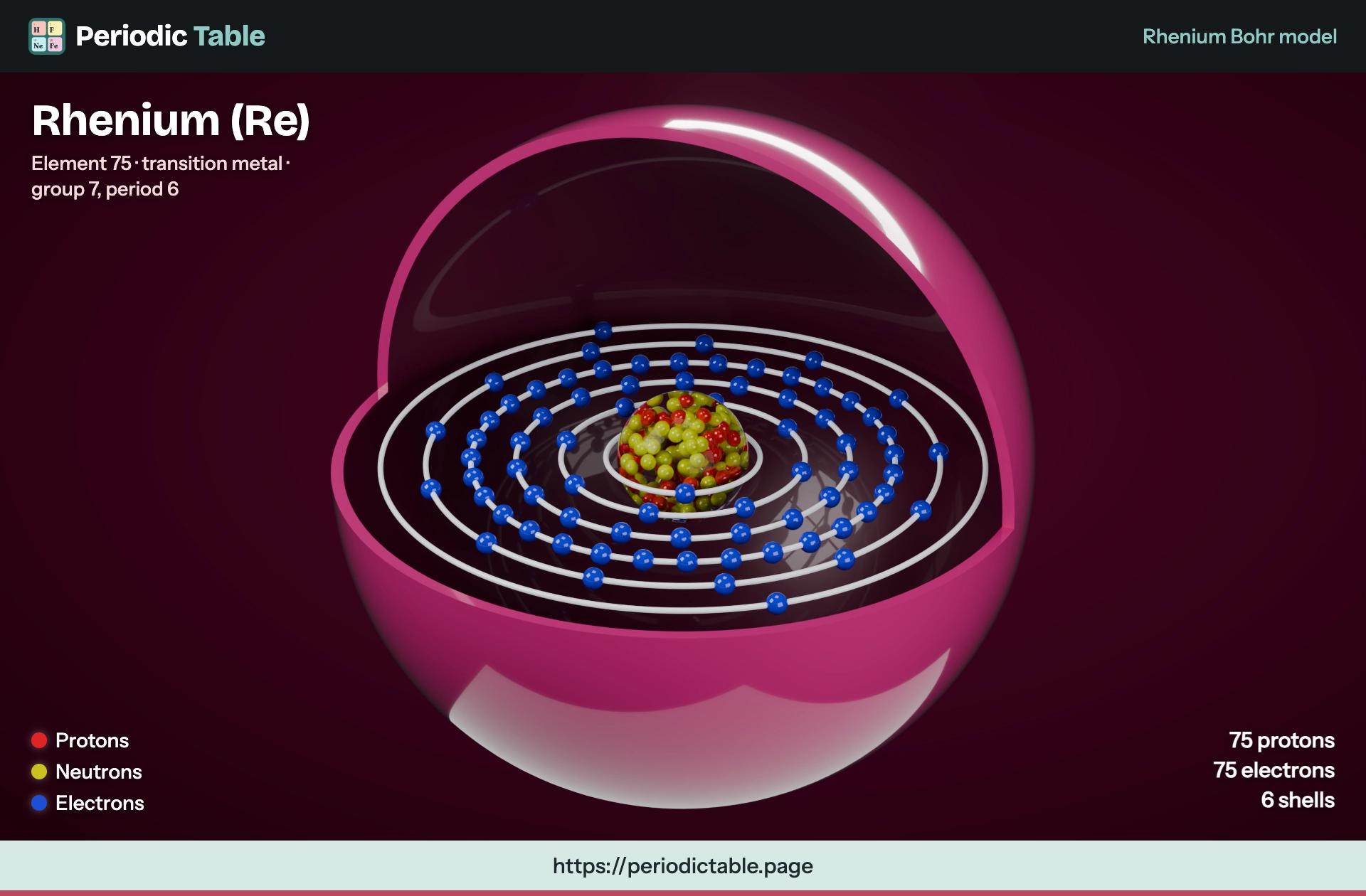
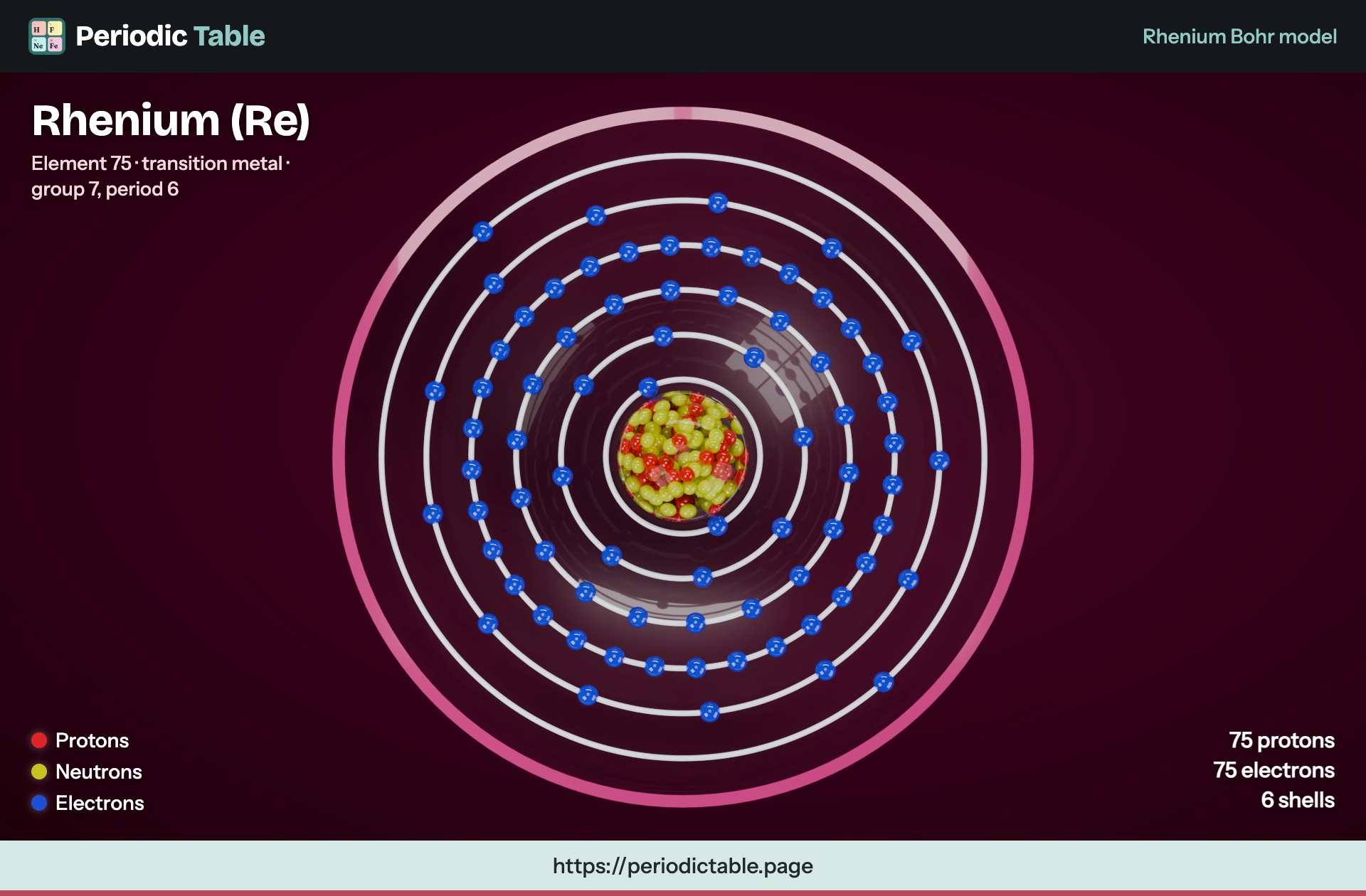
This is a Bohr model of rhenium (Re), a simplified picture of a single rhenium atom. Its nucleus holds 75 protons, and a neutral rhenium atom has 75 electrons, arranged around it in 6 shells (2 in shell K, 8 in shell L, 18 in shell M, 32 in shell N, 13 in shell O and 2 in shell P).
Rhenium periodic table electron configuration
- Shorthand
- [Xe] 4f14 5d5 6s2
- Full
- 1s2 2s2 2p6 3s2 3p6 4s2 3d10 4p6 5s2 4d10 5p6 6s2 4f14 5d5
- Electrons per shell
- 2, 8, 18, 32, 13, 2
Rhenium element properties and atomic data
- Atomic number
- 75
- Atomic mass
- 186.2071 u
- Phase at STP
- Solid
- Melting point
- 3185.85°C (3459 K)
- Boiling point
- 5595.85°C (5869 K)
- Density
- 21.02 g/cm³
- Electronegativity (Pauling)
- 1.9
- Period
- 6
- Group
- 7
- Block
- d-block
- Appearance
- Silvery-grayish
- Discovery date
- 1925
- Discovered by
- Masataka Ogawa
- Named by
- Walter Noddack
Rhenium metal properties at a glance
Polished, the element shows a bright metallic lustre. The values below are standard published data. Pyrolusite, mining and ore processing appear in the manganese boiling point, along with the batteries that depend on it.
| Property | Value |
|---|---|
| Atomic number | 75 |
| Atomic mass | 186.207 u |
| Group and period | Group 7, period 6 (d-block) |
| Density at 20 °C | 21.02 g/cm3 |
| Melting temperature | 3,186 °C (3,459 K) |
| Boiling temperature | 5,596 °C (5,869 K) |
| Electron configuration | [Xe] 4f14 5d5 6s2 |
| Electronegativity (Pauling) | 1.9 |
| Common oxidation states | +7, +6, +4, +3 |
Density and melting point
At 21.02 g/cm3, rhenium is the fourth-densest element, behind osmium, iridium and platinum. Its high melting point is beaten only by tungsten and carbon, yet it never turns brittle on cooling: it stays ductile right up to melting, and that ductility lets it be rolled cold.
A high recrystallisation temperature gives it excellent creep resistance at high temperature, and it survives repeated thermal cycling without cracking. It also keeps a high modulus of elasticity, shows high electrical resistivity over a wide range and does not form carbides.
Electron configuration and oxidation
All five 5d and both 6s electrons can be given up, so the element reaches the +7 state found in perrhenates. On any periodic chart you will find it under the symbol Re in group 7. It resists tarnish in dry air, although fine powder oxidises to a volatile oxide when heated in air.
Element 75 history and the Rhenus name
The name comes from Rhenus, the Latin word for the Rhine River, chosen by the German team that confirmed the discovery. It was the last stable element found in nature, so the story of element #75 spans two continents and two decades. Chemistry of single atoms and nuclear physics meet in the seaborgium electron configuration, a record of laboratory experiments.
Masataka Ogawa and nipponium
In 1908 the Japanese chemist Masataka Ogawa announced a new element, nipponium, which he took to be the lighter of Mendeleev's two gaps, later filled by technetium. Nobody could reproduce it and the claim faded. Decades later, X-ray study of his samples suggested he had actually isolated the heavier missing element.
Noddack, Tacke and berg in 1925
In 1925 Walter Noddack, Ida Tacke and Otto Berg identified the element by X-ray spectroscopy in platinum ores, columbite and gadolinite. Collecting a usable amount was harder: in 1928 they worked through about 660 kg of mineral concentrate to obtain one gram.
Occurrence of natural rhenium
The element never occurs native and forms almost no minerals of its own. It is scattered at roughly one part per billion, turning up as a trace companion in columbite, tantalite and the sulphide ores of porphyry deposits, which is why world output is measured in tens of tonnes a year.
Molybdenite and porphyry mining
Almost all supply comes from the porphyry copper deposit, a large, low-grade body of rock with copper sulphides spread through it. The molybdenite in that rock carries rhenium as a by-product, so output follows molybdenum mining, not demand for the rare element itself. A tonne of ore yields only a fraction of a gram.
Production and fabrication of pure rhenium
Recovery and shaping are two separate stages.
From flue dusts to ammonium perrhenate
When molybdenite concentrate from copper smelting is roasted, the element volatilises as its heptoxide and collects in the flue dusts and scrubber liquors. Ion exchange then pulls it out as ammonium perrhenate (APR), the main traded form. Heating APR in hydrogen yields rhenium powder, which is pressed and sintered by powder metallurgical methods.
Rolling, welding and machining
Sintered bar can be rolled into sheet and drawn into rhenium wire, but it work hardens quickly, so heavy reductions need annealing between passes. Joints are made by inert-gas or electron beam welding with the part shielded from air, and spark erosion or abrasive grinding handles final shapes.
Uses and applications of rhenium alloys
Most supply goes into turbine blades, with refinery catalysts taking most of the rest. As an alloy ingredient, a few percent changes how its host behaves at temperature.
Superalloys for jet engines
Single-crystal nickel-based superalloys for gas turbine engines carry about 3% rhenium in second-generation grades and around 6% in third-generation grades, letting blades run hotter before they creep. Military jet engines, missiles and the rocket thrusters on small satellites all depend on it, and some missile parts use it as heat insulation.
Catalysts in the petroleum industry
In the petroleum industry, platinum and rhenium catalysts drive catalytic reforming, which turns naphtha into high-octane gasoline and the aromatics benzene and xylene; that process made lead-free gasoline practical. The same chemistry serves hydrogenation, hydrocracking and the metathesis of olefins (alkenes). A catalyst speeds a chemical reaction without being used up, and this one resists poisoning by nitrogen, sulfur and phosphorus.
Electrical, medical and electronics uses
- Thermocouples: paired with tungsten, it reads furnace temperatures up to about 2,200 °C.
- Electrical contact material, thanks to its wear resistance and resistance to arc corrosion.
- Filaments for mass spectrographs and ion gauges, and fine wire in flash lamps for flash photography.
- Heating elements, electromagnets, thermistors, semiconductors and vacuum technology parts.
- A molybdenum alloy containing it is superconducting below about 10 K, a superconductor used in electronics, space and nuclear work.
- Medicine: after neutron bombardment makes it radioactive, it treats restenosis and liver tumours.
- A coating on wires and pipes in marine and chemical plants, where its resistance to corrosion pays off.
Rhenium compounds, isotopes and recycling
The element occurs as two nuclides: about 37% mass 185, which is stable, and 63% mass 187, a weak beta emitter with a half-life of roughly 41 billion years. Dozens of unstable isotopes have been made in reactors.
The most useful rhenium compounds are the volatile heptoxide, perrhenic acid and the perrhenate salts behind most catalyst production. Because primary supply is tied to molybdenum roasting, recycling of spent catalysts and turbine-blade scrap now covers a large share of demand.