


Seaborgium element (Sg): seaborgium periodic table facts
Seaborgium periodic table facts: seaborgium (Sg) is element 106, a transition metal in group 6, period 7. Seaborgium is a synthetic element you will never hold in your hand: it has the symbol Sg, sits at position 106, and exists only for seconds or minutes after a laboratory forges it, because nothing in nature makes it. If you wonder why a complete octet keeps this colorless, odorless gas unreactive, the argon melting point has the answer.
This chemical element is famous for two reasons — it was named for Glenn T. Seaborg while he was still alive, making it the first element named after a living person, and the handful of nuclei ever made have shown that it behaves like a heavier version of tungsten. Below you will find its key data, how scientists make and detect it, the fight over its discovery and name, its isotopes, and what its chemistry looks like.
Rotate the 3D Bohr model of seaborgium
Drag to orbit, scroll to zoom.
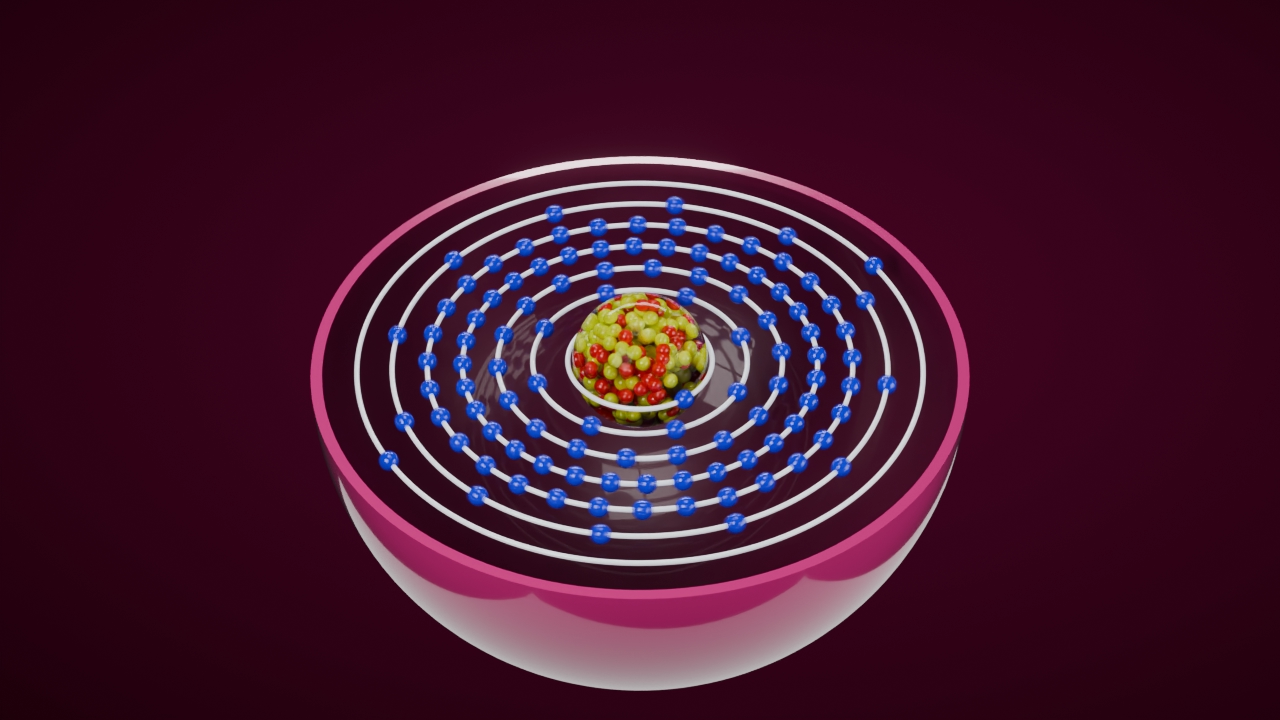
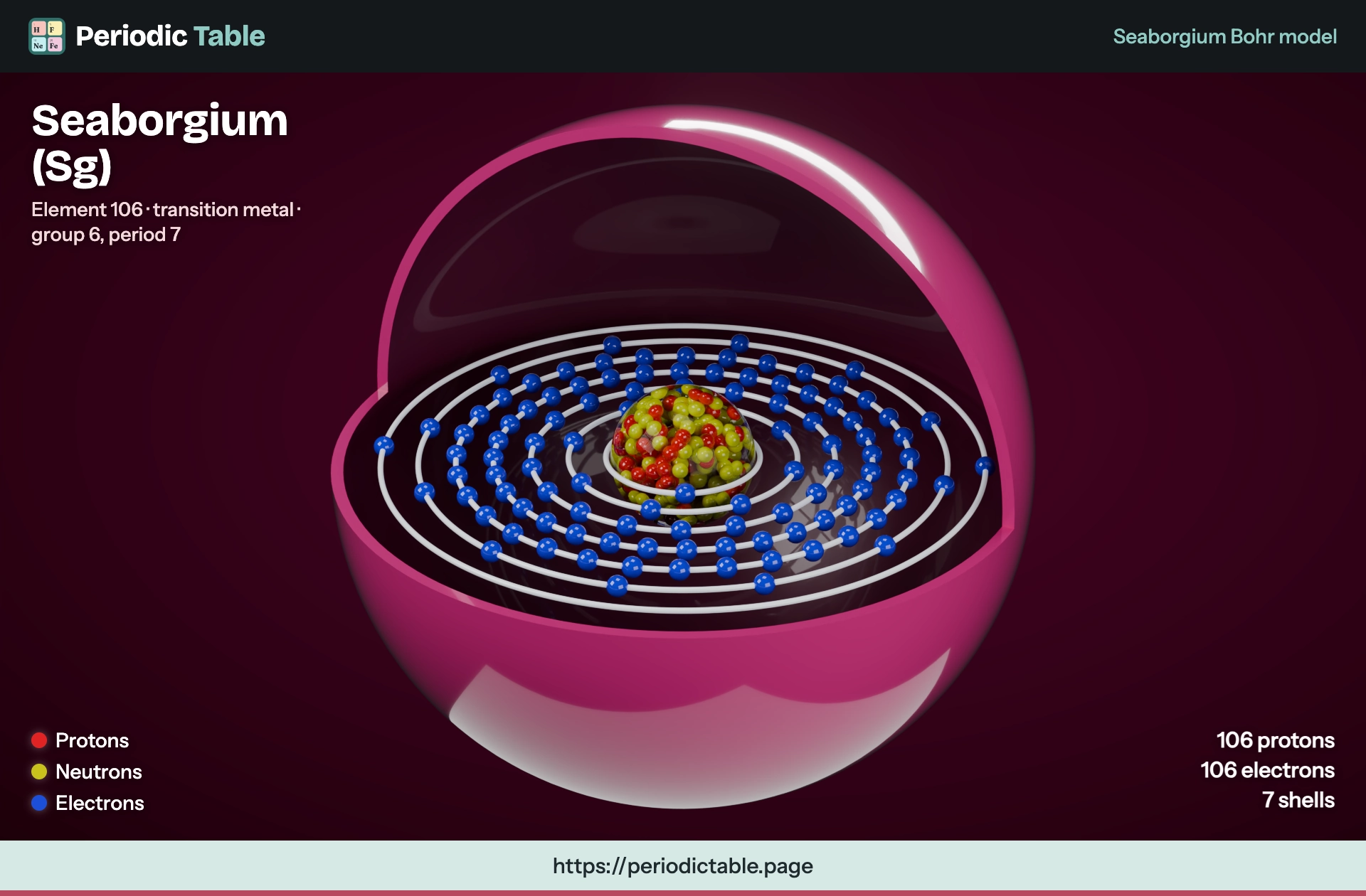
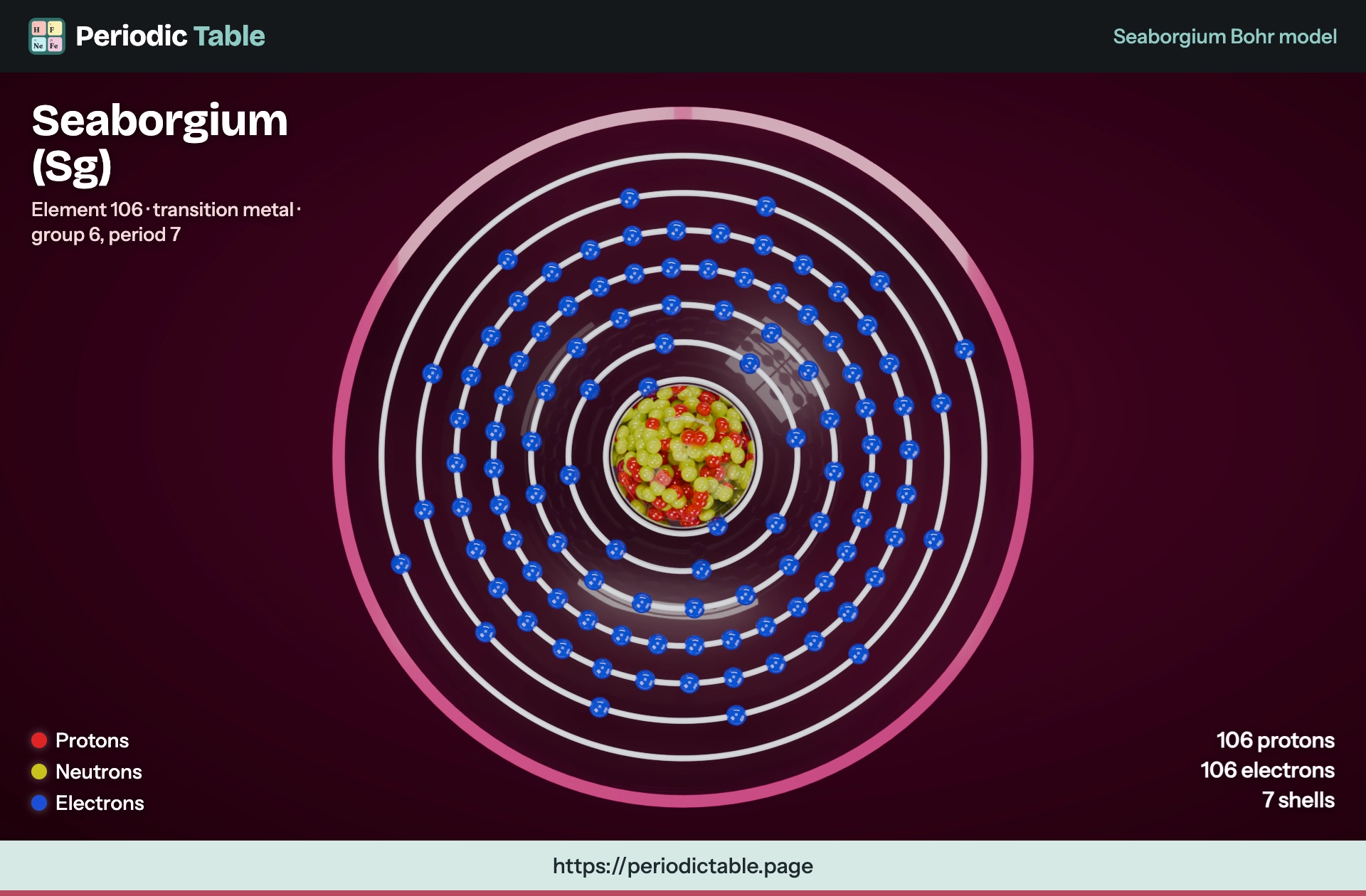
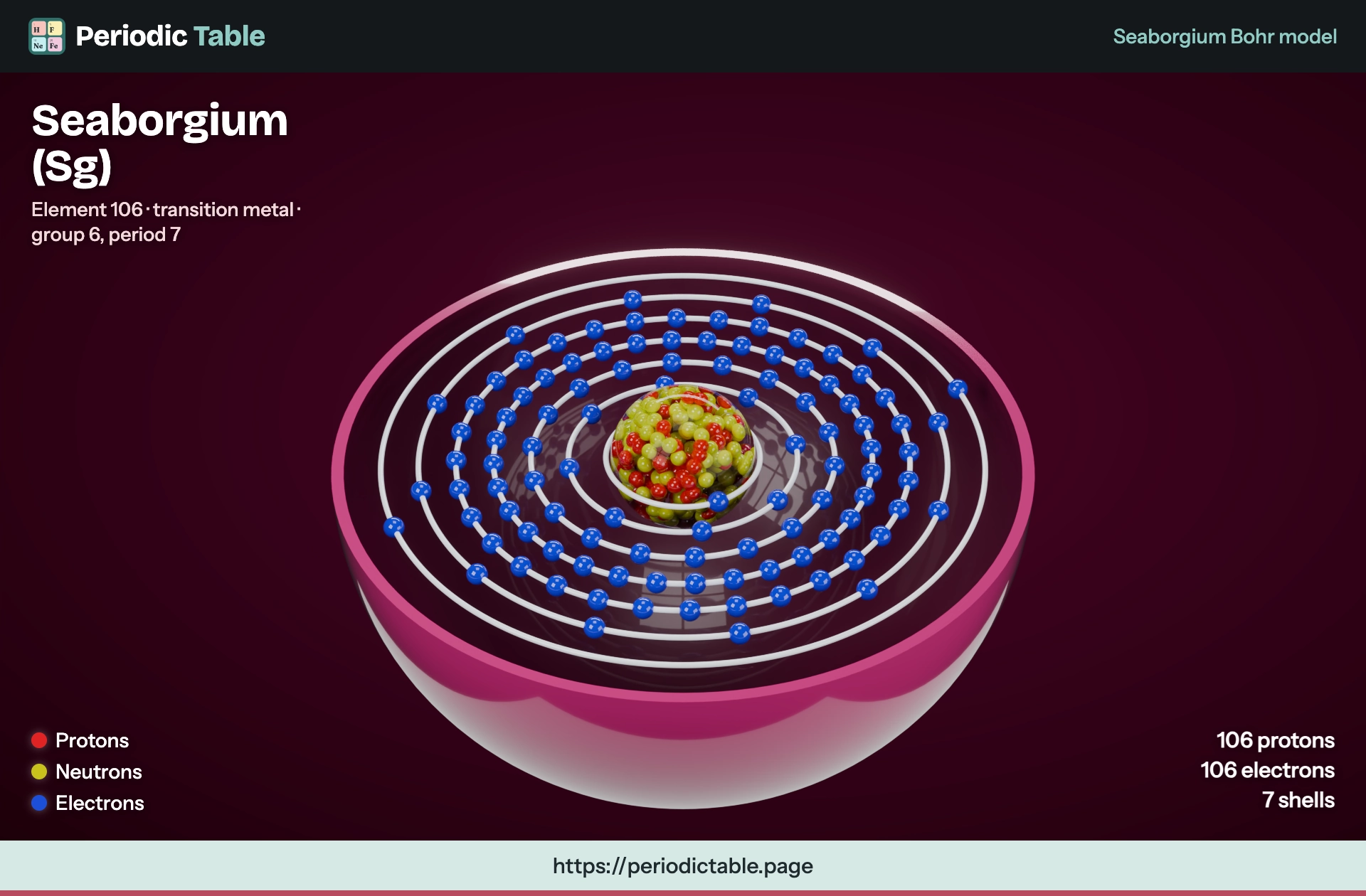
This is a Bohr model of seaborgium (Sg), a simplified picture of a single seaborgium atom. Its nucleus holds 106 protons, and a neutral seaborgium atom has 106 electrons, arranged around it in 7 shells (2 in shell K, 8 in shell L, 18 in shell M, 32 in shell N, 32 in shell O, 12 in shell P and 2 in shell Q).
Seaborgium periodic table electron configuration
- Shorthand
- *[Rn] 5f14 6d4 7s2
- Full
- 1s2 2s2 2p6 3s2 3p6 4s2 3d10 4p6 5s2 4d10 5p6 6s2 4f14 5d10 6p6 7s2 5f14 6d4
- Electrons per shell
- 2, 8, 18, 32, 32, 12, 2
Seaborgium element properties and atomic data
- Atomic number
- 106
- Atomic mass
- [269] u
- Phase at STP
- Unknown
- Melting point
- Unknown
- Boiling point
- Unknown
- Density
- 35 g/cm³
- Electronegativity (Pauling)
- Unknown
- Period
- 7
- Group
- 6
- Block
- d-block
- Appearance
- Unknown
- Discovery date
- 1974
- Discovered by
- Lawrence Berkeley National Laboratory
- Named by
- —
Seaborgium element facts: a radioactive synthetic metal
Every number in the seaborgium element profile below is either measured from a few short-lived nuclei or predicted by theory, because no visible sample has ever existed. The element is radioactive in every form, and its bulk properties such as melting point and boiling point remain unknown. Where a value is marked predicted, it comes from relativistic calculations rather than experiment. In jet engine superalloys and thermocouples, uses of this metal are featured in the rhenium element and its applications section.
| Property | Value |
|---|---|
| Symbol / atomic number 106 | Sg (written 106 Sg on many periodic table tiles) |
| Group, period, block | Group 6, period 7, d-block |
| Category | Transition metals (transactinide) |
| Electron configuration | [Rn] 5f14 6d4 7s2 |
| Mass number of most stable isotope | [269] or [267] (data not decisive) |
| Phase at STP | Solid (predicted) |
| Density | 23–24 g/cm3 (predicted) |
| Crystal structure | Body-centered cubic (predicted) |
| Atomic radius | 132 pm (predicted) |
| Covalent radius | 143 pm (estimated) |
| Ionization energies | 757, 1733, 2484 kJ/mol (1st–3rd; all but the first estimated) |
| Oxidation states | 0, +6 observed; +3, +4, +5 predicted |
| Natural occurrence | Synthetic only |
| CAS number | 54038-81-2 |
The electron configuration tells you most of what matters chemically: four 6d electrons and two 7s electrons outside a full radon core, the same outer pattern as the other group members. With so many electrons and such a heavy nucleus, relativistic effects shift orbital energies enough that predictions for this metal differ noticeably from a simple extrapolation down the group. Note that the mass in brackets is the mass number of the longest-lived known isotope, not a weighted average, since there is no natural mixture to average.
Element 106 as a transactinide element in group 6 and period 7
On the periodic table, element 106 sits in group 6, directly below tungsten, with chromium and molybdenum above it. It is a transactinide element — one of the elements after lawrencium (103) — and the fourth member of the 6d series of transition metals in period 7, following rutherfordium and dubnium and preceding bohrium. When comparing boiling points and London dispersion forces going down the group 18, each trend is explained step by step.
That placement is why Mendeleev-style naming would have called it eka-tungsten: "one place below tungsten." The prediction that it should act as the heavier homologue of its group neighbour was the whole point of testing its chemistry, and experiments have confirmed it. Like every congener above it, it is expected to favour the +6 oxidation state and to form oxo-compounds, halides and a carbonyl.
- Above it: chromium (24), molybdenum (42), tungsten (74)
- Left neighbour: dubnium (105); right neighbour: bohrium (107)
- Block: d-block, so its chemistry is driven by 6d and 7s electrons
How seaborgium atoms are made as a superheavy element
Seaborgium atoms are produced in particle accelerators by nuclear fusion: a beam of light ions is fired at a target of heavy nuclei, and on rare occasions a projectile and a target nucleus fuse. Because both are positively charged, the beam has to be accelerated to a large fraction of the speed of light to overcome electrostatic repulsion, yet not so hard that the fused system falls apart. The merged system is an excited compound nucleus, which cools by boiling off neutrons; if it fissions first, the superheavy element is lost.
Nuclear physics splits these fusion reactions into two families:
- Hot fusion — light, energetic projectiles (such as neon-22) hit actinide targets like curium-248; the compound nucleus is very excited (about 40–50 MeV) and sheds three to five neutrons.
- Cold fusion — heavier projectiles hit lead or bismuth targets; excitation is lower (about 10–20 MeV), only one or two neutrons are emitted, and the product is more likely to survive. This has nothing to do with the room-temperature "cold fusion" claim.
The odds of any single collision working are described by the cross section, measured in nanobarns or picobarns for these reactions. The neutron-poor isotopes from Sg-257 to Sg-261 came from cold fusion, while most heavier ones turn up as daughters in the decay of hassium, darmstadtium and flerovium, so the number of protons and neutrons you end up with depends on which reaction you choose.
Detecting superheavy elements one atom at a time
Superheavy elements are studied one atom at a time. A separator using electric and magnetic fields pulls the slow-moving product away from the unreacted beam and implants it in a silicon detector, which logs where and when it landed. The detector then waits for the nucleus to decay and records the energy, position and time again.
Two decay modes dominate for nuclei this heavy: alpha decay and spontaneous fission. An alpha decay produces a known daughter, so a decay chain that ends in already-characterised decay products pins down the parent's identity. Fission scatters the nucleus into unpredictable fragments and identifies nothing on its own, which is why the Berkeley group trusted alpha chains far more than fission counts.
Shell effects give some of these deformed nuclei extra resistance to fission, and the hoped-for island of stability lies further out, around 300 nucleons. Only a few atoms of this element are made in a typical experiment run lasting weeks.
Discovery of seaborgium: the Berkeley team and the Dubna team
Two laboratories reported the discovery of element 106 within months of each other in 1974. At the Joint Institute for Nuclear Research in Dubna, in the Soviet Union, a group led by Yuri Oganessian bombarded lead-208 and lead-207 targets with chromium-54 ions and saw dozens of spontaneous-fission events lasting a few milliseconds, which they assigned to seaborgium-260 (first proposed as mass 259).
A few months later, the Berkeley team — Albert Ghiorso, Glenn T. Seaborg's colleagues at the University of California, Berkeley including Carol Alonso, and Kenneth Hulet of the Lawrence Livermore National Laboratory — fired oxygen-18 ions at a californium-249 target using the SuperHILAC. They recorded around seventy alpha decays from seaborgium-263 with a half-life of about 0.9 seconds, each followed by the known daughters rutherfordium-259 and nobelium-255:
$$^{249}_{98}\mathrm{Cf} + ^{18}_{8}\mathrm{O} \rightarrow ^{263}_{106}\mathrm{Sg} + 4\,^{1}_{0}n$$
The same reaction had been tried in 1971, but upgrades to the HILAC accelerator stalled the analysis; when the 1974 data matched, the team realised they may have seen the new element three years earlier, which would have moved the date of discovery back to 1971.
The rival discovery claims dragged on until 1992, when the IUPAC/IUPAP Transfermium Working Group ruled the Dubna evidence unconvincing — it lacked yield curves and angular selection — and credited the discovery to Berkeley, whose result was anchored to known daughter nuclei. A confirming experiment followed in 1993 at the 88-Inch Cyclotron of the Lawrence Berkeley National Laboratory, designed by Ken Gregorich and run with Darleane Hoffman and students, giving the team the right to propose a name.
Naming seaborgium after glenn T. Seaborg
The eight discoverers floated names honouring Isaac Newton, Thomas Edison, Finland and others before Albert Ghiorso suggested the lab's own associate director, and the name "seaborgium" was announced at the American Chemical Society meeting in San Diego in March 1994. It made element 106 the first element named after a person who was still alive. Under IUPAC rules, discoverers propose a name, it goes through public review, and the union makes the final decision — a process that would be tested hard over the next three years.
The naming controversy over a living person
In August 1994 IUPAC ruled that no element could carry the name of a living scientist, and its September 1994 list dropped the Berkeley name entirely, moving rutherfordium to element 106. The naming controversy that followed spanned elements 104 to 109 and three laboratories in the United States, Russia and Germany. Until a name was agreed, the element went by its systematic placeholder, unnilhexium (Unh).
| Element | Systematic name | American proposal | Russian proposal | IUPAC 1994 | Final (1997) |
|---|---|---|---|---|---|
| 104 | Unnilquadium | Rutherfordium | Kurchatovium | Dubnium | Rutherfordium |
| 105 | Unnilpentium | Hahnium | Nielsbohrium | Joliotium | Dubnium |
| 106 | Unnilhexium | Seaborgium | — | Rutherfordium | Seaborgium |
The American Chemical Society kept using the Berkeley names in its journals regardless. A 1995 compromise restored the name but cut other American proposals, and in August 1997 IUPAC finally adopted the American and German names for 104–109, except that element 105 became dubnium to honour Dubna; hahnium was dropped, and the 106th name finally went onto every periodic table.
Seaborg is often grouped with einsteinium and fermium, but those names were only made public after their namesakes had died. The only other element named for a living person is oganesson (118), for Yuri Oganessian, in 2016.
Glenn Seaborg and the transuranium elements
Glenn Seaborg earned the honour through decades of nuclear chemistry. In 1940 he shared in the discovery of plutonium, made by bombarding uranium with deuterons, and he went on to help create americium, curium, berkelium, californium, einsteinium, fermium, mendelevium and nobelium. His 1944 actinide concept moved the heavy elements into their own row of the periodic table.
He shared the 1951 Nobel Prize in Chemistry with Edwin McMillan for work on the transuranium elements and chaired the U.S. Atomic Energy Commission from 1961 to 1971. He died in February 1999, less than two years after the name became official.
Seaborgium isotopes and their half-lives
There are no stable or naturally occurring isotopes of seaborgium. Isotopes with mass numbers 257–269 and 271 have been reported, and several have metastable states (isomers). Almost all decay by alpha emission or spontaneous fission; Sg-261 can also undergo electron capture to dubnium-261.
The heaviest isotopes live longest, and the even-odd ones tend to prefer alpha decay while even-even ones fission. The table lists a selection with recent published values.
| Isotope | Half-life | Decay mode | How it was made |
|---|---|---|---|
| Sg-258 | 2.7 ms | SF | Bismuth-209 + vanadium-51 |
| Sg-260 | 4.95 ms | SF, α | Lead-208 + chromium |
| Sg-263 | 940 ms | α, SF | Daughter of darmstadtium-271 |
| Sg-265 | 9.2 s | α | Curium-248 + neon-22 |
| Sg-267 | 9.8 min | α | Daughter of hassium-271 |
| Sg-269 | 5 min | α, SF | Daughter of flerovium-285 |
| Sg-271 | 31 s | α, SF | Daughter of flerovium-287 |
Which isotope is the most stable is still open: seaborgium-267 at about 9.8 minutes and Sg-269 at about 5 minutes have overlapping error bars. To get a feel for what a half-life of that length means, apply the decay law:
$$N = N_0 \times \left(\frac{1}{2}\right)^{t / t_{1/2}}$$
For Sg-267, after 30 minutes \(N/N_0 = 0.5^{30/9.8} \approx 0.12\), so only about 12% of a batch would remain; after one hour it falls to about 1.4%. For Sg-265 (9.2 s), the same hour leaves essentially nothing. That is why chemists favour the longer-lived isotopes: even a 9-second half-life gives an automated system just enough time to carry a single nucleus into a reaction chamber.
Predicted properties of seaborgium
Because only a few nuclei exist at any moment, the bulk properties of the metal have to be predicted. Seaborgium is expected to be a solid with a body-centred cubic structure like tungsten.
Early estimates put its density near 35 g/cm3; calculations from 2011 and 2013 lowered that to 23–24 g/cm3, still among the densest of all elements. In visible quantities it would probably look silvery grey.
Seaborgium oxidation states and electron configuration
The 7s orbital is relativistically stabilised and the 6d orbitals destabilised, so the two end up close in energy and the element is expected to lose its 6d electrons before its 7s pair. The predicted ionisation sequence runs [Rn]5f146d47s2 for the neutral atom down to the bare [Rn]5f14 core for Sg6+, whose six-coordinate ionic radius is predicted at 65 pm.
- +6 should be the most stable oxidation state in both gas and solution, as it is for tungsten.
- +5 and +4 should be less stable, and +3 — the usual oxidation state of chromium — the least stable of all.
- Sg(IV) should oxidise to Sg(VI) even more readily than W(IV) does.
Expected compounds include a very volatile hexafluoride, SgF6, a moderately volatile hexachloride, SgCl6, and oxychlorides. In water, the hydrated Sg6+ ion should undergo hydrolysis to oxoanions, the simplest being seaborgate, SgO42−, though less readily than its lighter group partners. In hydrofluoric acid it should form fluoro-complexes such as SgOF5−.
Experimental chemistry of seaborgium compounds
Experimental chemistry on seaborgium compounds is hard: every reaction is run on single nuclei, under harsh conditions, before they decay. Even so, four results stand out.
- Seaborgium oxychloride (1995–1996). Nuclei made by hot fusion were reacted in the gas phase with an O2/HCl mixture. Adsorption measurements showed SgO2Cl2 to be slightly less volatile than the lighter oxychlorides — confirming that volatility drops down the group.
- Seaborgium oxide hydroxide (2001). Reacting the element with oxygen in moist conditions formed SgO2(OH)2, via seaborgium oxide, SgO3, just as the lighter homologues do.
- Aqueous solution (1997–1998). In cation-exchange experiments the element washed out with an HNO3/HF solution, probably as SgO2F2 or [SgO2F3]−, but it stuck in 0.1 M nitric acid, unlike molybdenum and tungsten, showing that its hydrolysis stops earlier.
- Seaborgium hexacarbonyl (2014). Sg(CO)6 — the first observation of the zero oxidation state — proved volatile and reactive toward silicon dioxide, matching the group 6 carbonyls.
$$\mathrm{Sg} + \mathrm{O_2} + 2\,\mathrm{HCl} \rightarrow \mathrm{SgO_2Cl_2} + \mathrm{H_2}$$
Taken together, these experiments place element 106 firmly in the group 6 chemistry family.
Seaborgium uses, research value and absence in nature
Seaborgium has no practical uses. Its only value is in research: it tests whether relativistic quantum chemistry correctly predicts how the heaviest elements behave, and it is a benchmark for radiochemistry methods built to handle single, fleeting nuclei.
Searches for primordial Sg nuclei have all come back negative — a 2022 study set an upper limit of 5.1 × 10⁻¹⁵ Sg per atom of tungsten in natural ores. Every nucleus of element 106 that has ever existed on Earth was made by people, and almost all of them decayed within minutes.