


Nihonium element (Nh): nihonium periodic table facts
Nihonium periodic table facts: nihonium (Nh) is element 113, a post-transition metal in group 13, period 7. You will never hold a piece of nihonium: this synthetic element with atomic number 113 has only ever existed a few atoms at a time inside accelerator laboratories, and each atom vanishes within seconds. Students who ask why the name follows Pluto and how decay shapes each isotope's behaviour will find element 94, plutonium for isotope data and radioactive decay explanations.
Even so, its slot on the periodic table tells you a lot about how the heaviest elements behave. Below you'll find how the highly radioactive element is made, who discovered it, why Japan named it, and what chemists predict a chemical element this heavy would actually do.
Rotate the 3D Bohr model of nihonium
Drag to orbit, scroll to zoom.
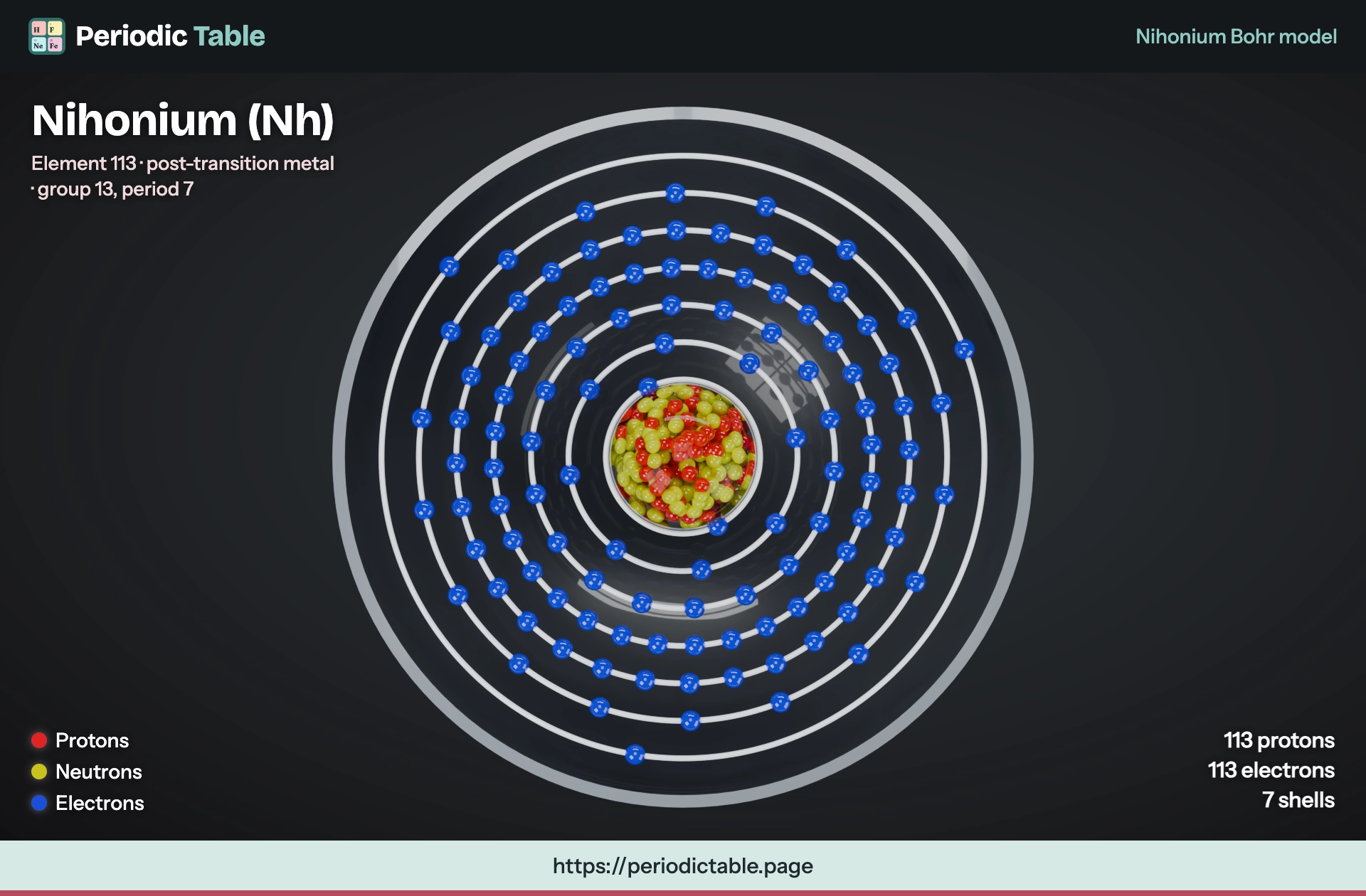
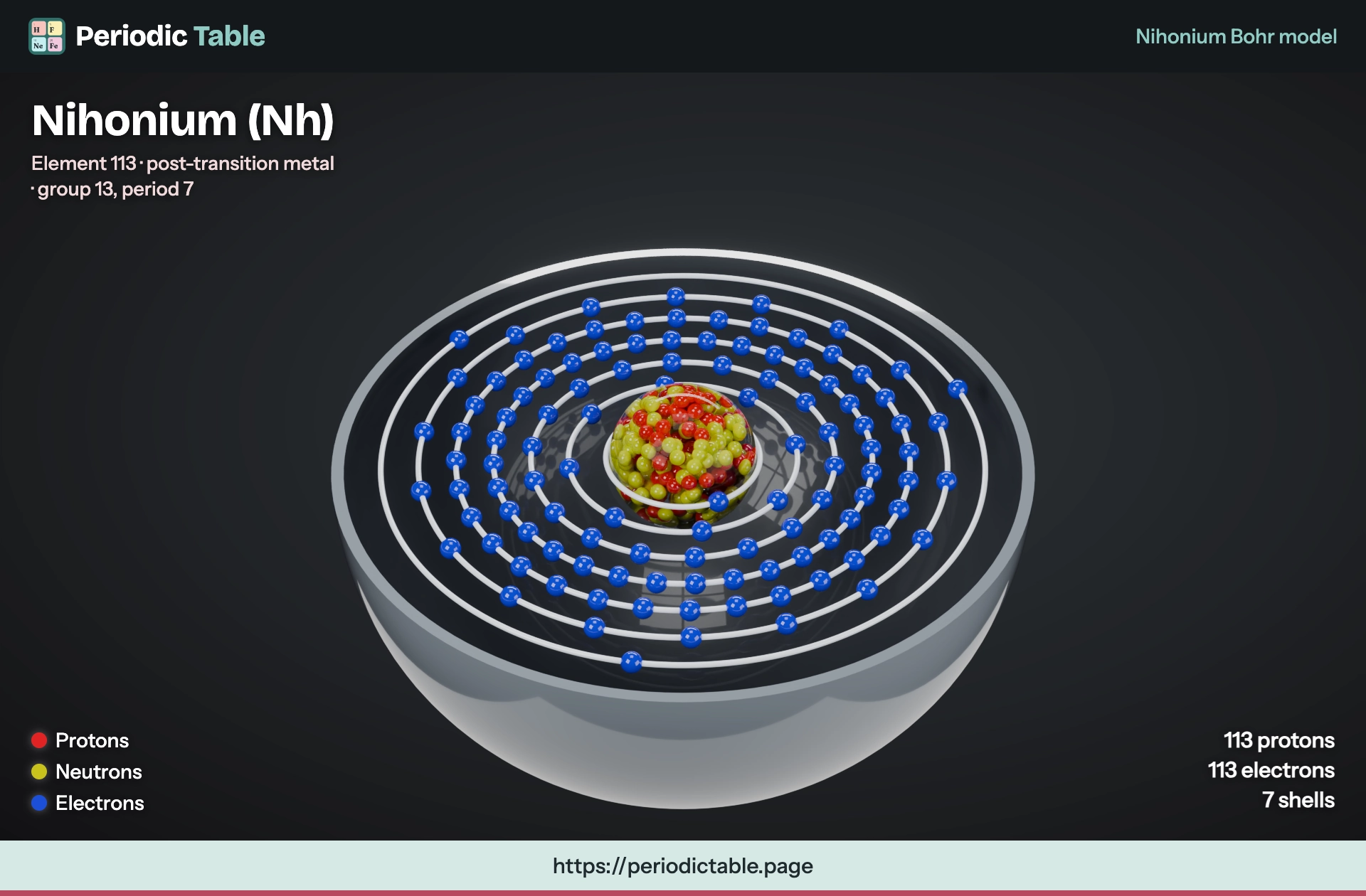
This is a Bohr model of nihonium (Nh), a simplified picture of a single nihonium atom. Its nucleus holds 113 protons, and a neutral nihonium atom has 113 electrons, arranged around it in 7 shells (2 in shell K, 8 in shell L, 18 in shell M, 32 in shell N, 32 in shell O, 18 in shell P and 3 in shell Q).
Nihonium periodic table electron configuration
- Shorthand
- *[Rn] 5f14 6d10 7s2 7p1
- Full
- 1s2 2s2 2p6 3s2 3p6 4s2 3d10 4p6 5s2 4d10 5p6 6s2 4f14 5d10 6p6 7s2 5f14 6d10 7p1
- Electrons per shell
- 2, 8, 18, 32, 32, 18, 3
Nihonium element properties and atomic data
- Atomic number
- 113
- Atomic mass
- [286] u
- Phase at STP
- Unknown
- Melting point
- 426.85°C (700 K)
- Boiling point
- 1156.85°C (1430 K)
- Density
- 16 g/cm³
- Electronegativity (Pauling)
- Unknown
- Period
- 7
- Group
- 13
- Block
- p-block
- Appearance
- Unknown
- Discovery date
- 2004
- Discovered by
- RIKEN
- Named by
- —
What is nihonium? element 113 at a glance
Nihonium carries the symbol Nh and is the 113th entry on the periodic table, which means every one of its atoms holds 113 protons in its nucleus. It is a superheavy element and a transactinide element: it sits past the actinide series, in the stretch of the table where no elements occur in nature and every isotope is radioactive. Nothing about it can be weighed, melted or photographed in bulk, so most entries in a data sheet for Nh are either measured on single atoms or calculated from theory, as with the other superheavy elements around it. Fiber optics fans can see how the internet depends on this metal in erbium compounds, with more on lasers and optics.
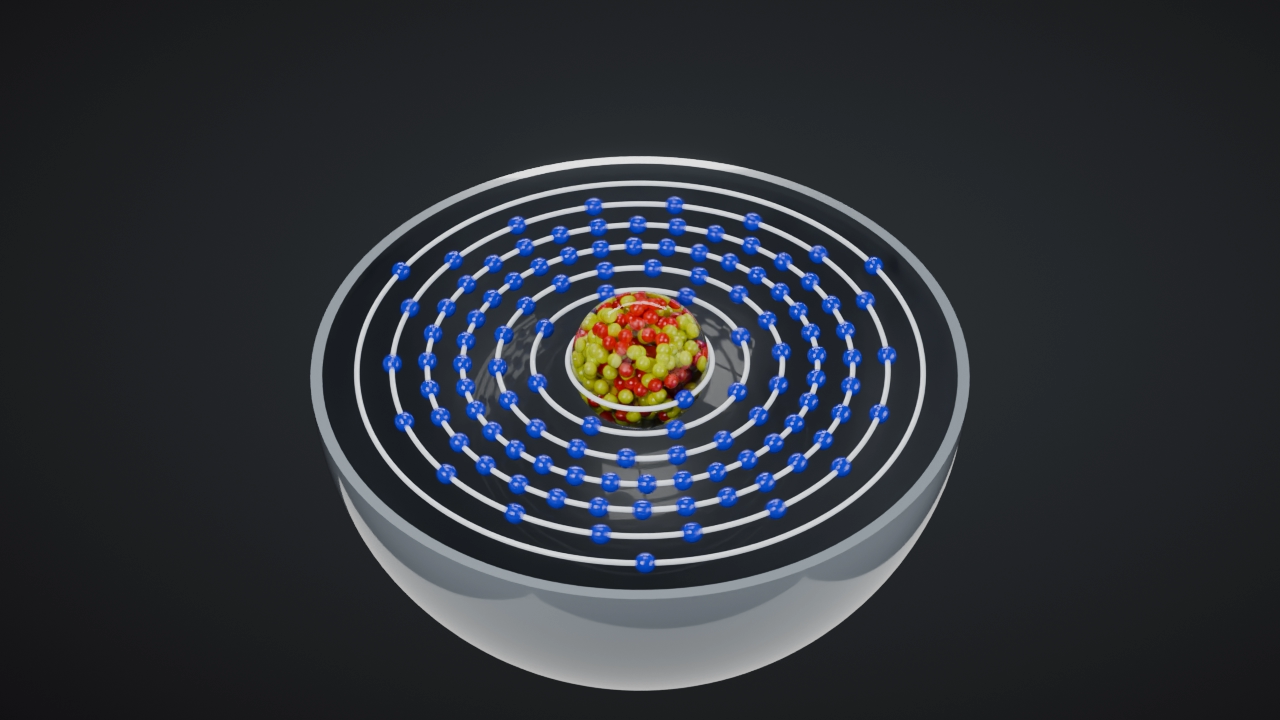
The table below collects the figures most reference sources agree on. Where a value is marked predicted, it comes from relativistic quantum calculations rather than a measurement.
| Property | Value |
|---|---|
| Atomic number | 113 |
| Relative atomic mass | [286] (mass number of the longest-lived isotope) |
| Group / period / block | Group 13 / period 7 / p-block |
| Electron configuration | [Rn] 5f14 6d10 7s2 7p1 (predicted) |
| State at 20 °C | Solid (predicted) |
| Natural occurrence | None; made only in accelerators |
| CAS number | 54084-70-7 |
| Named after | Japan (Nihon) |
Because the bracketed figure is the mass number of the longest-lived isotope found so far, the atomic mass listed for Nh could change if a longer-lived isotope turns up. That is normal for synthetic elements, whose standard masses are placeholders until better data arrives.
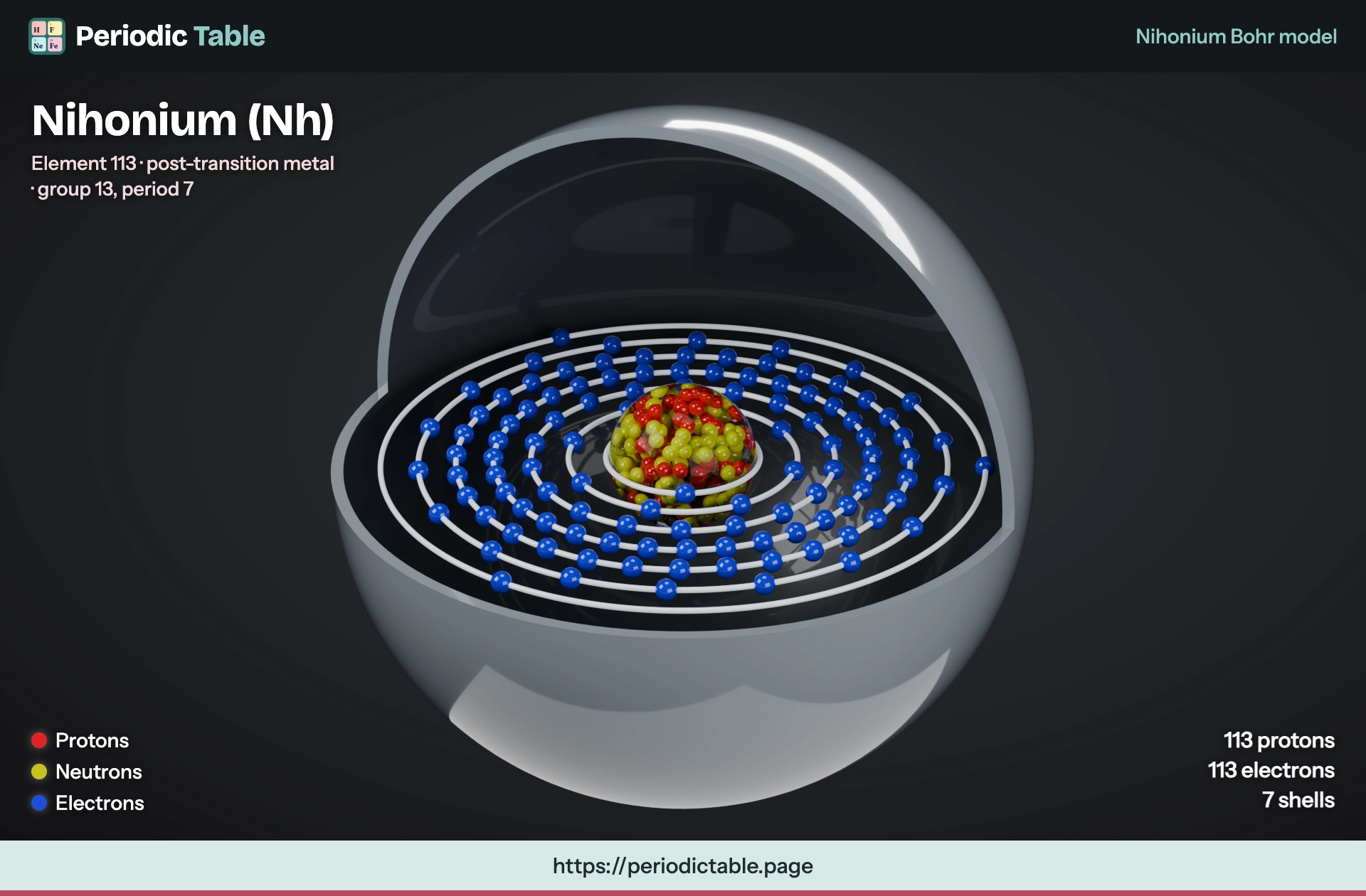
Where it sits: group 13, period 7 and the P-block
It is the heaviest member of the boron group and the first of the 7p elements, squeezed between copernicium (element 112) on its left and flerovium (element 114) on its right. That position matters for its chemistry: both neighbours are expected to behave like nearly inert closed-shell atoms, so Nh is the odd one out in its own row, with a single loosely held p electron. Of all the elements in group 13, it is the only one never seen in a weighable amount.
Making a synthetic element: how nihonium atoms form
Every one of the few dozen nihonium atoms ever observed came from nuclear fusion in a particle beam. As with all superheavy elements, a target of a heavy element is struck with a beam of lighter ions accelerated to roughly a tenth of the speed of light. Most collisions do nothing useful: the two nuclei approach, cling together for about 10−20 seconds and separate again, because electrostatic repulsion between their positive charges tears the merger apart before the short-range strong interaction can bind it. Geology and metallurgy students tracing native nuggets to metals used in industry can follow the platinum atomic weight for the alloys.
On rare occasions the pair does fuse into an excited compound nucleus. That nucleus sheds its excess energy by emitting a few neutrons (or a gamma ray), leaving a slightly cooler superheavy nucleus behind.
How likely this is for a given beam and target is measured as the reaction's cross section, and for Nh it is tiny: on the order of femtobarns, which is why runs last months and yield single atoms. Scientists can spend a year of beam time to see one event.
- The target is a thin foil of the heavier nuclei: bismuth at Riken, americium or neptunium at the JINR.
- The beam supplies the lighter nuclei (zinc ions for the Japanese route, calcium ions for the Russian one), tuned so they hit hard enough to touch but not so hard that the product falls apart.
- A separator pulls the slow fusion products away from the unreacted beam and delivers them to a detector.
To count as a new element in nuclear physics, the product must survive at least 10−14 seconds, long enough to gather electrons around the nucleus. Even the shortest-lived Nh isotope, at about 2 milliseconds, clears that bar by many orders of magnitude.
Cold fusion and hot fusion routes
Two strategies competed in the race to make Nh. The cold fusion route, pioneered by Yuri Oganessian in 1974 and used by the GSI laboratory in Darmstadt to make elements 107 to 112, fires medium-weight ions at lead or bismuth-209 targets. The compound nucleus forms with little excitation energy, but yields fall steeply with each extra proton; its own zinc-on-bismuth attempts at element 113 in 1998 and 2003 found nothing.
The alternative bombards heavy actinide targets such as americium-243 with calcium-48 ions. Calcium-48 is doubly magic (20 protons and 28 neutrons, each a magic number) and unusually neutron-rich, so the fused nuclei start closer to stability. Oganessian's group returned to this older method, and the resulting products have more neutrons and much longer lifetimes than anything the bismuth route can reach.
Alpha decay, spontaneous fission and detecting superheavy elements
Once a new nucleus lodges in the detector, scientists record its position, energy and arrival time, then wait for it to decay. These elements decay mainly in two ways, both driven by proton repulsion:
- Alpha decay ejects a helium-4 nucleus, lowering the atomic number by two. The emitted alpha particles have characteristic energies, and a string of them forms a decay chain that can be traced step by step.
- Spontaneous fission splits the nucleus into two large fragments. It ends the chain and leaves no single identifiable daughter.
The strongest proof of a new element is a chain that runs into daughter nuclides already known from other experiments. A chain that ends in spontaneous fission among unknown nuclei is much harder to pin down, and that single detail shaped the whole dispute over the discovery of nihonium.
The discovery of nihonium: Riken versus the JINR
Two teams on two continents produced the element between 2003 and 2004, and settling who discovered it first took more than a decade. The discovery credit hinged less on dates than on how convincingly each group of scientists proved what it had made, a test that has decided many disputes over new elements.
The JINR and Livermore claims from Dubna
In August 2003 the JINR (Joint Institute for Nuclear Research) in Dubna, Russia, where a team led by Oganessian had already made elements 114 and 116, working with the Lawrence Livermore National Laboratory in California, fused americium with calcium to make element 115. Its alpha decays produced atoms of element 113, which were reported in February 2004; each chain ended in spontaneous fission of a dubnium isotope. Over the next two years the JINR group strengthened the claim with chemistry: they isolated the final product of the chain and showed it behaved like dubnium, a group 5 element.
A 2006 JINR run also produced Nh directly from a neptunium target. The weakness was that none of the nuclei in these chains had ever been seen before, so there was no known anchor.
Riken's three atoms and their decay chain
At Riken near Tokyo, a team led by Kōsuke Morita chose cold fusion, firing zinc-70 at bismuth. The yield was far lower, but the products would decay into known nuclides. The first atom appeared on 23 July 2004, decaying through roentgenium, meitnerium and bohrium.
A second followed in April 2005. The decisive third came in August 2012 after 450 more days of beam time, and it is the atom that clinched the discovery; unlike the first two, which ended in spontaneous fission, its chain ran through six alpha decays into a known mendelevium isotope, tying it firmly to the chart of nuclides. Morita's team kept this experiment running even after the 2011 earthquake forced Riken to shut down other accelerator programmes.
Meanwhile, a 2010 JINR run with a berkelium target made element 117 (tennessine), whose chain passed through element 115 (moscovium) and then 113, adding more isotopes to the record. In August 2015 a Berkeley team confirmed the element 115 chain from the 2003 experiment.
How the joint working party awarded naming rights
New-element claims are judged by the Joint Working Party of IUPAC and IUPAP, the international chemistry and physics unions. Its 2011 report accepted neither team's claim to element 113. Its 2015 report, released by IUPAC in December 2015 and published in full in January 2016, gave priority and naming rights to Riken: the 2012 chain was anchored to known nuclei, while the JINR claims from 2003 onward lacked a cross-bombardment that independently confirmed the atomic number.
The JINR still received credit for the discovery of elements 115, 117 and 118. A May 2016 Lund–GSI study questioned parts of the reasoning but still found Riken's data consistent. For the first time, an Asian team would name an element.
Naming Nh: from ununtrium to nihonium
Before 2016, the element went by several stand-in names. Mendeleev's old convention would have called it eka-thallium, "one below thallium."
From 1979 IUPAC assigned the systematic element name ununtrium (symbol Uut), a Latin-number placeholder meaning "one-one-three." Researchers in the field mostly ignored it and simply wrote E113 or "element 113."
Riken's researchers had floated other options, including japonium and names honouring physicist Yoshio Nishina or the institute itself. In 2016 the team settled on nihonium after about an hour of discussion.
The name comes from Nihon, one of the two ways to say Japan in Japanese, often glossed as "Land of the Rising Sun." The choice carried several meanings:
- It credited Japan, where all three accepted atoms were made, and the public funding behind Riken.
- It aimed to restore trust in science in Japan after the 2011 Fukushima nuclear disaster.
- It quietly honoured Masataka Ogawa, whose 1908 claim to an element he called nipponium (from the other Japanese name for the country) was never accepted. That name and its symbol Np could not be reused, since Np now belongs to neptunium.
Morita proposed the name and the symbol Nh to IUPAC in March 2016. IUPAC and IUPAP published the proposal in June 2016, and after a five-month public comment period it was approved on 28 November 2016. A naming ceremony followed in Tokyo on 14 March 2017, attended by Crown Prince Naruhito.
Nihonium isotopes and half-lives
No isotope of nihonium is stable or found in nature. Eight isotopes of nihonium have been reported, with mass numbers 278, 282 to 287 and 290; the heaviest two are not yet confirmed. Each was made either directly by fusion or as the decay product of a heavier element, and every one of them decays by alpha emission to an isotope of roentgenium.
| Mass number | Half-life | Decay mode |
|---|---|---|
| 278 | 2.0 ms | α |
| 282 | 61 ms | α |
| 283 | 123 ms | α |
| 284 | 0.90 s | α, electron capture |
| 285 | 2.1 s | α, spontaneous fission |
| 286 | 9.5 s | α |
Two branches stand out. Nihonium-284 may also decay by electron capture into copernicium-284, and the 285 isotope shows a small fission branch. All of these isotopes are short-lived and unstable, which is why only a handful of atoms of each have ever been studied.
Nihonium-286, the most stable isotope
Nihonium-286 is both the heaviest confirmed isotope and the most stable isotope known, with a half-life of roughly 10 seconds (measurements range from about 8 to 9.5 seconds). That is long enough for a chemistry experiment, which is why researchers treat it as the most useful nihonium isotope. Its mass number, 286, is also the value quoted in brackets in periodic table listings.
Why half-life grows near the island of stability
Beyond curium, nuclei grow less stable with every added proton, because Coulomb repulsion grows faster than the strong force can compensate. Calculations in the 1960s predicted that closed shells near element 114 and 184 neutrons would push back, creating an island of stability where superheavy elements might last minutes or longer.
Nh shows the trend clearly: from mass 278 to mass 286 the half-lives rise from milliseconds to seconds, and near the neutron shell at N = 184 each extra neutron so far multiplies the lifetime by about 5 to 20. The known isotopes are still too neutron-poor to reach the island itself.
Predicted properties of nihonium as a post-transition metal
Very little about Nh has been measured, because production is slow and expensive and the atoms decay almost at once. The predicted properties below come from relativistic models and from extending trends down the boron group. They point to a dense, soft, rather noble post-transition element, solid at room temperature, much like the heavier elements just before it.
| Predicted property | Nh value | Thallium (measured) |
|---|---|---|
| Melting point | about 430 °C | 304 °C |
| Boiling point | about 1,100 to 1,130 °C | 1,473 °C |
| Density | 16 to 18 g/cm³ | 11.85 g/cm³ |
| Crystal structure | Hexagonal close-packed | Hexagonal close-packed |
| Bulk modulus | 20.8 GPa | 43 GPa |
| Atomic radius | about 170 pm | 170 pm |
The striking entry is the density. Since its atoms are heavier than thallium's but about the same size, nihonium should be roughly half again as dense. It would also be soft, with a bulk modulus about half that of its lighter neighbour.
Relativistic effects and the 7p subshell
Electrons in an atom this heavy move at a large fraction of the speed of light, and the resulting relativistic effects reshape the chemistry. The spin–orbit interaction pulls the 7s electrons inward (the inert pair effect) and divides the 7p level into two parts, one more tightly held than the other, a split chemists call subshell splitting. The single p electron sits in the lower 7p1/2 level.
- The first ionisation energy is predicted at 7.306 eV, the highest among the metallic elements of its group.
- The electron affinity is estimated near 0.68 eV, above the 0.4 eV of the element above it.
- The contracted orbitals keep the atom the same size as thallium instead of larger, as plain periodic trends would suggest.
Physicists also expect the 6d levels to sit close enough in energy to join bonding, which could allow compounds with no lighter analogue. With only three valence electrons and one of them easy to remove, the outer shell explains almost every prediction in the next two sections.
How Nh compares with thallium and its homologues
Nihonium belongs to the family of boron, aluminium, gallium, indium and thallium, and those homologues are the starting point for every prediction about it. Reading down a column of the periodic table is how chemists first guessed the behaviour of most new elements. Its lighter homologue thallium is the closest guide, but the relativistic shifts above mean the match breaks down in important ways.
| Feature | Thallium (Tl) | Nihonium (Nh) |
|---|---|---|
| Preferred charge | +1, with +3 also common | +1, with +3 strongly destabilised |
| Behaviour of the +1 ion | Forms strongly basic TlOH | Closer to silver; forms an amphoteric oxide |
| Reactivity | Reactive | Less reactive, rather noble |
| Negative charge | Weak | Can accept an electron, like astatine |
Going down the group, the lower charge state becomes more favoured: aluminium and gallium prefer +3, indium starts to show +1, and by thallium +1 wins. Nihonium is expected to push that further.
Its +1 ion should resemble silver more than its group partner, and in some respects it behaves like astatine, one p electron short of a filled outer shell. So periodic trends get you the broad picture, while relativity rewrites the details.
Nh chemistry and oxidation states
The chemical properties of nihonium are almost entirely theoretical, but the predictions are consistent across models. The +1 oxidation state should be the most stable, because the inert 7s pair resists taking part in bonding. The standard electrode potential of the Nh+/Nh couple is predicted at +0.6 V, which would make it a fairly noble metal.
The simplest expected nihonium compound is nihonium monohydride, NhH. Relativistic contraction should shorten its bond rather than lengthen it, which is unique among the 7p monohydrides, and the bond should have notable pi character.
A monofluoride, NhF, should also exist. Other predicted behaviours:
- NhCl should dissolve in excess hydrochloric acid or ammonia, unlike TlCl.
- The +1 ion should hydrolyse to the amphoteric oxide Nh2O rather than a strong base.
- In the +3 state, the trifluoride NhF3 and trichloride should be T-shaped rather than flat like their boron counterparts, and unstable toward losing a halogen molecule.
- A −1 state is possible: nihonium should be the most electronegative of the metallic group 13 elements, gaining an electron as the halogens do to reach a closed shell configuration.
- Higher oxidation states of +3 and +5 have been suggested, but these compounds are expected to fall apart easily.
One practical prediction matters for experiments: nihonium hydroxide, NhOH, should be more volatile than the element itself, so trace water in a gas stream can change what actually reaches a detector.
Experimental chemistry on elemental nihonium
Only isotopes 284, 285 and 286 live long enough for chemical tests. Between 2010 and 2012, JINR experiments on the 284 isotope sent the atoms through Teflon (PTFE) tubes at 70 °C in a carrier gas toward detectors coated with gold.
Ten to twenty atoms were produced, yet none arrived. The likeliest reading was low volatility: the atoms stuck along the way instead of drifting through.
A 2017 JINR run removed the quartz surfaces and still saw no atoms after separation, pointing to unexpectedly strong retention on Teflon. That suggested the earlier species may have been the hydroxide rather than elemental nihonium, and that high-temperature methods would be needed.
In 2024 scientists at GSI measured how strongly the atoms bind to silica and to gold surfaces. The adsorption enthalpy on silica came out at about 58 kJ/mol, showing the element is less reactive than its lighter congener thallium but more reactive than its closed-shell neighbours, elements 112 and 114, as the relativistic models predicted.
Uses of nihonium and safety
There are no practical uses of nihonium outside scientific research. With only a few atoms ever made, each lasting seconds, it cannot be stored, sold or built into anything. Its value lies in what it teaches:
- How nuclear shell structure keeps superheavy nuclei alive longer than simple models predict.
- How relativity changes chemistry at the bottom of the table, alongside the other new elements up to oganesson.
- Better accelerator, separator and single-atom detection methods that carry over to other isotope work and to the next discovery beyond oganesson.
As for safety, nihonium would be toxic mainly through its radioactivity, but no one outside a heavily shielded accelerator facility will ever encounter it. Its atoms decay before they could reach the environment.