


Erbium element (Er): erbium periodic table facts
Erbium periodic table facts: erbium (Er) is element 68, a lanthanide in period 6 of the f-block. If you have ever streamed a video over a long-haul internet link, you have relied on erbium without knowing it. Nuclear waste, proliferation and safety are weighed in the plutonium density page, along with MOX fuel and spent fuel handling.
This silvery-white rare earth metal was first teased out of minerals from Ytterby, Sweden, and today it sits in the bottom rows of the periodic table as a quiet workhorse. It is never found free in nature, yet this chemical element powers fiber-optic amplifiers, skin-resurfacing tools and rosy glass, and this guide walks you through its data, reactions, isotopes, uses, discovery and safety.
Rotate the 3D Bohr model of erbium
Drag to orbit, scroll to zoom.
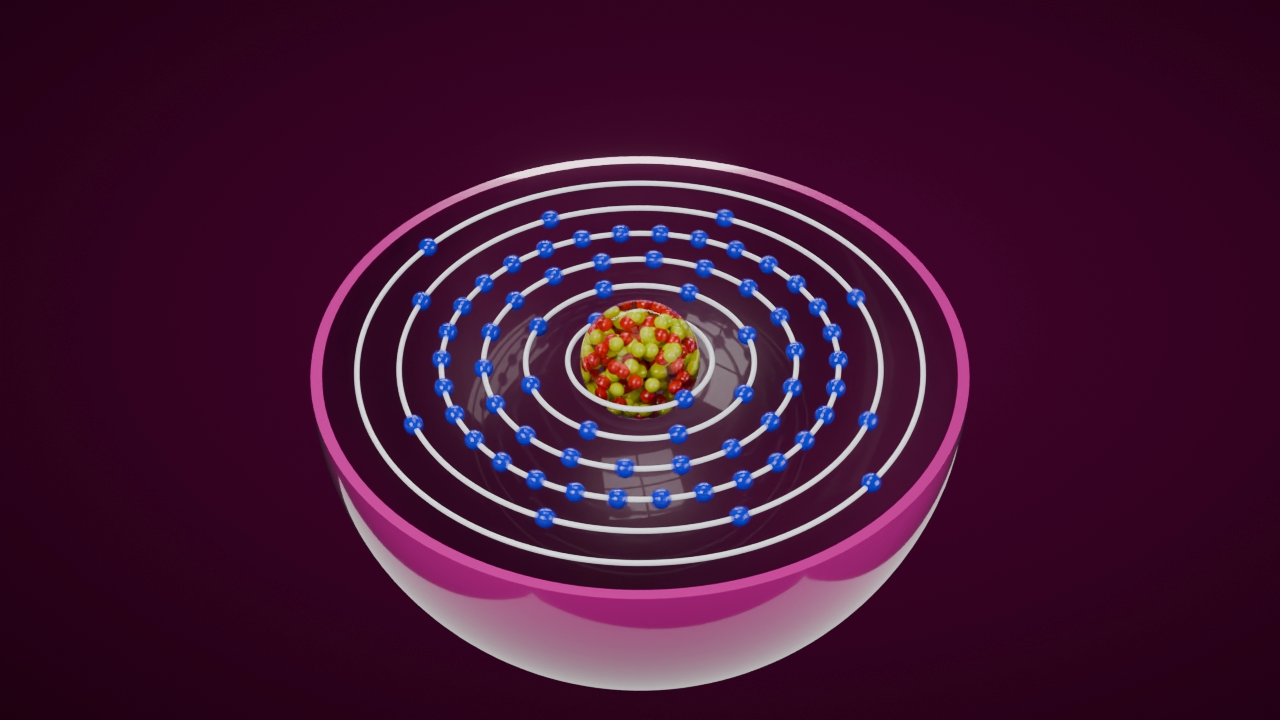
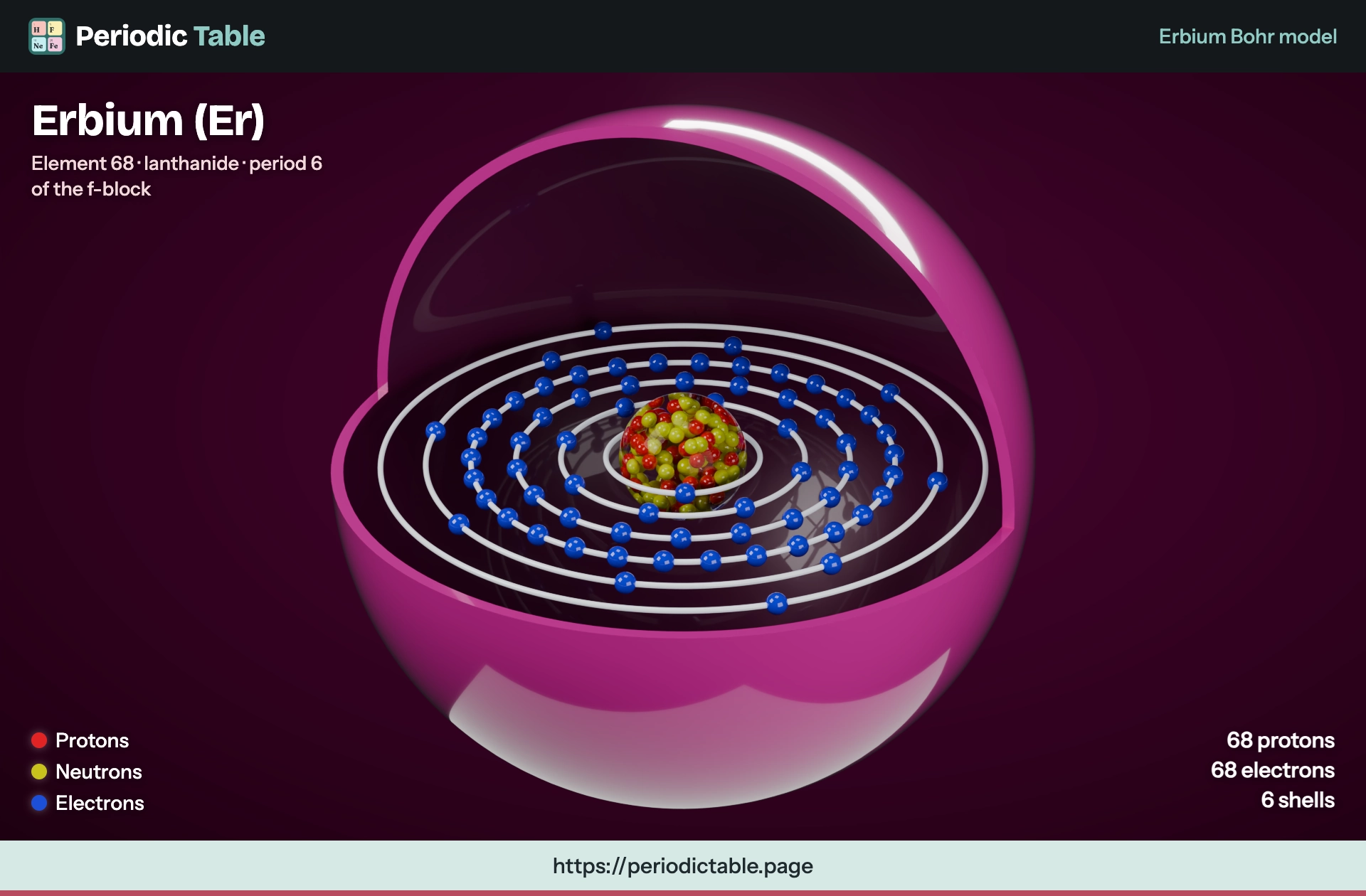
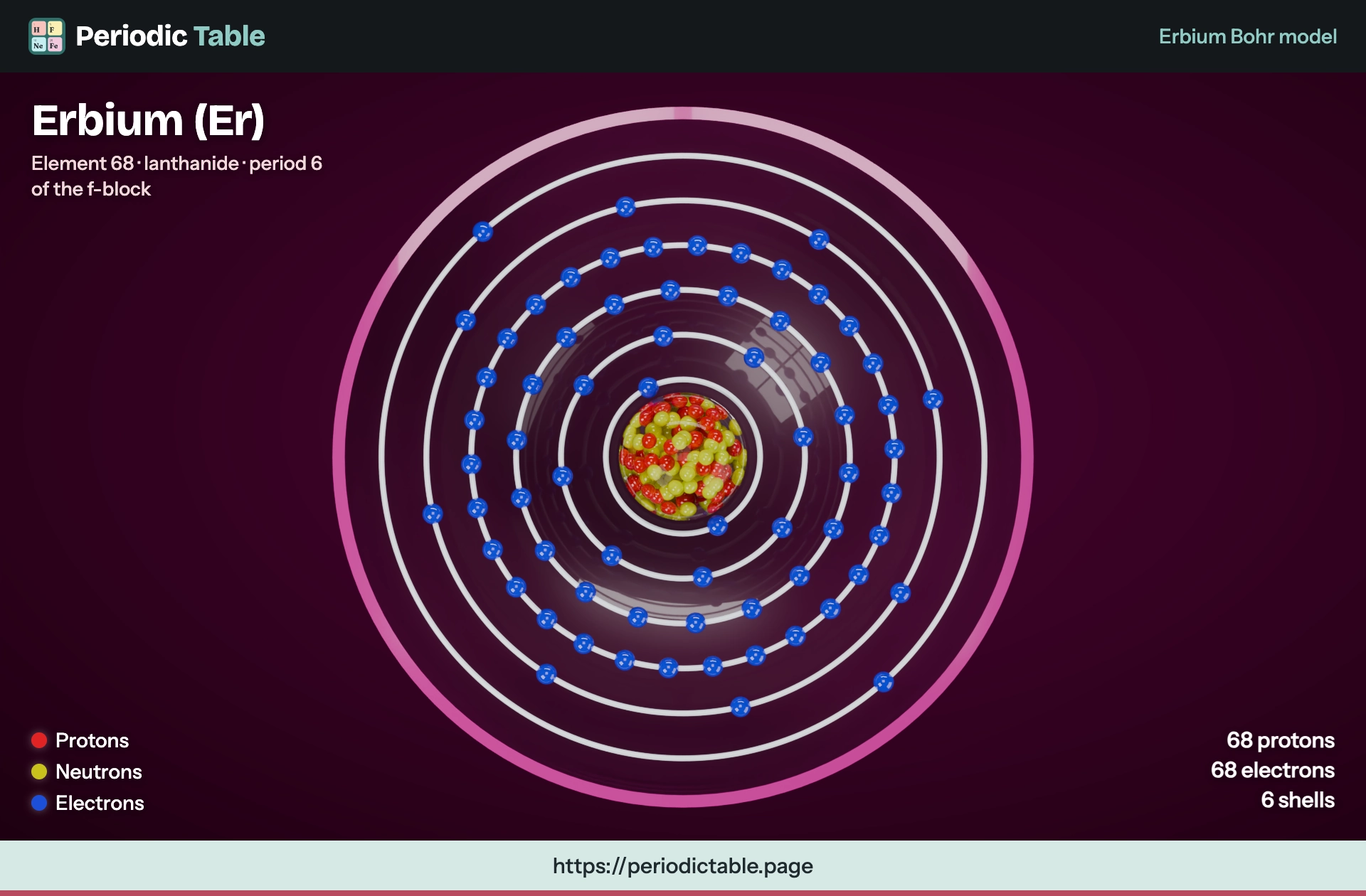
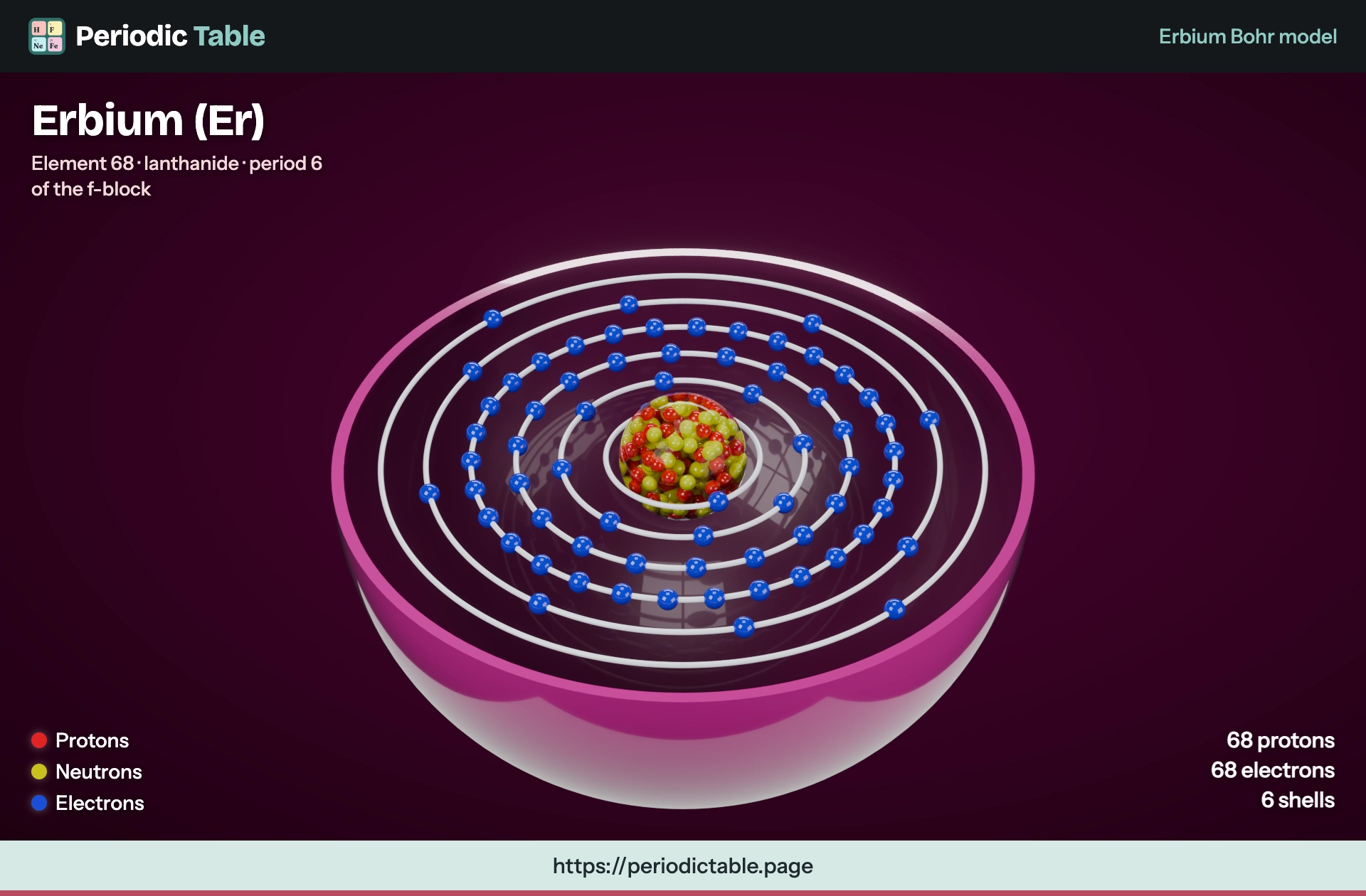
This is a Bohr model of erbium (Er), a simplified picture of a single erbium atom. Its nucleus holds 68 protons, and a neutral erbium atom has 68 electrons, arranged around it in 6 shells (2 in shell K, 8 in shell L, 18 in shell M, 30 in shell N, 8 in shell O and 2 in shell P).
Erbium periodic table electron configuration
- Shorthand
- [Xe] 4f12 6s2
- Full
- 1s2 2s2 2p6 3s2 3p6 4s2 3d10 4p6 5s2 4d10 5p6 6s2 4f12
- Electrons per shell
- 2, 8, 18, 30, 8, 2
Erbium element properties and atomic data
- Atomic number
- 68
- Atomic mass
- 167.2593 u
- Phase at STP
- Solid
- Melting point
- 1528.85°C (1802 K)
- Boiling point
- 2867.85°C (3141 K)
- Density
- 9.066 g/cm³
- Electronegativity (Pauling)
- 1.24
- Period
- 6
- Group
- —
- Block
- f-block
- Appearance
- Silvery white
- Discovery date
- 1843
- Discovered by
- Carl Gustaf Mosander
- Named by
- —
Erbium element facts: atomic number, atomic mass and melting point
The erbium element carries the symbol Er and sits at atomic number 68, between holmium (67) and thulium (69). It belongs to the lanthanides, the f-block series that fills the 4f subshell across period 6. Its standard atomic weight is 167.259 ± 0.003, which is why reference tables round it to 167.26. After a hydrogen bomb test, fallout, a silvery radioactive metal and tiny samples are covered on the einsteinium periodic table page for readers.
| Property | Value for Er |
|---|---|
| Proton count (Z) | 68 |
| Atomic mass | 167.259 u |
| Classification | Lanthanide, f-block, period 6 |
| Electron configuration | [Xe] 4f12 6s2 |
| Melting point | 1529 °C (1802 K) |
| Boiling point | 2868 °C (3141 K) |
| Density at 20 °C | 9.07 g/cm3 |
| Crystal structure | Hexagonal close-packed (hcp) |
| Appearance | Silvery white, soft solid |
| CAS number | 7440-52-0 |
The electron configuration explains most of what follows: twelve 4f electrons are buried beneath the 5s and 5p shells, so they barely feel the atom's surroundings. That shielding keeps the element's colour and glow remarkably consistent from one compound to the next.
Physical properties of erbium metal
Freshly cut erbium metal is bright, malleable and fairly soft, so it can be rolled or shaped without cracking. Like every rare-earth element, it looks much like its neighbours, and its measured physical properties shift noticeably with impurity content, so purity grade always matters when you compare published figures. To see how cold fusion of zinc and bismuth produced atoms in 2004, read element 113 for the experiment details.
Mechanical and thermal data
The figures below describe the polycrystalline solid at room temperature. They place Er among the stiffer lanthanides, though far below structural metals such as steel.
| Quantity | Value |
|---|---|
| Young's modulus | 69.9 GPa |
| Shear modulus | 28.3 GPa |
| Bulk modulus | 44.4 GPa |
| Specific heat capacity | 168 J/(kg·K) |
| Thermal conductivity | 14.5 W/(m·K) |
Magnetic ordering at low temperatures
Cool the solid and its magnetism changes character twice. Above 80 K it is paramagnetic; between 19 K and 80 K it turns antiferromagnetic; below 19 K it becomes ferromagnetic. Researchers have even trapped tiny Er3N clusters inside a fullerene cage to study these atoms in isolation.
Chemical properties and oxidation states of Er
The element is trivalent in almost all of its chemistry, so +3 is the oxidation state you will meet in labs and industry. Unusual complexes in the 0, +1 and +2 oxidation states exist, but they need carefully protected conditions. It is also fairly electropositive, which drives the reactions below.
Reactions with air, water and acids
In dry air the surface keeps its lustre thanks to a thin protective film, but in moist air it will slowly tarnish. Heated in oxygen, it burns to the sesquioxide:
$$4\,\mathrm{Er} + 3\,\mathrm{O_2} \rightarrow 2\,\mathrm{Er_2O_3}$$
It reacts sluggishly with cold water and much faster with hot water, releasing hydrogen and forming erbium hydroxide:
$$2\,\mathrm{Er} + 6\,\mathrm{H_2O} \rightarrow 2\,\mathrm{Er(OH)_3} + 3\,\mathrm{H_2}$$
It combines with all four common halogens to give trihalides such as \(\mathrm{ErCl_3}\), and dilute sulfuric acid dissolves it into a rose-red solution of hydrated Er3+ ions.
Electronegativity and ionization energies
Its low electronegativity fits the reactive picture above. The atomic data below are the values most references quote.
- Pauling scale value: 1.24
- First three ionization energies: 589.3, 1150 and 2194 kJ/mol
- Atomic radius (empirical): 176 pm
- Covalent radius: 189 ± 6 pm
Erbium isotopes and natural abundance
Natural erbium is a blend of six stable isotopes. The heaviest share belongs to erbium-166, about one third of every atom you hold, followed by mass 168 at roughly 27%.
| Isotope | Natural abundance (%) |
|---|---|
| Erbium-162 | 0.139 |
| Erbium-164 | 1.601 |
| Erbium-166 | 33.503 |
| Erbium-167 | 22.869 |
| Erbium-168 | 26.978 |
| Erbium-170 | 14.910 |
About thirty radioactive forms have been made in the lab. The longest-lived of these radioisotopes is 169Er, with a half-life of 9.39 days; most others vanish within hours or minutes.
Lighter ones decay mainly by electron capture into holmium, heavier ones by beta decay into thulium. 165Er has drawn interest for Auger therapy because it emits no gamma rays.
Optical properties of Er ions
The optical properties are what make element 68 valuable. Its trivalent ion shows sharp absorption bands across the visible, ultraviolet and near infrared, and those narrow lines give its salts their delicate pink color. Crystals of the chloride glow more intensely under fluorescent tubes, because the lamp's phosphor emits light at the very wavelength the ion absorbs.
Robert Bunsen's nineteenth-century flame spectra first mapped these lines. What his prism could not show was the region just beyond red light, and it is that line near 1.5 µm, invisible to him, that turned erbium from a laboratory curiosity into a telecom staple.
Uses and applications of the rare earth metal
Most erbium demand comes from optics, healthcare and specialist materials. Here are the main applications, grouped by industry.
Erbium-doped fiber amplifiers in optical communications
Silica fibers lose the least light near 1550 nm, and Er3+ happens to amplify exactly there. In erbium-doped fiber amplifiers (EDFAs), a pump diode at 980 or 1480 nm excites the dopant ions, which then release their energy by stimulated emission at the frequency of the weak incoming signal. The result is an all-optical amplifier that boosts every channel at once, with no conversion back to electronics.
- Long optical fibers in undersea and terrestrial links use an EDFA every 50 to 100 km.
- Co-doping with aluminium or phosphorus stops the dopant ions from clustering.
- The same fiber, placed inside a cavity, makes efficient fiber lasers.
That is why fiber optics and optical communications are the single largest market for the element.
Lasers in medicine and dentistry
The Er:YAG laser emits at 2940 nm, light that the moisture in tissue absorbs extremely strongly. The energy stays in a shallow surface layer, so an erbium laser can resurface skin in dermatology, vaporise decayed enamel in dentistry and support precise laser surgery with little heat damage to surrounding tissue. Medical erbium lasers are now routine in clinics.
Nuclear, alloy and glass uses
Beyond light, element 68 does several quieter jobs:
- Nuclear technology: it is a useful neutron absorber in control rods and serves as a burnable poison in fuel design.
- Alloy work: added to vanadium, it lowers hardness and improves workability.
- Cryogenics: the Er3Ni nickel compound has an unusually high specific heat capacity near liquid-helium temperatures, which suits cryocoolers.
- Colour: as a colorant it tints porcelain, cubic zirconia, inexpensive jewelry and sunglasses.
Erbium compounds
Its chemistry is dominated by the +3 ion, so erbium salts share the same rosy tint regardless of partner atom.
Oxides and halides
The sesquioxide and the trihalides are the compounds you are most likely to meet in a lab or a supplier's catalogue.
Erbium oxide (erbia)
Er2O3 is the only known oxide. It has a cubic bixbyite-type structure, is insoluble in aqueous media and dissolves slowly in hot mineral acids. You form it by burning the element or by heating its oxalate, and it activates phosphors and tints infrared-absorbing glass.
Erbium fluoride
ErF3 is a pinkish powder used in IR-transmitting windows and up-converting materials, and it is the intermediate that calcium reduces to the pure element.
Erbium chloride
The violet trichloride is made through an ammonium salt route, (NH4)2ErCl5, which is then heated under vacuum to leave monoclinic crystals.
Erbium bromide and iodide
The bromide is a violet solid used in crystal growth and chemical analysis, while the iodide is a faintly rose compound that you can prepare by reacting the element directly with iodine.
Erbium tetraboride
ErB4 is hard and high-melting, which suits it to semiconductors and even rocket engine nozzles.
Organometallic compounds
Like other lanthanides, Er cannot undergo π backbonding, so its organometallic chemistry is limited to largely ionic cyclopentadienides and σ-bonded alkyls and aryls.
History of this lanthanide: from Ytterby gadolinite to isolation
The story begins in a feldspar quarry, and its discovery is one of science's great mix-ups. In 1843, Swedish chemist Carl Gustaf Mosander was purifying yttria from gadolinite and found it held two further earths. He named them erbia and terbia after the same village that also inspired the names of yttrium and ytterbium.
Mosander's names did not stay put. Around 1860 the Swiss spectroscopist Marc Delafontaine swapped the two labels, and by 1877 they had flipped again, a mix-up that confused chemists for decades. The same mineral eventually yielded ytterbium, scandium and gadolinium as well as terbium and yttrium, plus two more neighbours of element 68, while the original name settled for good on the pale pink earth we now write as Er2O3.
- 1843: Mosander identifies the new earth in gadolinite.
- 1905: Georges Urbain and Charles James independently isolate fairly pure oxide.
- 1934: Wilhelm Klemm and Heinrich Bommer reduce the anhydrous chloride with potassium vapor to obtain reasonably pure metallic Er.
Where Er comes from: ores and supply risk
You will never find the element uncombined. It occurs alongside other rare earths in monazite and bastnäsite ores, while the main commercial ore minerals are xenotime and euxenite.
The richest source today is the ion adsorption clays of southern China, where yttrium makes up about two-thirds of the concentrate and erbia around 4 to 5%. Average crustal content is roughly 2.8 mg/kg.
Supply is concentrated: China produces most of the world's output, with Russia and Malaysia far behind, and the Royal Society of Chemistry rates its supply risk at 9.5 out of 10. That makes it one of the rare earth elements that optical-network builders watch most closely.
How the rare-Earth element is separated and produced
Getting element 68 out of rock takes several chemical steps, because it always travels with its chemical twins. Crushed ore is digested in hydrochloric or sulfuric acid, partially neutralised to pH 3 to 4 to strip out thorium, then treated with ammonium oxalate. The oxalates are roasted to oxides, and cerium is removed because its oxide resists nitric acid.
The Er fraction is then pulled apart from neighbouring rare earths by ion exchange on resin columns, the ion-exchange method that slashed separation costs in the late 20th century. Finally, the purified Er fluoride or oxide is reduced with calcium at about 1450 °C under argon.
Erbium safety, toxicity and biological role
Erbium has no known biological role, although its salts may stimulate metabolism. You take in around 1 mg a year from food, and it collects mainly in bones, with smaller amounts in the kidneys and liver.
The bulk solid is only slightly toxic if swallowed, and most of its salts are of low toxicity. Fine metallic dust is the real hazard: it is a fire and explosion hazard, so handle powders under inert gas.