


Einsteinium element (Es): einsteinium periodic table facts
Einsteinium periodic table facts: einsteinium (Es) is element 99, an actinide in period 7 of the f-block. You will not find a jar of einsteinium on any shelf: the total amount ever isolated would barely be visible, and most of it decayed away within weeks. To learn how Seaborg, McMillan, Kennedy and Wahl made the first sample at Berkeley in 1940, see uses of plutonium for the full history of its discovery.
Einsteinium (Es) is a synthetic, radioactive chemical element with atomic number 99, the seventh transuranium element and a member of the actinide series. It was first spotted in 1952 in debris from a hydrogen bomb test, and today it is made a few milligrams at a time to answer some of the hardest questions in nuclear science.
Rotate the 3D Bohr model of einsteinium
Drag to orbit, scroll to zoom.
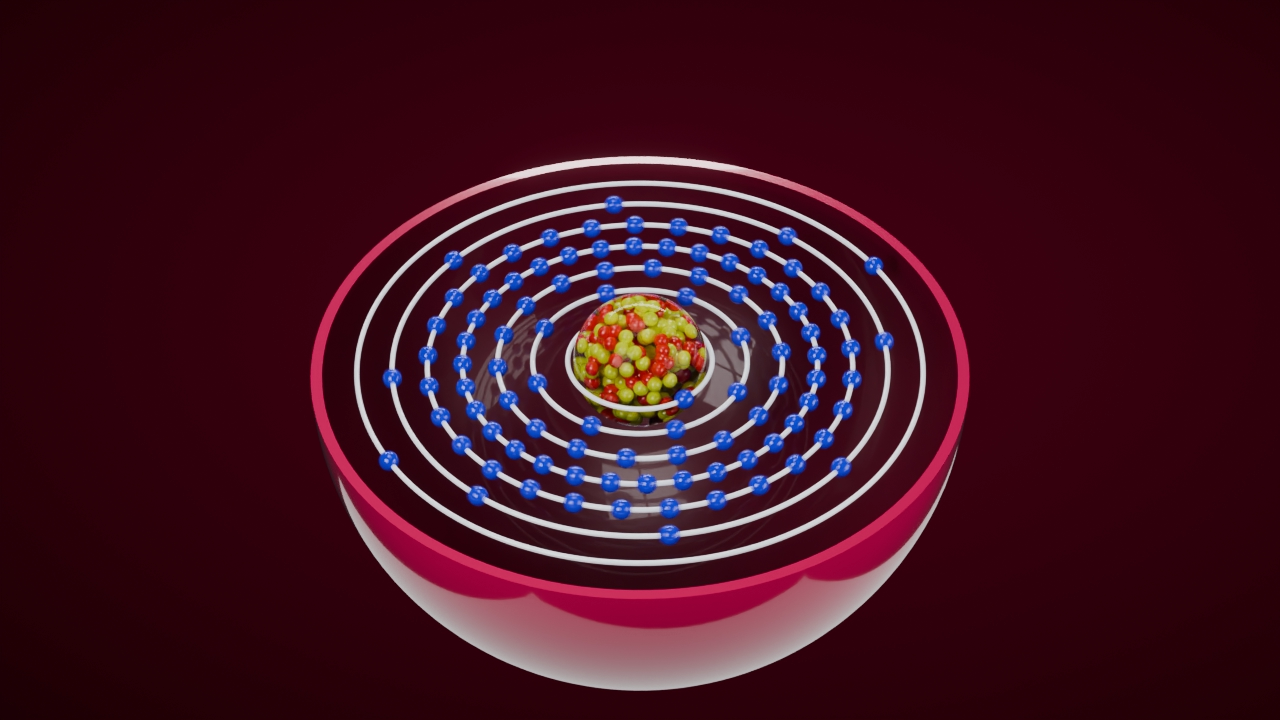
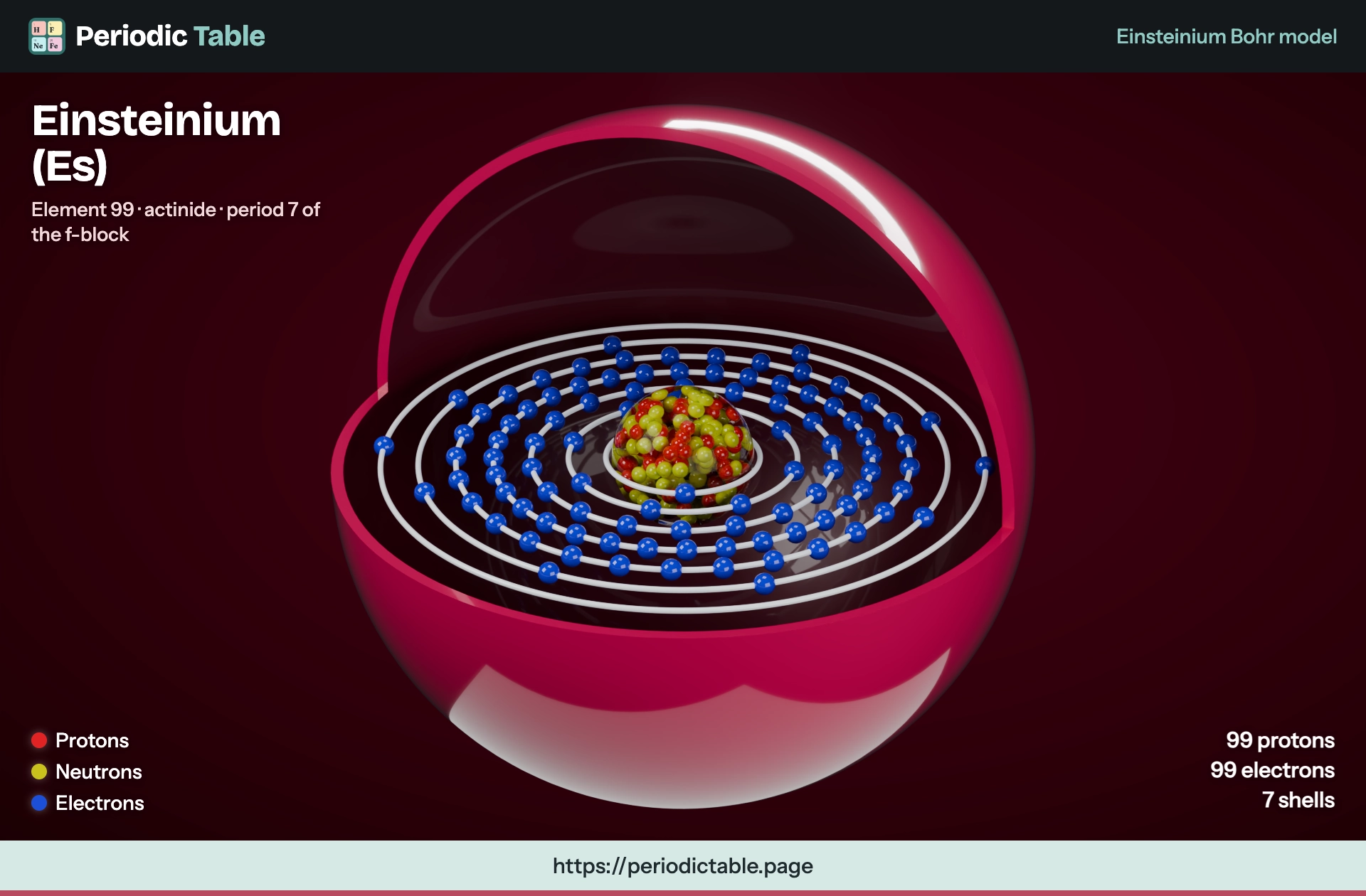
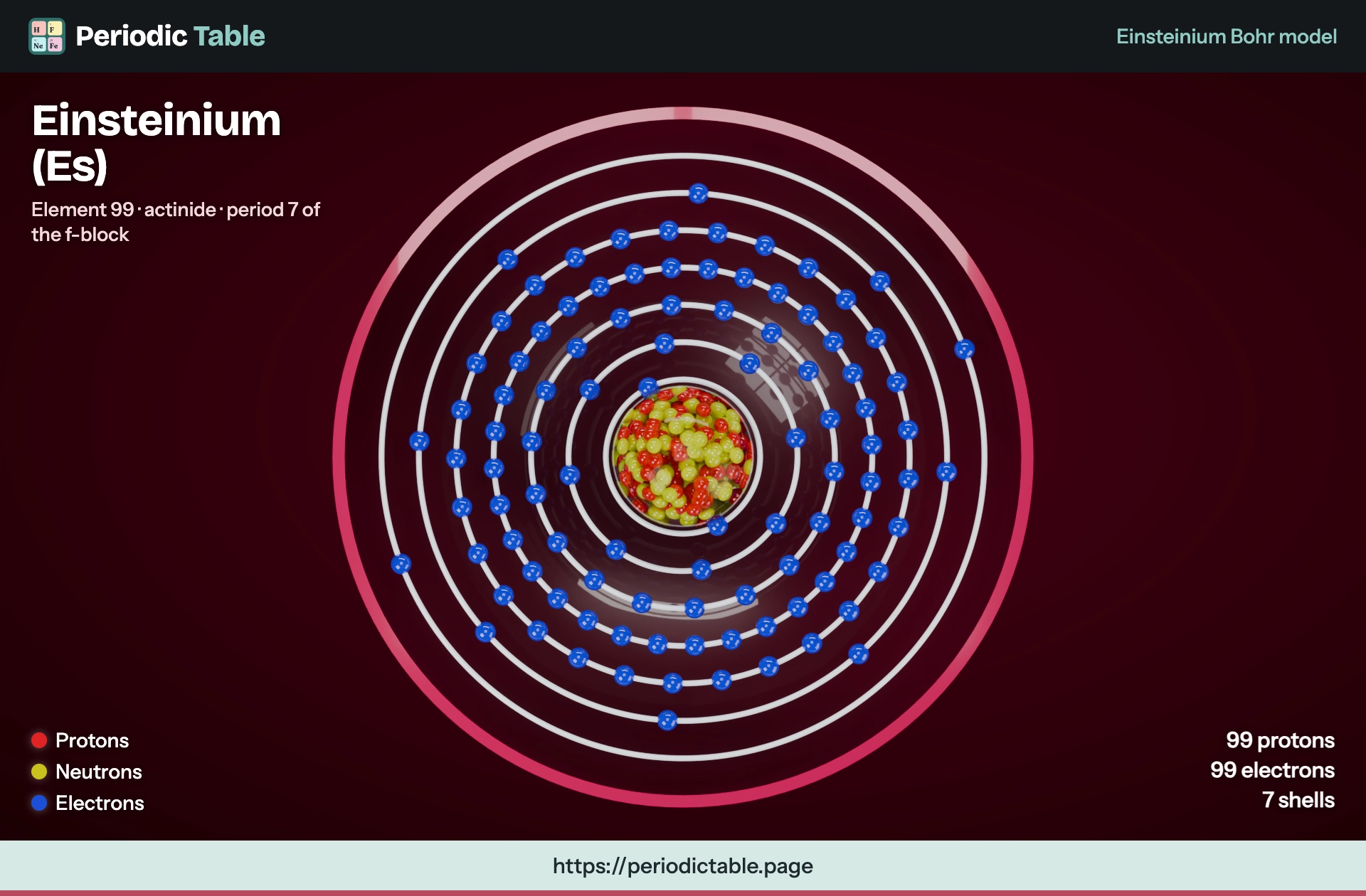
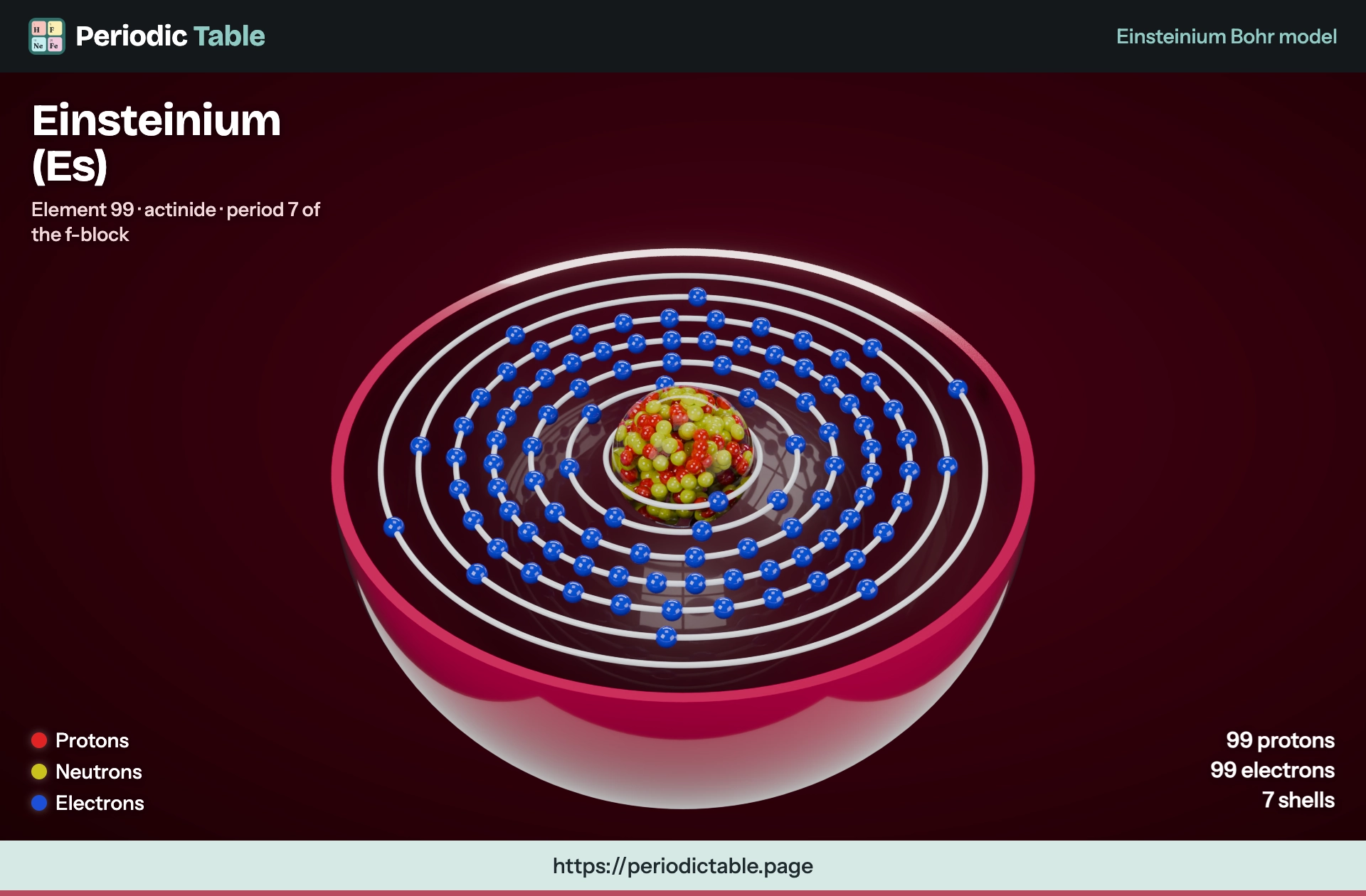
This is a Bohr model of einsteinium (Es), a simplified picture of a single einsteinium atom. Its nucleus holds 99 protons, and a neutral einsteinium atom has 99 electrons, arranged around it in 7 shells (2 in shell K, 8 in shell L, 18 in shell M, 32 in shell N, 29 in shell O, 8 in shell P and 2 in shell Q).
Einsteinium periodic table electron configuration
- Shorthand
- [Rn] 5f11 7s2
- Full
- 1s2 2s2 2p6 3s2 3p6 4s2 3d10 4p6 5s2 4d10 5p6 6s2 4f14 5d10 6p6 7s2 5f11
- Electrons per shell
- 2, 8, 18, 32, 29, 8, 2
Einsteinium element properties and atomic data
- Atomic number
- 99
- Atomic mass
- [252] u
- Phase at STP
- Solid
- Melting point
- 859.85°C (1133 K)
- Boiling point
- 995.85°C (1269 K)
- Density
- 8.84 g/cm³
- Electronegativity (Pauling)
- 1.3
- Period
- 7
- Group
- —
- Block
- f-block
- Appearance
- Silver-colored
- Discovery date
- 1952
- Discovered by
- Lawrence Berkeley National Laboratory
- Named by
- —
Einsteinium (Es) key facts: atomic number and atomic mass
Before getting into the story and the chemistry, here are the core periodic table numbers for Es. Several of them carry the word "estimated" or "unknown," because almost every measurement on this element has been made on microscopic samples that were busy destroying themselves while scientists studied them. To keep electric motors working at high temperature, the dysprosium metal outlines how adding it to permanent magnets helps.
| Property | Value |
|---|---|
| Symbol | Es |
| Atomic number | 99 (99 protons) |
| Atomic mass | [252] (mass number of the longest-lived isotope) |
| Group / block / period | Actinides, f-block, period 7 |
| Electron configuration | [Rn] 5f11 7s2 |
| Appearance | Soft silvery metal that glows in the dark |
| Melting point | 860 °C (1133 K) |
| Boiling point | about 996 °C (1269 K), estimated |
| Density | 8.84 g/cm3 |
| Electronegativity | 1.3 on the Pauling scale |
| Covalent radius | 165 pm |
| Common oxidation state | +3 (also +2) |
| CAS number | 7429-92-7 |
| Discovered | 1952, Albert Ghiorso and co-workers |
The atomic mass is written in square brackets because Es has no stable form. Instead of an average of natural isotopes, the bracketed figure is simply the mass of its longest-lived nucleus, Es-252.
Discovery of einsteinium in the Ivy Mike fallout
The discovery of this element is tied to the first full-scale thermonuclear explosion. On 1 November 1952 the United States detonated Ivy Mike, a thermonuclear device of about 10 megatons, on Enewetak Atoll in the South Pacific. The test was a direct descendant of work begun under the Manhattan Project, and nobody involved expected a new element to come out of it. Fiber optics fans can see how the internet depends on this metal in erbium (Er), with more on lasers and optics.
Aircraft flew through the mushroom cloud carrying filter paper to collect debris. When that fallout reached the lab, chemists found plutonium-244, a nucleus that could only form if a uranium-238 nucleus had swallowed six neutrons in a row. That hinted at something stranger: in the extreme neutron flux of the blast, some uranium nuclei had undergone rapid neutron capture fifteen times, followed by a chain of beta decay steps that raised their atomic number all the way to 99.
A team led by Albert Ghiorso at the University of California, Berkeley (the group that later became Lawrence Berkeley National Laboratory), working with Argonne and Los Alamos, chemically separated the debris and detected a characteristic 6.6 MeV alpha signal from Es-253. Larger samples later came from tons of coral scraped off the atoll, yet fewer than 200 atoms of the new element were recovered from the first analysis.
Because the test itself was classified during the Cold War, the find stayed secret. The Berkeley group then produced elements 99 and 100 independently in reactors and cyclotrons, and once that work and the bomb results were declassified, the discovery was announced in 1955. It was a rare case of a nuclear test doubling as a chemistry experiment.
How Albert Einstein lent element 99 his name
Inside the weapons project the new element was jokingly called "pandemonium," a nod to Project PANDA, the codename for the bomb's design effort. The official proposal named the two new elements after Albert Einstein and Enrico Fermi, giving element 100 the name fermium. Both physicists died before the names were made public at the 1955 Geneva conference on peaceful uses of atomic energy.
The first symbol was "E"; IUPAC later changed it to "Es." The choice fits better than it first looks: Einstein's work on Brownian motion and quantum physics helped prove atoms were real.
Einsteinium in the actinide series of the periodic table
On the periodic table, einsteinium sits in the second floating row at the bottom, the actinide series, between californium (98) and fermium (100). That row holds the actinides from actinium to lawrencium, and every member past uranium (92) is a transuranium element. Einsteinium is the seventh of those transuranic elements and the heaviest one ever seen as a visible, weighable lump of pure material.
Directly above it, in the lanthanide row, is holmium. The two share a surprising number of traits: einsteinium's density is almost the same as holmium's, even though each einsteinium atom is far heavier, and both favour a +3 charge in solution. That parallel is one of the most useful tools chemists have for predicting how heavy elements behave when samples are too small to test directly.
Einsteinium electron configuration and valence electrons
Einsteinium's ground state is [Rn] 5f11 7s2: eleven electrons in the 5f subshell on top of the radon core, plus two in the 7s orbital. Those 7s electrons and the outer 5f electrons are the valence electrons that set its chemistry. Its first two ionization energies are about 619 and 1158 kJ/mol, and its electron affinity has never been measured reliably, which is typical for an element available only in micrograms.
Physical properties of einsteinium
The physical properties of einsteinium describe a soft, silvery, metallic solid with a low melting point of 860 °C, below its neighbours californium (900 °C) and fermium (1,527 °C). Its bulk modulus is only about 15 GPa, one of the lowest among non-alkali elements, so it is unusually easy to compress.
It is also volatile for such a heavy element, and that volatility shows up in its high vapor pressure. Many standard figures, such as specific heat and electrical conductivity, have never been measured at all.
Magnetic studies on the pure element, its oxide and its fluoride found paramagnetic, Curie-Weiss behaviour from liquid-helium temperatures to room temperature, with some of the highest magnetic moments of any actinide. Most other properties of einsteinium are reported with wide error bars, because samples are tiny and constantly changing.
Why einsteinium metal glows
A sample of einsteinium metal gives off a visible glow. The radioactivity of einsteinium-253 releases roughly 1,000 watts of energy per gram, enough heat to make a tiny speck light up blue in a dark room.
That same output is why a crystal of it never stays a clean crystal for long. The element glows because it is cooking its own structure from the inside.
Crystal structure and self-radiation damage
Einsteinium is thought to adopt a face-centered cubic crystal structure, unlike the double hexagonal packing of lighter actinides such as americium. Its self-radiation is so intense that it shatters the crystal lattice faster than researchers can measure it, which may explain the low density and melting point. Most measurements are therefore taken straight after heating the sample to anneal out the damage.
Einsteinium chemical properties and its +3 oxidation state
Like the other actinides, einsteinium is reactive: it tarnishes in air and is attacked by oxygen, steam and acids. Its main chemical properties centre on the trivalent ion. The +3 oxidation state is the most stable in solids and in water, where Es ions give the solution a pale pink colour.
What makes einsteinium chemistry distinctive is how easily it reaches the +2 oxidation state. That divalent form is firmly established in solid compounds, and it can be produced by reducing einsteinium(III) with samarium(II) chloride. Many of the lighter actinides, including uranium, neptunium and plutonium, show no stable +2 state at all.
A +4 state has been suggested but not confirmed. The trend toward a stable divalent ion grows as you move along the actinides toward nobelium, and einsteinium is where it first becomes obvious.
Isotopes of einsteinium by half-life
All 18 known isotopes of einsteinium are radioactive, with mass number values from 240 to 257, plus a handful of nuclear isomers. Most of them vanish in under 30 minutes, and every isotope other than the four below has a half-life shorter than 40 hours.
| Isotope | Half-life | Main decay | Why it matters |
|---|---|---|---|
| Es-252 | 471.7 days | Alpha decay | Longest-lived einsteinium-252, but very hard to make in bulk |
| Es-254 | 275.7 days | Alpha decay | Einsteinium-254 is the preferred target for superheavy element work |
| Es-255 | 39.8 days | Beta decay | Einsteinium-255 decays to fermium-255 |
| Es-253 | 20.47 days | Alpha decay | The isotope made in the largest amounts |
The short half-lives of the common isotopes of einsteinium explain why no sample stays pure, and why scientists rarely get a second look at the same material.
How fast an einsteinium-253 sample decays
Every einsteinium-253 nucleus alpha-decays to berkelium-249, which then beta-decays to californium-249. The amount of Es-253 left after time \(t\) follows the standard half-life law:
$$N = N_0 \times \left(\tfrac{1}{2}\right)^{t / 20.47}$$
Take a 0.85 microgram sample freshly separated from a reactor batch. After 7 days about 0.67 µg remains (78.9%); after 14 days, 0.53 µg; after 30 days, 0.31 µg; and after 60 days only 0.11 µg, about 13% of the start.
That works out to losing about 3.3% of the radioactive material every day, so it drops to a tenth of its starting amount in 68 days. By contrast, an Es-252 sample would still hold about 92% of its atoms after the same 60 days.
Nuclear fission and critical mass
This element has a high rate of nuclear fission, which gives it a low critical mass: about 9.89 kg for a bare sphere of Es-254, falling to roughly 2.26 kg with a water reflector. That number is purely theoretical, since the world has never held more than a sliver of a gram. Es-253 also undergoes spontaneous fission, but very rarely compared with its alpha decay.
How einsteinium is produced in a nuclear reactor
Almost all einsteinium today comes from a dedicated high-flux nuclear reactor. The leading source is the 85-megawatt High Flux Isotope Reactor at Oak Ridge National Laboratory in Tennessee, alongside the SM-2 reactor at Dimitrovgrad in Russia. Targets of curium or plutonium are put through months of intense neutron bombardment, climbing step by step through heavier elements such as berkelium and californium before finally reaching it.
A typical Oak Ridge campaign turns tens of grams of curium into decigram amounts of californium but only milligrams of einsteinium. The first weighable speck of Es-253 was made there in 1961, and output reached about 3 milligrams per year in the 1970s. Separation cuts the pure yield roughly tenfold, so a single milligram is a big event, and that scarcity is a major reason the element is so poorly characterised.
Laboratory synthesis with ion beams
Lighter isotopes are made in a laboratory instead, by firing light ions at heavy targets in a cyclotron or other particle accelerator. Hitting uranium-238 with nitrogen ions, or berkelium-249 with alpha particles, yields isotopes from Es-247 to Es-252. These laboratories produce only a few atoms at a time, though in 2020 an Oak Ridge team made about 200 nanograms of Es-254, enough to measure some of its bond chemistry for the first time.
Einsteinium from nuclear explosions
After that first test, the US tried to make heavy elements on purpose in thermonuclear tests, first in the Pacific and later underground in Nevada. A single blast could produce in a microsecond what a reactor makes in a year, because its neutron flux was billions of times higher.
The catch was recovery: drilling through melted rock retrieved only a tiny fraction of the debris, so the approach was dropped despite the rich yields of heavy uranium-derived isotopes. Planners also hoped the blasts would reveal elements beyond fermium, but none turned up.
Separation by ion exchange
Pulling the product out of a reactor target means separating it from other actinides and fission products. Chemists run repeated cation exchange columns at high temperature, then use chromatography with eluants such as alpha-hydroxyisobutyrate so each element leaves the column at its own time. Berkelium is removed first, because it oxidises to +4 and precipitates.
Solvent extraction with HDEHP is an alternative. To obtain the metal itself, einsteinium(III) fluoride can be reduced with lithium, though reducing the oxide with lanthanum works better.
Is element 99 found in nature?
No. Any einsteinium present when the Earth formed decayed away billions of years ago, and making it from natural uranium would need many neutron captures in a row, which does not happen in rock.
Every atom on Earth today was made by people within the last few years. The same rapid neutron-capture process seen in the bomb debris does run in supernovas, where it drives the nucleosynthesis of heavy elements, and spectral lines of einsteinium have been reported in Przybylski's Star, an unusual star rich in actinides.
Einsteinium compounds: oxides and halides
Only a few einsteinium compounds are known, most made from microgram samples using remote handling. The oxides start with einsteinium(III) oxide, made by burning the nitrate. This colourless oxide exists in cubic, monoclinic and hexagonal forms, and self-irradiation can switch a sample from one phase to another on its own.
The halides cover both the +3 and +2 states. Einsteinium trifluoride forms when fluoride ions are added to a solution; the trichloride is an orange solid; the bromide is pale yellow; and the iodide is amber.
Divalent dichloride, dibromide and diiodide have been made by reducing the trihalides with hydrogen. Oxyhalides such as the oxychloride form when a trihalide meets water vapour and hydrogen halide.
Organoeinsteinium complexes and luminescence
Researchers have also built organic complexes, including einsteinium citrate and chelate compounds, partly to test how it travels through the body. Luminescence from Es ions was too weak to see in those chelates but was observed in acid solutions, with a broad peak near 1064 nm.
Einsteinium applications in research
Einsteinium has no commercial applications. With so little of it and such short half-lives, its value lies entirely in scientific research, from nuclear chemistry and the search for new elements to studies of radiation damage in materials.
Making mendelevium and heavier elements
The most famous use came in 1955, when a team at Berkeley bombarded about a billion atoms of Es-253 with alpha particles and made 17 atoms of mendelevium, element 101. Einsteinium-254 later served as the target in a 1985 attempt to reach element 119, because its long half-life gives experimenters time to work, and it was used to calibrate an instrument on the Surveyor 5 lunar probe. It remains a stepping stone toward heavier elements.
Radiation therapy research
Its intense radioactivity has drawn interest for radiation therapy. One proposal binds it to a biological carrier that would deliver the isotope straight to a cancer tumor. Animal experiments were carried out, but scarcity, and a 20-day half-life for the most available isotope, have kept this idea at the research stage.
Einsteinium safety and toxicity
Most toxicity data for Es come from animal studies. After ingestion by rats, only about 0.01% reaches the bloodstream. Of that, around 65% settles in the bones and 25% in the lungs, with about 10% excreted.
Its distribution over bone surfaces resembles plutonium's. As with all synthetic transuranium elements, swallowing or inhaling it is a serious health hazard, so work happens in shielded hot cells.
Fun facts about radioactive einsteinium
- Es is the highest-numbered element on the periodic table ever produced in a quantity large enough to see with the naked eye.
- Worldwide output is usually under a milligram a year, so there is rarely more than a few milligrams on Earth.
- Einsteinium and fermium were found in the same debris and announced together.
- Its discovery was a military secret for three years because it came from a classified hydrogen bomb test.
- The element with atomic number 99 almost carried the name "pandemonium."
- A pure sample turns itself into other elements at a few percent per day, so any bottle labelled einsteinium is always partly something else.