


Dysprosium element (Dy): dysprosium periodic table facts
Dysprosium periodic table facts: dysprosium (Dy) is element 66, a lanthanide in period 6 of the f-block. If you have ever driven an electric car or switched on a wind farm's power, you have probably relied on dysprosium without knowing it. To learn how Seaborg, McMillan, Kennedy and Wahl made the first sample at Berkeley in 1940, see plutonium oxidation states for the full history of its discovery.
This soft rare-earth element, symbol Dy, sits at number 66 on the periodic table, has a bright silver luster and is never found free in nature, only locked inside a handful of minerals. Here you will find the key facts, properties, compounds, isotopes, origins and applications of this chemical element, plus why the clean energy transition depends on it.
Rotate the 3D Bohr model of dysprosium
Drag to orbit, scroll to zoom.
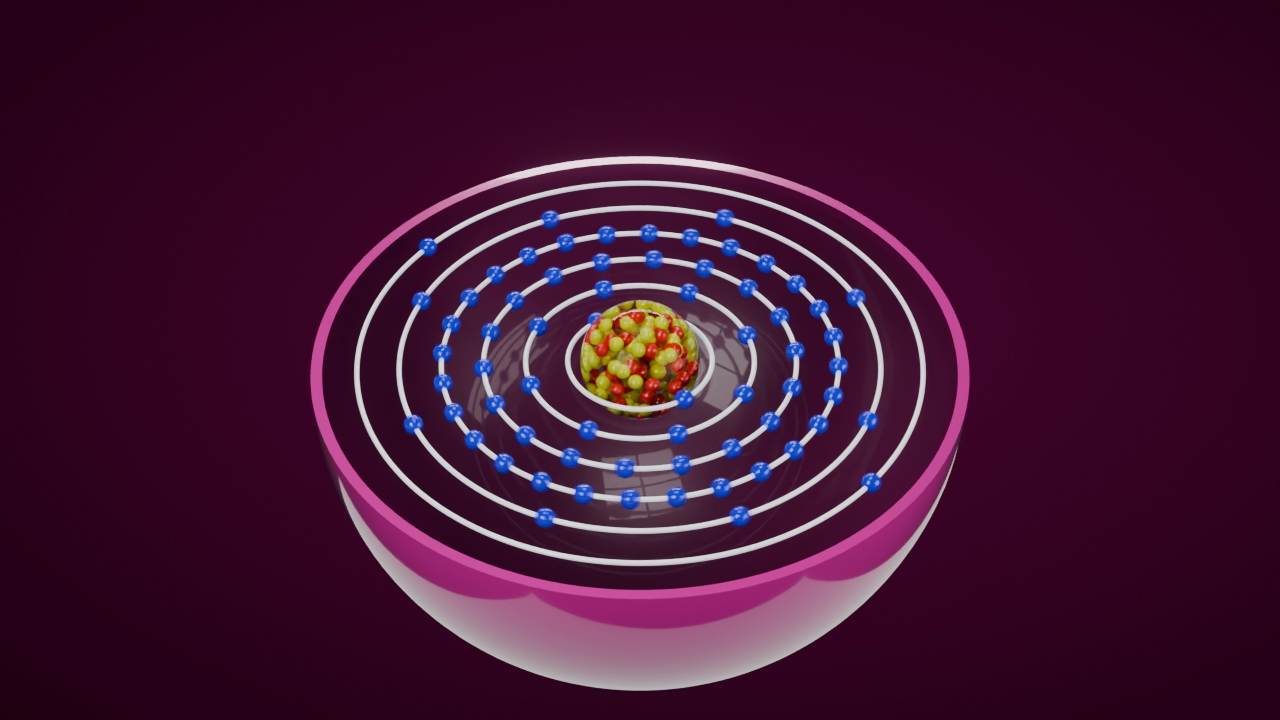
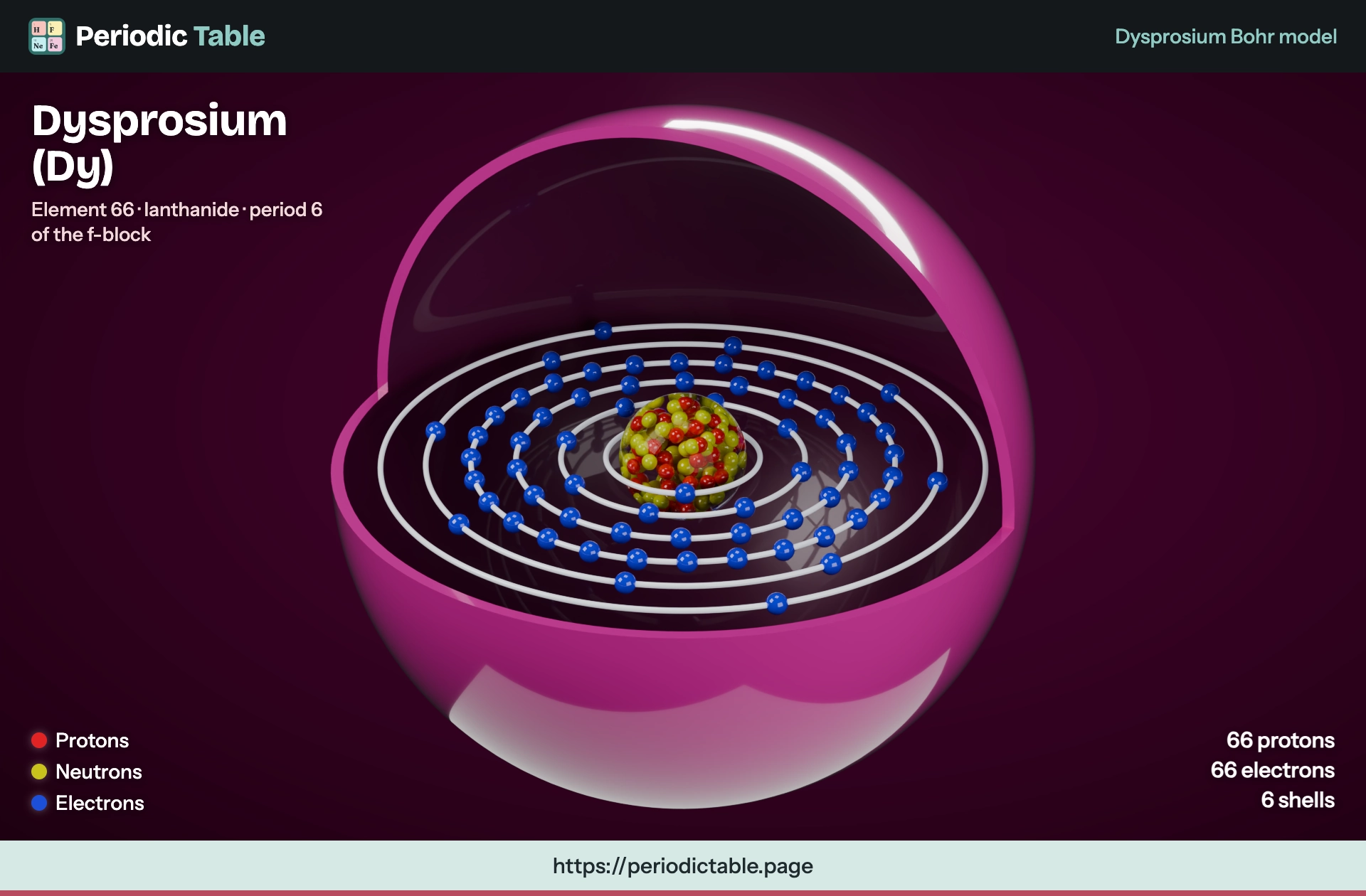
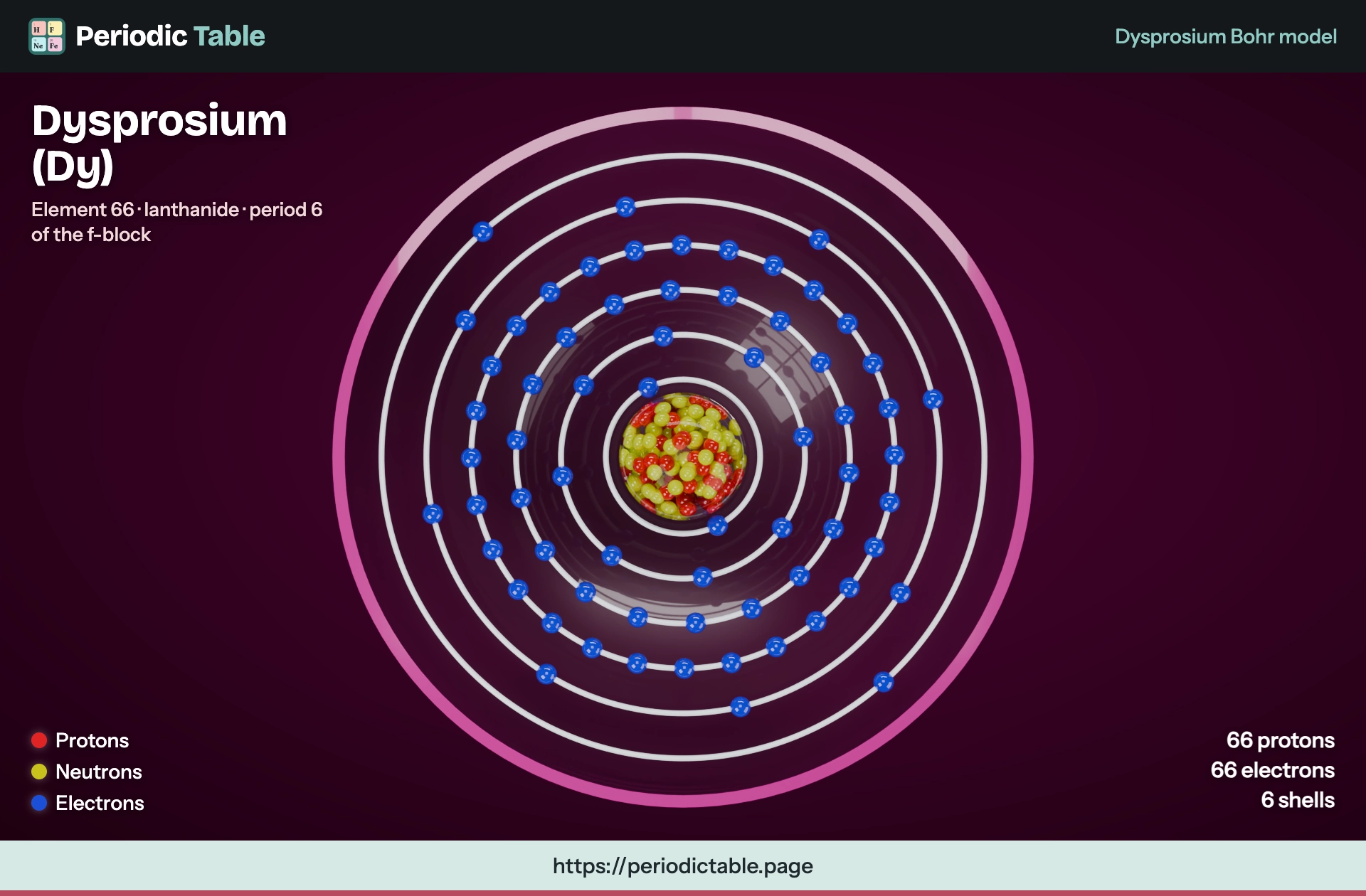
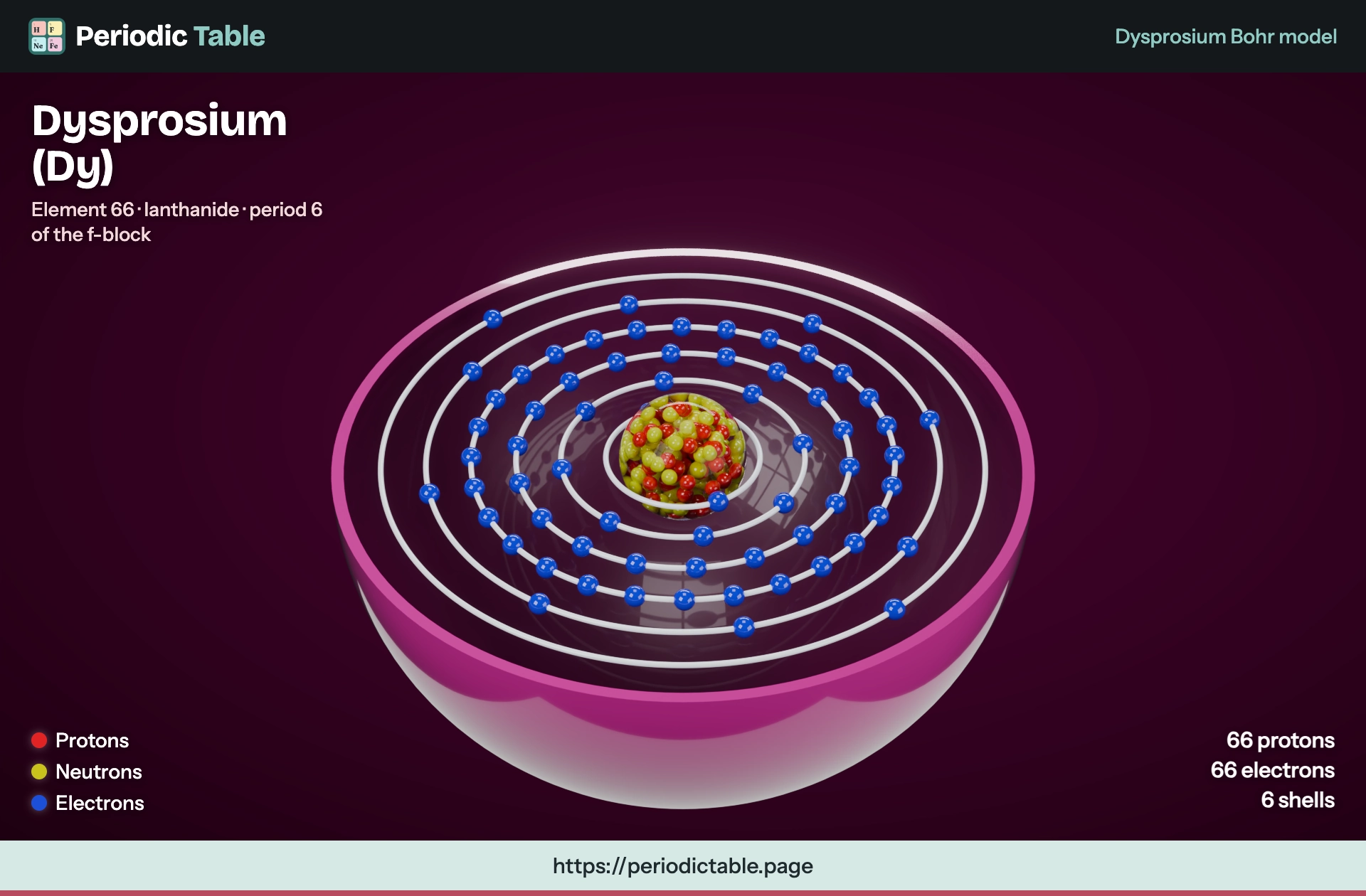
This is a Bohr model of dysprosium (Dy), a simplified picture of a single dysprosium atom. Its nucleus holds 66 protons, and a neutral dysprosium atom has 66 electrons, arranged around it in 6 shells (2 in shell K, 8 in shell L, 18 in shell M, 28 in shell N, 8 in shell O and 2 in shell P).
Dysprosium periodic table electron configuration
- Shorthand
- [Xe] 4f10 6s2
- Full
- 1s2 2s2 2p6 3s2 3p6 4s2 3d10 4p6 5s2 4d10 5p6 6s2 4f10
- Electrons per shell
- 2, 8, 18, 28, 8, 2
Dysprosium element properties and atomic data
- Atomic number
- 66
- Atomic mass
- 162.5001 u
- Phase at STP
- Solid
- Melting point
- 1406.85°C (1680 K)
- Boiling point
- 2566.85°C (2840 K)
- Density
- 8.54 g/cm³
- Electronegativity (Pauling)
- 1.22
- Period
- 6
- Group
- —
- Block
- f-block
- Appearance
- Silvery white
- Discovery date
- 1886
- Discovered by
- Lecoq de Boisbaudran
- Named by
- —
Dysprosium element facts and atomic data
The dysprosium element belongs to the lanthanide series, the row of fifteen f-block elements that fill the inner f subshell. It sits in period 6 between terbium and holmium. The table below gathers the core reference values in one place. For radiocarbon dating questions, students checking carbon atoms will find carbon-12, carbon-13 and carbon-14 and their uses.
| Property | Value |
|---|---|
| Symbol | Dy |
| Atomic number | 66 |
| Atomic mass | 162.500 u |
| Block and period | f-block, period 6 |
| Electron configuration | [Xe] 4f10 6s2 |
| Melting point | 1680 K (1407 °C) |
| Boiling point | 2840 K (2562 °C) |
| Density | 8.55 g/cm³ |
| Crystal structure | Hexagonal close-packed |
| Common oxidation state | +3 |
| CAS number | 7429-91-6 |
Atomic number, atomic mass and electron configuration
Every Dy nucleus carries 66 protons. The standard atomic weight is 162.500, and you can check it yourself from the isotope abundances listed further down: weighting each isotope's mass by its share gives 162.4995, which rounds to the published figure. One gram of dysprosium therefore holds roughly 3.7 × 10²¹ atoms.
Its configuration leaves four unpaired electrons in the 4f subshell, the source of its unusual magnetism. Losing the two outer s electrons plus one f electron gives the trivalent ion. Electronegativity is 1.22 on the Pauling scale, first ionization energies start at 573.0 kJ/mol, the empirical atomic radius is 178 pm and the covalent radius about 192 pm.
Melting point, boiling point and density
Dysprosium is a solid at room temperature that melts at 1407 °C and boils at 2562 °C. At 8.55 g/cm³ it is a little lighter than copper. Mechanical data round out the picture: a specific heat capacity of about 170 J/(kg·K), a Young's modulus of 61.4 GPa, a shear modulus of 24.7 GPa and a bulk modulus of 40.5 GPa, which together describe a fairly soft, workable material.
How dysprosium metal behaves
In pure form, dysprosium looks unremarkable, yet its behaviour changes sharply with temperature and purity. Two traits matter most: how it handles and how it responds to a magnetic field. In the story of the Ivy Mike test in 1952, the einsteinium element page tells how scientists found a new heavy metal in coral debris.
Physical properties and crystal structure
The physical properties start with a bright, silvery finish and a softness that lets it be machined without sparking, as long as you avoid overheating it. Even small impurities can noticeably shift its hardness and behaviour, so published values always assume high-purity samples.
At ordinary temperatures the atoms pack in a hexagonal close-packed lattice; this changes to body-centred cubic just before it melts and to an orthorhombic form at very low temperatures. It also carries some of the strongest atomic moments found in nature.
Magnetic properties across temperature
The magnetic properties of Dy pass through three distinct states as it cools:
- Paramagnetic above about 179 K (−94 °C): the atomic moments point randomly unless an outside field lines them up.
- Helical antiferromagnetic between about 179 K and 90 K: moments within each atomic layer are parallel, but each layer is twisted at a fixed angle to the next, forming a spiral.
- Ferromagnetic below its Curie temperature of roughly 90.5 K (−182.7 °C): all moments align and it behaves like a strong permanent magnet.
That low-temperature ordering is why researchers prize it for cryogenic work, even though it is only paramagnetic in everyday conditions.
Chemical properties and oxidation state of element dysprosium
The chemical properties of dysprosium follow the pattern of its neighbouring elements. The usual valence is +3, with +2 appearing in a few compounds. It is quite electropositive, so it gives up electrons readily:
- It keeps its shine in dry air but will tarnish slowly in moist air, building a dull surface film.
- It reacts slowly with cold water and quickly with hot water, forming dysprosium hydroxide, Dy(OH)3, and releasing hydrogen gas.
- It combines vigorously with all the halogens above roughly 200 °C.
- It dissolves readily in dilute sulfuric acid, giving yellow Dy(III) ions in solution.
In everyday chemistry terms, dysprosium atoms behave much like the rest of the series, which is exactly why separating them is so difficult.
Common dysprosium compounds
Most dysprosium compounds contain the Dy(III) ion, and many are faintly yellow or greenish. The most important ones you will meet are:
- Dysprosium oxide (Dy2O3), also called dysprosia: a white powder that is more strongly magnetic than iron oxide and the usual feedstock for refining.
- Dysprosium fluoride and dysprosium chloride: halides reduced to the pure form during production.
- Dysprosium bromide and dysprosium iodide: used in high-intensity lighting.
- Dysprosium nitrate: a strong oxidizer that can ignite organic material.
- Dysprosium sulfate and dysprosium carbonate: salts formed by straightforward acid reactions; the carbonate hydrate is insoluble in water.
Doped crystals of calcium sulfate or fluoride with a trace of Dy also form the sensing part of the dosimeters covered below.
Isotopes of Dy and their natural abundance
Natural dysprosium is a mix of seven stable isotopes. 164Dy, also written dysprosium-164, is the most common at just over 28%:
| Isotope | Natural abundance (%) |
|---|---|
| Dy-156 | 0.056 |
| Dy-158 | 0.095 |
| Dy-160 | 2.329 |
| Dy-161 | 18.889 |
| Dy-162 | 25.475 |
| Dy-163 | 24.896 |
| Dy-164 | 28.260 |
Dozens of radioisotopes have also been made in the lab. The longest-lived is Dy-154, with a half-life of about 1.4 million years. In physics, these strongly magnetized atoms have been laser-cooled into a Bose-Einstein condensate and even a two-dimensional supersolid, making them a workhorse for quantum simulation.
Dysprositos: the history of a hard-to-isolate lanthanide
The story is in the name. In 1886 the French chemist Paul Emile Lecoq de Boisbaudran, a pioneer of spectroscopy, noticed an unfamiliar spectrum in a holmium oxide sample that had itself been split out of erbium ores.
He dissolved it in acid and precipitated it with ammonia, repeating the cycle more than 30 times; one account puts the oxalate precipitations at 58. Worn down by the effort, he chose the Greek dysprositos, meaning "hard to get".
The discovery did not deliver usable material. Georges Urbain prepared a purer sample in 1905, but clean separation from its neighbouring elements only arrived after Frank Spedding at Iowa State University developed ion-exchange chromatography in the early 1950s. That method is still the basis of modern rare-earth refining.
Where the rare earth element is mined and produced
No mineral has dysprosium as its main rare earth element. Instead it turns up as a minor partner in xenotime, fergusonite, gadolinite, euxenite, polycrase, bastnasite and monazite, usually alongside yttrium and other rare earth elements. Its crustal share is only about 5 parts per million, low even among the rare-earth elements.
Production starts with mining monazite sand or ion-adsorption clays, and dysprosium is often a by-product of yttrium extraction. Unwanted minerals are removed magnetically or by flotation, then ion exchange separates the dysprosium from its neighbours. The purified ions are reacted with fluorine or chlorine, and the resulting halide is reduced with calcium or lithium in a tantalum crucible under helium, leaving the heavier liquid product to settle below the slag.
Supply risk, producers and price
China dominates refining, with Myanmar and Australia as the other major sources, so supply concentration is extreme and recycling rates stay below 10%. The price has swung hard over the past two decades as export rules tightened and loosened. Because there is no easy substitute in high-temperature magnets, energy agencies consistently rank dysprosium among the most critical materials for the energy transition.
Uses of dysprosium in modern technology
The main uses of dysprosium all trace back to its magnetism, its appetite for neutrons or its light emission. Below are the applications that account for nearly all demand in modern technology.
Permanent magnets for electric vehicles and wind turbines
Permanent magnets are the biggest market. Adding a few percent of dysprosium to neodymium-iron-boron magnets raises their coercivity, so the magnet resists being demagnetized at the high temperatures inside a motor. These dysprosium magnets are standard in almost every electric vehicle traction motor and in many direct-drive wind turbine generators.
The dysprosium alloys also improve corrosion resistance, which extends service life at damp offshore sites. A single motor may need under 100 grams, yet multiplied by millions of new cars and turbines each year that demand adds up fast.
Nuclear reactors and control rods
Dysprosium has a high thermal neutron absorption cross-section and does not swell or shrink much under bombardment. Dysprosium oxide combined with nickel forms cermets used in the control rods of nuclear reactors, where they soak up excess neutrons to slow the chain reaction.
Sensors, lighting and radiation detection
Smaller markets use the same magnetism and light emission in more specialised ways.
Terfenol-D: dysprosium in sonar and actuators
Terfenol-D, an alloy of terbium, iron and dysprosium, has the highest room-temperature magnetostriction known. This magnetostrictive material changes shape in a magnetic field, so it drives sonar transducers, actuators and precision fuel injectors.
Dysprosium lamps and lasers
Its iodide and bromide go into metal-halide lamps for film and stadium lighting, where the hot atoms emit bright green and red light. Combined with vanadium, it also serves as an active dopant in some laser materials.
Dysprosium for infrared and data storage
Dysprosium-cadmium chalcogenides emit infrared light useful for studying reactions, and because it is so easily magnetized it helped early hard disks and other data-storage media.
Dysprosium dosimeters and magnetic refrigerators
Dy-doped crystals glow in proportion to the ionizing radiation they absorb, giving a direct reading of exposure. Garnet salts such as dysprosium gallium garnet, a cousin of gadolinium compounds, cool samples by adiabatic demagnetization. Separately, dysprosium-based oxide-fluoride nanofibers are strong and heat-stable enough to reinforce other materials.
Handling dysprosium safely
Bulk dysprosium poses little chemical hazard, and the insoluble salts are non-toxic. Soluble salts such as the chloride and nitrate are mildly toxic if swallowed, though animal data suggest a very large dose would be needed to harm an adult.
The real risks are physical: fine powder is an explosion hazard when mixed with air near an ignition source, thin foil can be lit by a spark, and burning dysprosium reacts with water to release flammable hydrogen. Use a dry-powder extinguisher, never water, and store powder sealed under inert gas.