


Carbon element (C): carbon periodic table facts
Carbon periodic table facts: carbon (C) is element 6, a reactive nonmetal in group 14, period 2. Pencil lead, a diamond ring, the sugar in your coffee and the DNA in every cell you own share one ingredient: carbon, the chemical element with symbol C and atomic number 6. It is a nonmetal forged inside dying stars, a minor part of the Earth's crust, and yet the reason it is called the element of life is simple: carbon atoms link to each other and to almost anything else in more ways than any other element can. Readers weighing nuclear energy against radiation risk will find balanced facts under plutonium isotopes in plain terms.
Rotate the 3D Bohr model of carbon
Drag to orbit, scroll to zoom.
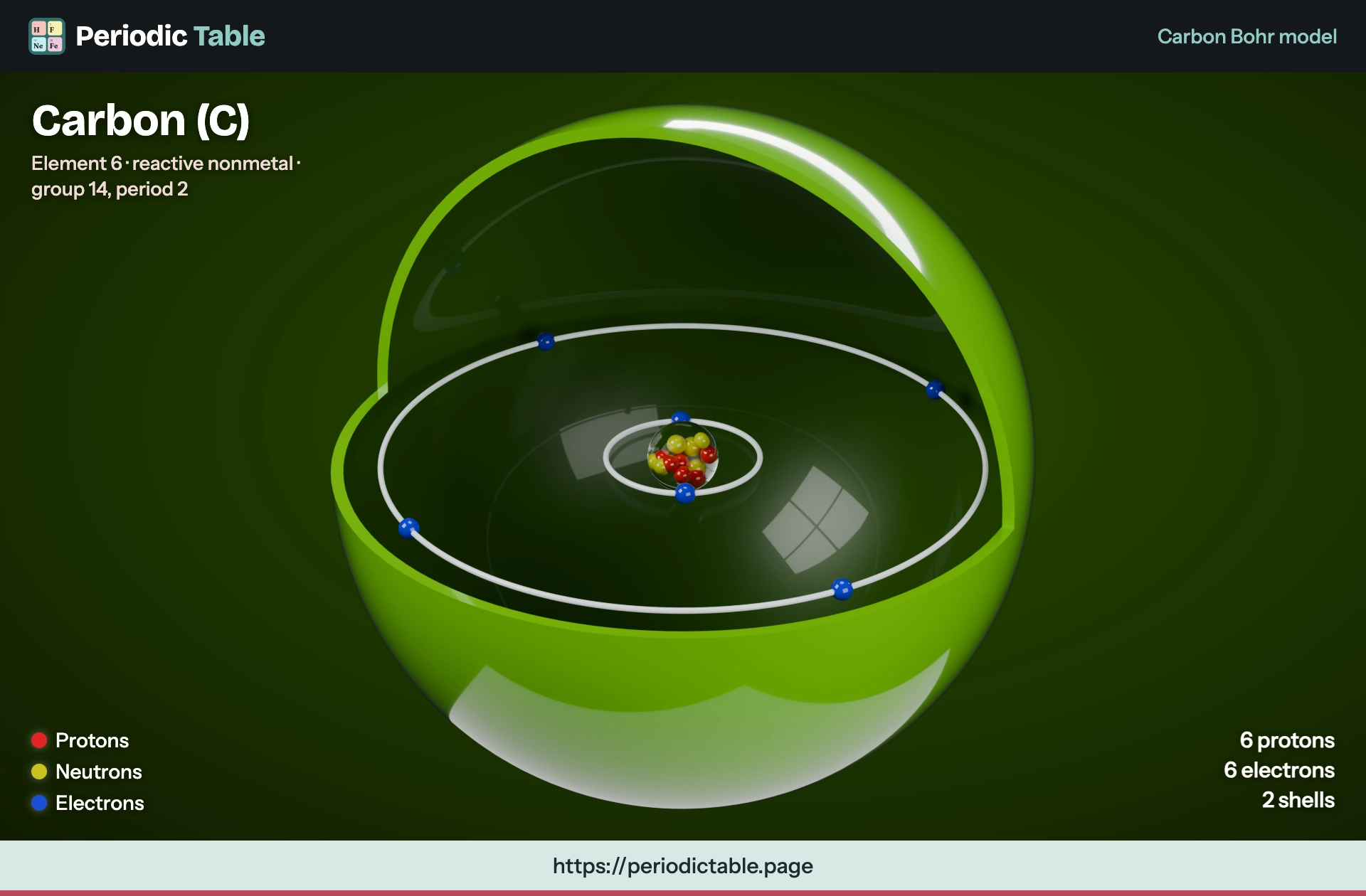
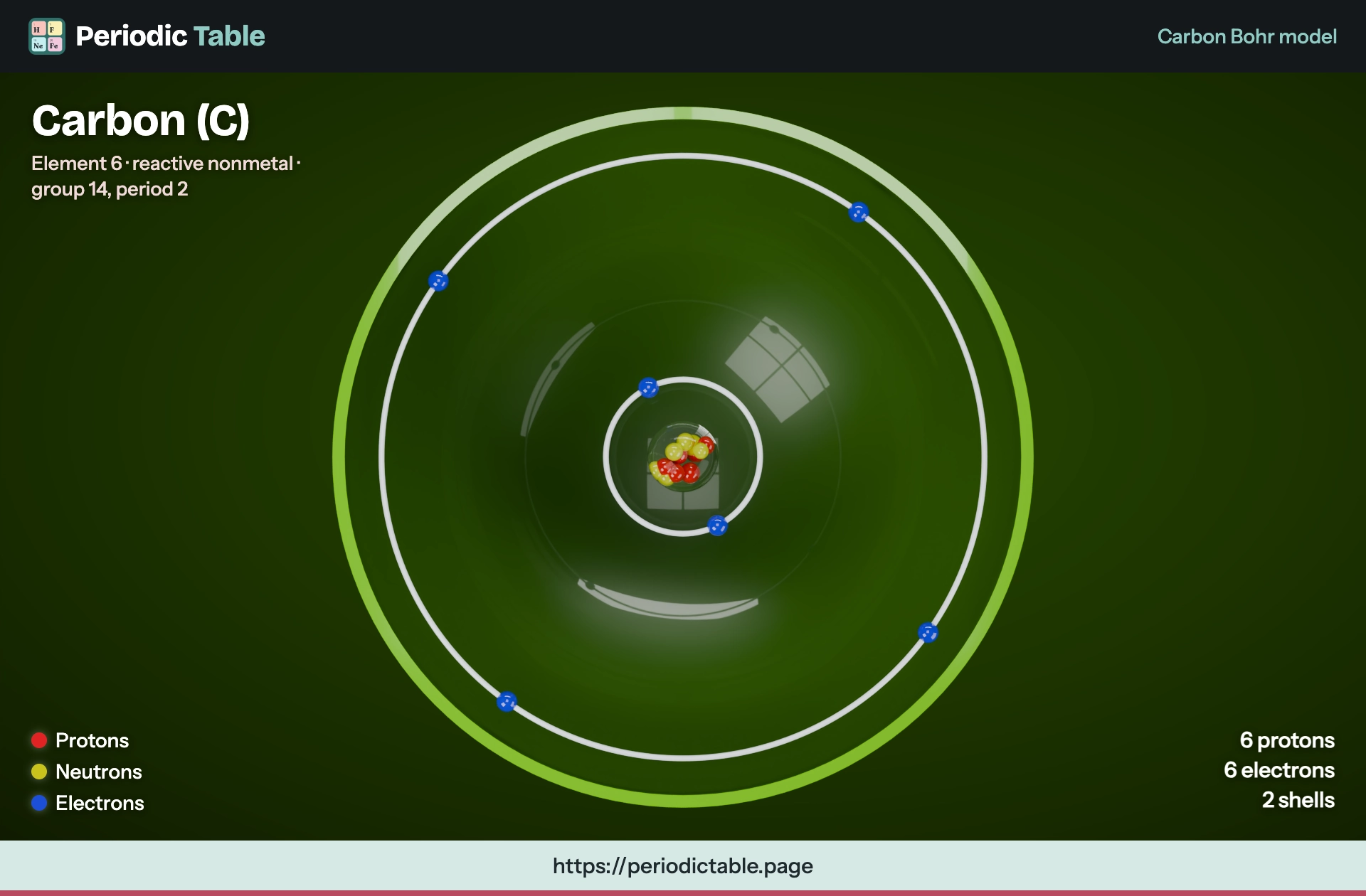
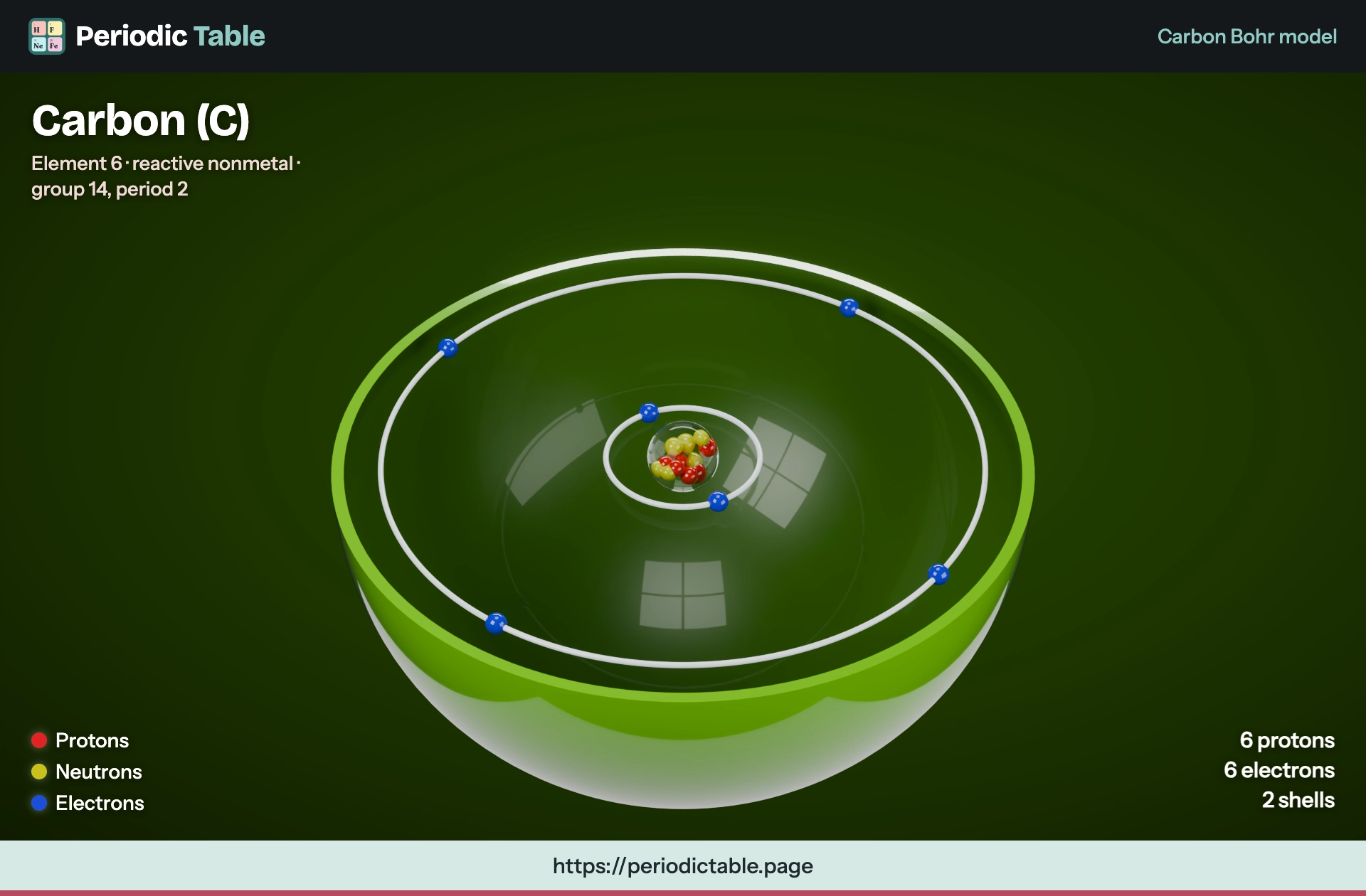
This is a Bohr model of carbon (C), a simplified picture of a single carbon atom. Its nucleus holds 6 protons, and a neutral carbon atom has 6 electrons, arranged around it in 2 shells (2 in shell K and 4 in shell L).
Carbon periodic table electron configuration
- Shorthand
- [He] 2s2 2p2
- Full
- 1s2 2s2 2p2
- Electrons per shell
- 2, 4
Carbon element properties and atomic data
- Atomic number
- 6
- Atomic mass
- 12.011 u
- Phase at STP
- Solid
- Melting point
- 4326.85°C (4600 K)
- Boiling point
- Unknown
- Density
- 1.821 g/cm³
- Electronegativity (Pauling)
- 2.55
- Period
- 2
- Group
- 14
- Block
- p-block
- Appearance
- Unknown
- Discovery date
- Ancient
- Discovered by
- Ancient Egypt
- Named by
- —
Carbon at a glance: atomic number, atomic mass and electron configuration
Carbon heads the carbon group, sitting in period 2 and the p-block of the periodic table of elements. Its neighbours tell you a lot about its character: boron sits to its left, nitrogen to its right, and silicon directly below it. Silicon shares the four-bond habit, but smaller carbon atoms make shorter, stronger links, which is why life is built on the lighter element rather than its heavier relative. As an element of alloys, lighting and electronics, with mining byproducts and oxide data in view, this metal appears in the scandium element overview and tables.
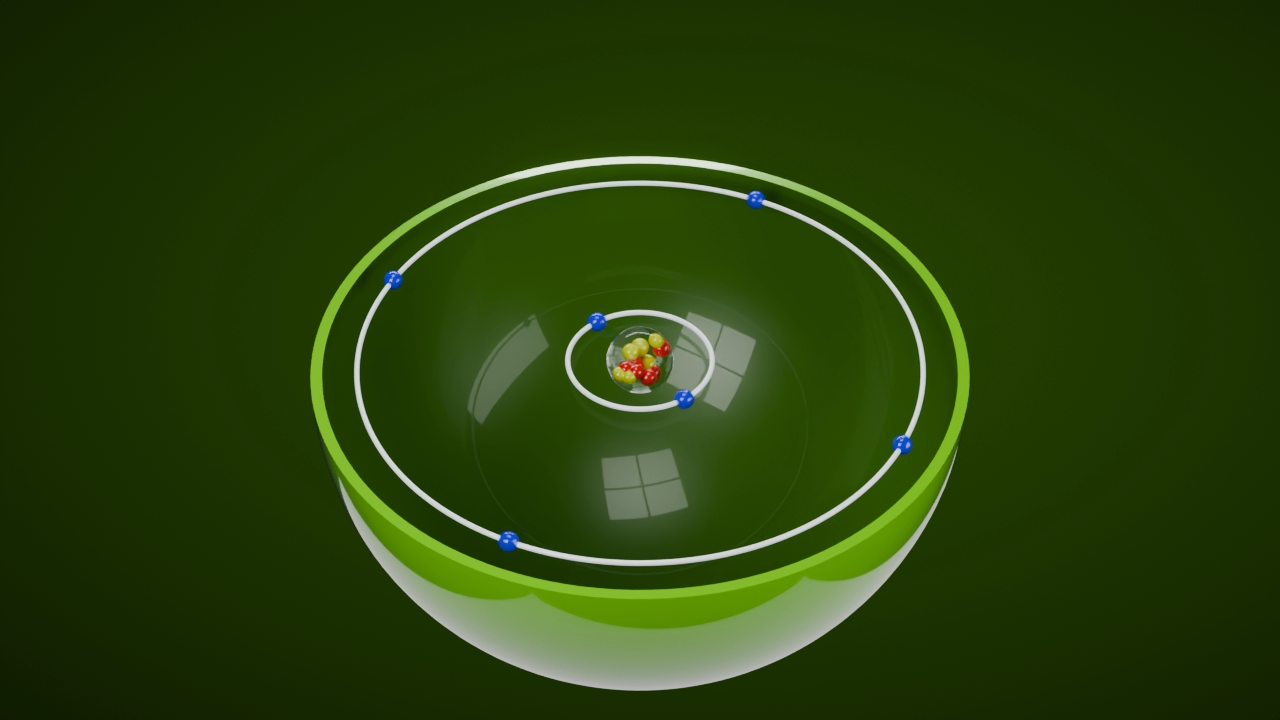
Each nucleus holds 6 protons. The most common form adds 6 neutrons, and a neutral atom carries six electrons: two in the inner shell and four in the outer one. That half-full outer shell is the single most important fact here, because it lets the atom share in every direction instead of giving charge away or grabbing more.
| Property | Value for carbon (C) |
|---|---|
| Symbol | C |
| Atomic number | 6 |
| Standard atomic mass | 12.011 |
| Electron configuration | [He] 2s2 2p2 (2, 4 electrons per shell) |
| Position in the periodic table | Group 14, period 2, p-block |
| Electronegativity (Pauling scale) | 2.55 |
| First three ionisation energies | 1,086.5 / 2,352.6 / 4,620.5 kJ/mol |
| Covalent radius | 77 pm (single bond, sp3) |
| Van der Waals radius | 170 pm |
| Electron affinity | about 122 kJ/mol |
| CAS number | 7440-44-0 |
| State at 20 °C | Solid |
An electronegativity of 2.55 places it in the middle of the scale: higher than its heavier group 14 element relatives (about 1.8 to 1.9) but lower than fluorine or chlorine. That middle position keeps its links mostly shared rather than ionic.
Its ionization energies climb steeply after the fourth electron, so it practically never forms a simple C4+ ion. The name comes from the Latin carbo, meaning coal or charcoal.
Physical properties of carbon
Carbon properties depend almost entirely on how the atoms are arranged, so no single density or hardness value describes every form. Graphite and diamond contain nothing else, yet one is soft, black and electrically conducting while the other rates 10 on the scratch scale and barely conducts at all. For materials research, look up uses of dysprosium to read about dysprosium oxide, alloys and crystals used in data storage.
In the language of solid-state physics, the arrangement sets everything from band gap to stiffness. The table below compares the two most common crystalline forms side by side.
| Property | Graphite | Diamond |
|---|---|---|
| Density | about 2.27 g/cm3 | about 3.51 g/cm3 |
| Mohs hardness | 1 to 2 | 10 |
| Crystal structure | Hexagonal layers | Diamond cubic |
| Thermal conductivity | roughly 120 to 165 W/(m·K) | roughly 900 to 2,300 W/(m·K) |
| Electrical conductivity | Conducts within each layer | Insulator |
| Specific heat capacity | about 709 J/(kg·K) | about 509 J/(kg·K) |
| Bulk modulus | about 33 GPa | about 442 GPa |
| Appearance | Black, metallic lustre | Clear when pure |
Diamond's Young's modulus of roughly 1,050 GPa makes it one of the stiffest substances known, and its thermal conductivity beats copper several times over, which is why a real diamond feels cold on your lip. Both forms are diamagnetic, meaning they are weakly pushed away by a magnetic field. Graphite's hardness figure is misleading on its own: its planes slide easily, but each plane is extraordinarily strong.
Sublimation point, melting point and boiling point
Carbon has the highest sublimation point of all the elements. At normal atmospheric pressure it has no true melting point at all: solid graphite sublimes, turning straight into vapour at about 3,640 °C (roughly 3,915 K). Older reference tables quote a melting point near 3,500 to 3,650 °C and a boiling point near 4,800 °C, but those figures are extrapolations rather than conditions you could reach in an open crucible.
Liquid carbon exists only above its triple point, at about 4,600 K and 10.8 MPa, so it needs high pressure as well as heat. In the vapor phase some of it forms dicarbon, a diatomic carbon molecule (C2) that glows green and gives comets their colour.
Chemical properties of the carbon atom
A single carbon atom has four valence electrons, which makes the element tetravalent: it typically forms four covalent bonds. They can point to four different partners or combine into double and triple links, and the atom is just as happy bonding to itself as to hydrogen or the halogens. That flexibility, more than any other property, is what makes its chemistry, and its millions of compounds, so vast.
In its elemental forms, though, it is fairly inert at room temperature. It is insoluble in water, resists dilute acids and alkalis, and only the strongest oxidizers attack it.
Hot concentrated nitric acid, for example, breaks graphite down into mellitic acid, C6(CO2H)6, which keeps graphite's six-membered rings intact. Heat changes the picture: a red-hot reaction with oxygen releases a great deal of energy, and hot coke will strip oxygen from metal oxides, which is the basis of smelting.
Oxidation states and covalent bonds
Carbon's oxidation states run from −4 to +4. In CH4 it sits at −4, in graphite or diamond at 0, in CO at +2, and in CO2 at +4, its most common state in inorganic chemistry. Because the atom shares charge rather than transferring it, those numbers are bookkeeping: the real story is the covalent bonds themselves.
It also forms carbonyl groups (C=O), the reactive heart of many organic molecules, and carbon disulfide (CS2), a solvent made by heating charcoal with sulfur. Its single links to itself survive ordinary conditions, and that durability is what lets long chains and rings exist.
Bond enthalpies of carbon bonds
Bond enthalpy is the energy needed to break one mole of a given bond in the gas phase. The values below are standard textbook averages; the exact figure for any one molecule shifts a little with its neighbours.
| Bond | Average bond enthalpy (kJ/mol) | Typical example |
|---|---|---|
| C–H | 413 | Hydrocarbons |
| C–C | 348 | Ethane, alkane chains |
| C=C | 614 | Alkenes |
| C≡C | 839 | Alkynes such as ethyne |
| C–O | 358 | Alcohols, ethers |
| C=O | 799 | Aldehydes, ketones, CO2 |
| C–N | 293 | Amines |
| C≡N | 891 | Nitriles |
| C–Cl | 328 | Chloroalkanes |
Two patterns stand out. A C=C double bond is less than twice as strong as a single one, which is why alkenes react readily by opening it. And the C=O bond is so strong that burning fuels releases a large amount of energy, the chemistry behind every flame you have ever lit.
Allotropes of carbon
An allotrope is a different structural form of the same element, and this one has more of them than almost any other. The atoms can stack into flat sheets, lock into a rigid three-dimensional lattice, curl into spheres and tubes, or tangle into a disordered mass.
Carbon allotropes span the full range of extremes: the softest and the hardest materials, the best lubricant and the best abrasive, a conductor and an insulator. Isolated atomic carbon is very short-lived, so the element is always found in one of these multi-atom arrangements.
Diamond
In diamond, every carbon atom bonds to four others at the corners of a tetrahedral arrangement, building a cubic crystal that extends in all three directions. There are no free electrons, so diamond does not conduct electricity, and breaking it means breaking strong links everywhere at once, which is why it is the hardest natural substance. Diamond is transparent across an unusually wide band of wavelengths and has a wide band gap, so engineers study it as a semiconductor for high-power electronics.
Natural diamond forms deep in the mantle under enormous pressure and heat. Synthetic diamonds were first made in the 1950s by squeezing graphite at a high temperature and pressure; today chemical vapor deposition grows diamond films from a hydrocarbon gas, and lab-grown gemstones are chemically identical to mined ones.
Beyond jewelry, diamond tips saws, drill bits and grinding wheels. A rare hexagonal cousin, lonsdaleite, forms when meteorites strike graphite.
Graphite and graphene
Graphite is the stable form of carbon at everyday temperature and pressure. Each atom bonds to three neighbours in a flat, hexagonal sheet, and the sheets stack in layers held together only by weak van der Waals forces.
The fourth electron of each atom joins a delocalised pi system spread across the sheet, so graphite is a good conductor along its planes but a poor one between them, which makes it strongly anisotropic. It is opaque and black, and because the planes slip past each other, it works as a dry lubricant; some graphite surfaces even show superlubricity, sliding with almost no friction.
Pull a single layer away and you have graphene, a sheet one atom thick, one of the strongest materials ever tested and a favourite subject of condensed-matter physics. You make tiny flakes of it every time you write with a pencil, since friction shears thin stacks off the graphite core.
Fullerenes, carbon nanotubes and amorphous carbon
Fullerenes are closed cages of carbon. The best known is buckminsterfullerene, C60, shaped like a football and nicknamed buckyballs.
Roll a graphene sheet into a cylinder instead and you get carbon nanotubes, which are among the strongest and most anisotropic materials known; related nanofibers reinforce plastics and battery electrodes. Linear acetylenic carbon, or carbyne, is a one-dimensional chain still being studied.
Amorphous carbon has no long-range crystal order. It is the main ingredient of charcoal, soot and lampblack, and it is isotropic, behaving the same in every direction. Glassy carbon, a hard, non-graphitizing form, is used for laboratory electrodes and for heat shields that must survive extreme temperatures.
Carbon isotopes: carbon-12, carbon-13 and carbon-14
Three carbon isotopes occur naturally. The lightest, 12C, makes up about 98.9% of the total and is stable; it also defines the atomic mass unit, since one atom of it is exactly 12 u.
The next accounts for about 1.1% and likewise never decays, which makes it useful as a tracer in chemistry and medicine. The heaviest, 14C, exists only in trace amounts and is a radionuclide.
| Isotope | Natural abundance | Half-life | Decay |
|---|---|---|---|
| Carbon-12 (12C) | about 98.9% | Stable | None |
| Carbon-13 (13C) | about 1.1% | Stable | None |
| Carbon-14 (14C) | Trace | about 5,700 years | Beta decay |
The ratio between the two non-radioactive forms is also a fingerprint. Plants take up slightly less of the heavy form during photosynthesis, so the gas released from burned plants and fossil fuels is depleted in it.
Measuring that isotopic signature in the air is one of the clearest proofs that the extra CO2 in the atmosphere comes from human activity. Each one therefore tells a different story: one sets the mass scale, one traces sources, and one keeps time.
Radiocarbon dating
Cosmic rays striking nitrogen in the upper atmosphere keep making fresh carbon-14, and living things absorb it as long as they eat or breathe. When an organism dies, the intake stops and what it holds decays at a fixed rate, so the fraction left tells you how long ago it died:
$$t = t_{1/2} \times \frac{\ln(N_0 / N)}{\ln 2}$$
Here \(t_{1/2}\) is the half-life, \(N_0\) the starting amount and \(N\) the amount remaining. A wooden tool keeping 37% of its original radiocarbon gives \(t = 5{,}700 \times \ln(1/0.37) \div \ln 2\), or about 8,180 years. This is radiocarbon dating, a standard method in archaeology for material up to roughly 50,000 years old.
Where carbon comes from: stars, space and the Earth
By mass, carbon is the fourth most abundant element in the universe, after hydrogen, helium and oxygen. On Earth it is far scarcer: it is only about the 15th most abundant element in the crust, at a few hundred parts per million. It makes up about 18% of the human body by mass, second only to oxygen.
Most of the planet's carbon is locked in rock as limestone, dolomite and marble, all built from carbonate minerals. Smaller reservoirs hold free carbon as graphite and diamond, organic matter in soils and sediments, CO2 dissolved in the oceans, and methane clathrates, ice-like solids that trap natural gas in seafloor mud and permafrost. Astronomy adds a wider view: carbon-rich molecules turn up in interstellar clouds, meteorites and the tails of comets.
The triple-alpha process and formation in stars
The Big Bang made almost no carbon. It is forged later, inside aging stars, through the triple-alpha process: when a star's core runs out of hydrogen and heats past roughly 100 million kelvin, three helium-4 nuclei fuse into one carbon-12 nucleus. In nuclear physics terms, this step of stellar nucleosynthesis is a bottleneck, and it works at all only because carbon-12 has an energy level that matches the reaction almost perfectly.
Carbon then helps power them in turn. In suns heavier than ours, such as Sirius, the carbon-nitrogen-oxygen cycle (CNO cycle) uses it as a catalyst to fuse hydrogen into helium.
When the most massive ones explode as a supernova, they scatter that material into space, where it becomes part of new planets and, eventually, part of you. That nuclear history explains why carbon is common in the cosmos but needed billions of years to build up.
Carbon compounds and the chemistry of life
Nothing else in the periodic table forms as many carbon compounds. Chemists have described more than ten million of them, and the number of possible structures is effectively unlimited. Their study is a whole discipline, organic chemistry, and it is the reason carbon is called the building block of life.
All known living organisms are built on carbon skeletons. Proteins, sugars, fats, DNA and RNA are long polymers in which chains and rings of carbon atoms carry a handful of other atoms such as phosphorus and sulfur.
In biology, the trick is the same one seen in diamond: long chains are strong enough to hold large molecules together, yet enzymes can still build them up and break them down at body heat. No rival balances those demands as well, which is why life elsewhere in the universe is also expected to be carbon-based.
Organic compounds and hydrocarbons
Organic compounds are, broadly, molecules containing carbon-hydrogen bonds. The simplest are hydrocarbons, made of carbon and hydrogen alone: methane (CH4), butane (C4H10), octane (C8H18) and the mixture of hundreds of others that makes up petrol. Combustion of a hydrocarbon in oxygen releases the energy stored in its bonds as heat and light:
$$\text{CH}_4 + 2\,\text{O}_2 \rightarrow \text{CO}_2 + 2\,\text{H}_2\text{O} + \text{energy}$$
Acetylene (C2H2), with its triple bond, burns hot enough in pure oxygen for welding and cutting metal. Add other atoms to the chain and you get alcohols, acids, aldehydes, ketones, amines and the rest of the organic families.
Inorganic compounds, carbides and carbonates
Inorganic compounds of carbon are fewer but industrially important. There are three oxides: carbon monoxide (CO), a toxic fuel gas and reducing agent; carbon dioxide (CO2); and the rare carbon suboxide (C3O2).
With the halogens it makes tetrahalides such as carbon tetrachloride (CCl4), once a common solvent, and mixed compounds like the old refrigerant freon (CCl2F2). Cyanide (CN−) is another toxic inorganic ion.
Carbides form when it combines with a metal at high temperature. Tungsten carbide is a very hard ceramic for cutting tools, calcium carbide reacts with water to release acetylene, and the iron carbide cementite is what hardens steel.
Carbonates contain the CO32− ion and make up chalk, coral and seashells. Organometallic compounds, which bond carbon directly to a metal atom, bridge the two worlds and drive many industrial catalysts.
The carbon cycle and carbon in the atmosphere
The carbon cycle moves the element between air, oceans, rocks and living things. Plants pull carbon dioxide from the atmosphere through photosynthesis and build it into sugars; animals and microbes return it as they breathe and decay. Oceans dissolve it, and over millions of years some of it is buried as limestone or as dead organic matter that becomes coal, oil and gas.
Because carbon dioxide is a greenhouse gas, the share of carbon held in the air rather than in rock sets Earth's climate. During the Carboniferous period, vast swamps locked it away as coal; at the end of the Permian, volcanic outgassing pushed it back into the air and coincided with the largest extinction on record. Today's transfer of buried carbon to the atmosphere, in what many scientists call the Anthropocene, is driving climate change in decades rather than millions of years.
Carbon dioxide, fossil fuels and emissions
Fossil fuels are ancient carbon. Peat slowly becomes lignite and then bituminous coal and anthracite, the highest grade with the most carbon.
Buried marine organic matter turns into kerogen and then into petroleum, crude oil and natural gas, with tar-like bitumen and asphalt as heavy fractions. Burning them returns in a few centuries what took millions of years to store, and emissions from fossil sources now total well over a trillion tonnes of CO2 since the industrial era began.
NASA's Orbiting Carbon Observatory satellites map where that gas rises and falls across the planet. Capture schemes aim to reverse the flow by turning CO2 back into stable carbonate rock or storing it underground, while renewable energy cuts how much buried fuel is burned in the first place, which is what the wider environment ultimately responds to.
History of the element carbon
Carbon is one of the few elements known since antiquity. The ancients used charcoal to smelt metals, and Egyptians and Sumerians were producing it by around 3750 BCE. Soot served as the black in early inks, and diamonds have been prized as gems for thousands of years.
What took longer was realising that these very different substances are one element. In 1772 Antoine Lavoisier showed that burning diamond produced the same gas as burning charcoal, and by 1789 he listed it among the elements.
In 1796 Smithson Tennant proved that diamond is made of carbon alone, and in 1779 Carl Scheele had shown that graphite, once thought to be a form of lead, is the same substance too. The discovery of fullerenes in 1985 and the isolation of graphene in 2004 each earned a Nobel Prize, proof that this ancient element still holds surprises.
How pure carbon is produced
Most elemental carbon used by industry is made rather than mined. Heating coal without air drives off volatile matter and leaves coke, a hard, porous fuel that is mostly carbon and essential to blast furnaces. Wood heated the same way gives charcoal.
Natural graphite is mined from veins and flakes, while synthetic graphite is made by baking petroleum residues and pitch at very high temperatures until the atoms reorder into stacked sheets. Activated carbon is produced by heating carbon-rich materials such as coconut shells or wood with steam or chemicals, which etches a huge internal surface into each grain.
In the laboratory, chemically pure carbon can be prepared by heating sugar in the absence of air, leaving only a black, glassy residue. In each case the goal is the same: control the carbon content and the arrangement of the atoms to suit the job.
Carbon uses in industry and everyday life
Carbon uses stretch from the steel in your car to the filter in your kitchen tap. The most important are:
- Steel and iron — coke reduces iron ore in smelting, and a small, carefully controlled amount of carbon turns soft iron into strong steel.
- Graphite products — drawing leads, lubricants, electrodes for electric-arc furnaces, high-temperature crucibles and the anodes of lithium-ion batteries.
- Diamond — jewelry, plus diamond-tipped cutting tools, drill bits and abrasive powders.
- Carbon black — a black pigment in inks, paints and tyres, where it also strengthens the rubber.
- Activated carbon — water filtration, air purifiers, gas masks and the removal of colour from sugar.
- Carbon fiber — light, stiff composites for aircraft, racing bikes, wind-turbine blades and sports gear.
- Carbon dioxide — the fizz in soft drinks, fire extinguishers, and solid dry ice for cooling.
Across chemical manufacturing, almost every plastic, fuel, solvent and medicine starts from organic compounds. The radioactive and heavy isotopes also serve as labels for tracing reactions and diagnosing disease.
Carbon supply risk and top producers
Carbon itself will never run out, but its useful forms are not spread evenly. Supply risk assessments therefore score coal, natural diamond and graphite separately. Graphite is the most concentrated: China dominates mining and refining, with India and Brazil among the other leading producers, and graphite is now treated as a critical material because battery anodes depend on it.
Natural diamond comes mainly from Russia, Botswana and the Democratic Republic of the Congo. Coal is mined widely, with China, India and the USA producing the most.
Recycling rates for these forms are low, so supply rests on mining and on synthetic production. Synthetic graphite and lab-grown diamond reduce dependence on any single country, at the cost of a lot of energy to make them.
Health effects and environmental effects of carbon
Elemental carbon has low toxicity. You swallow small amounts on the charred edges of grilled food, and hospitals give a charcoal slurry to absorb some swallowed poisons.
The main health effects come from dust: long-term breathing of carbon black or coal dust can scar the lungs and cause pneumoconiosis, the "black lung" disease of miners. The International Agency for Research on Cancer (IARC) has reviewed the carcinogenicity of carbon black, and workplace exposure limits apply to it.
Some simple carbon compounds are far more dangerous than the element. Carbon monoxide binds to haemoglobin and starves the body's tissues, and cyanide blocks cell respiration.
Atmospheric nuclear weapons tests between 1945 and 1980 nearly doubled the radiocarbon in the air. Because this isotope crosses the placenta and binds into growing tissue like any other carbon, that "bomb pulse" is now used to date when human cells formed.
Carbon in its elemental forms has no harmful environmental effects of its own. The environmental problem is carbon dioxide from burning fossil fuels and methane from farming and leaks, which upset the carbon cycle and warm the planet.