


Scandium element (Sc): scandium periodic table facts
Scandium periodic table facts: scandium (Sc) is element 21, a transition metal in group 3, period 4. If you have ever ridden a featherweight bike frame or watched a night match under stadium floodlights, you have already met scandium without knowing it. Physics and chemistry teachers use element 94 to show neutron capture, beta decay and spontaneous fission side by side.
This soft, silvery chemical element with atomic number 21 and the symbol Sc sits at the very start of the transition series, and a pinch of it turns ordinary aluminium into an aircraft-grade alloy. Below you get the key numbers, the reactions, where it comes from and why it costs so much, all in one place.
Rotate the 3D Bohr model of scandium
Drag to orbit, scroll to zoom.
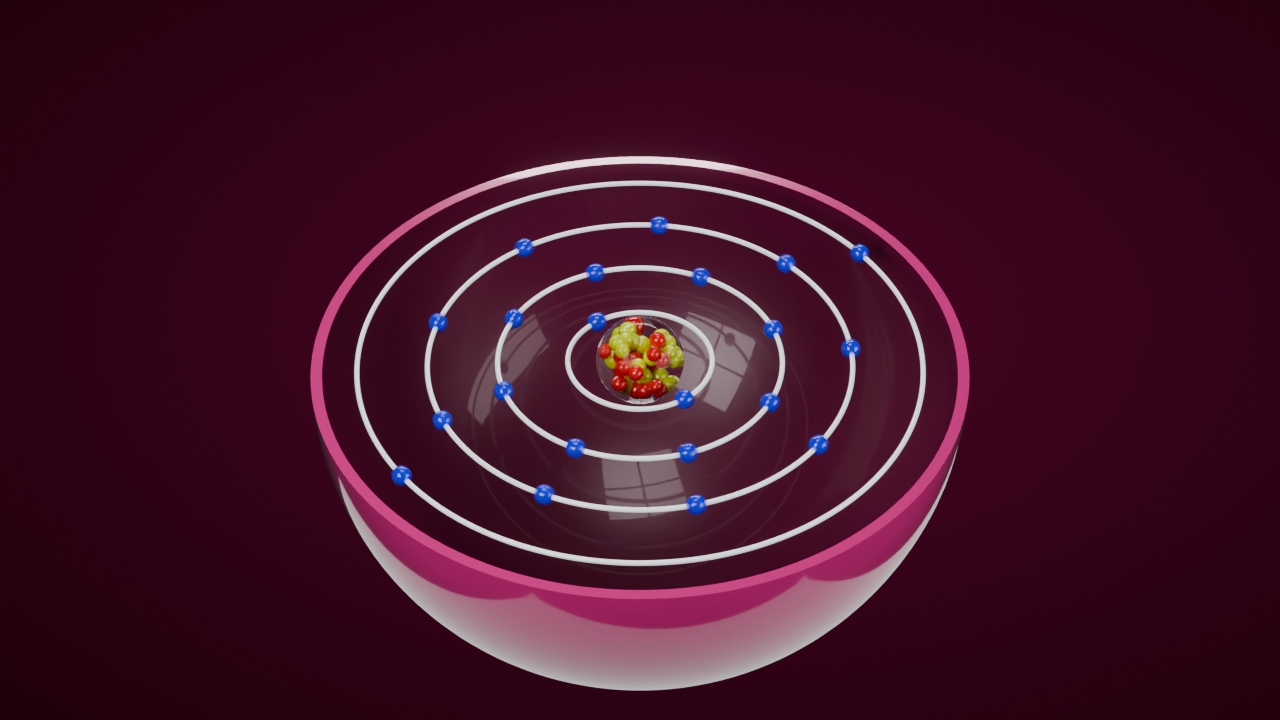
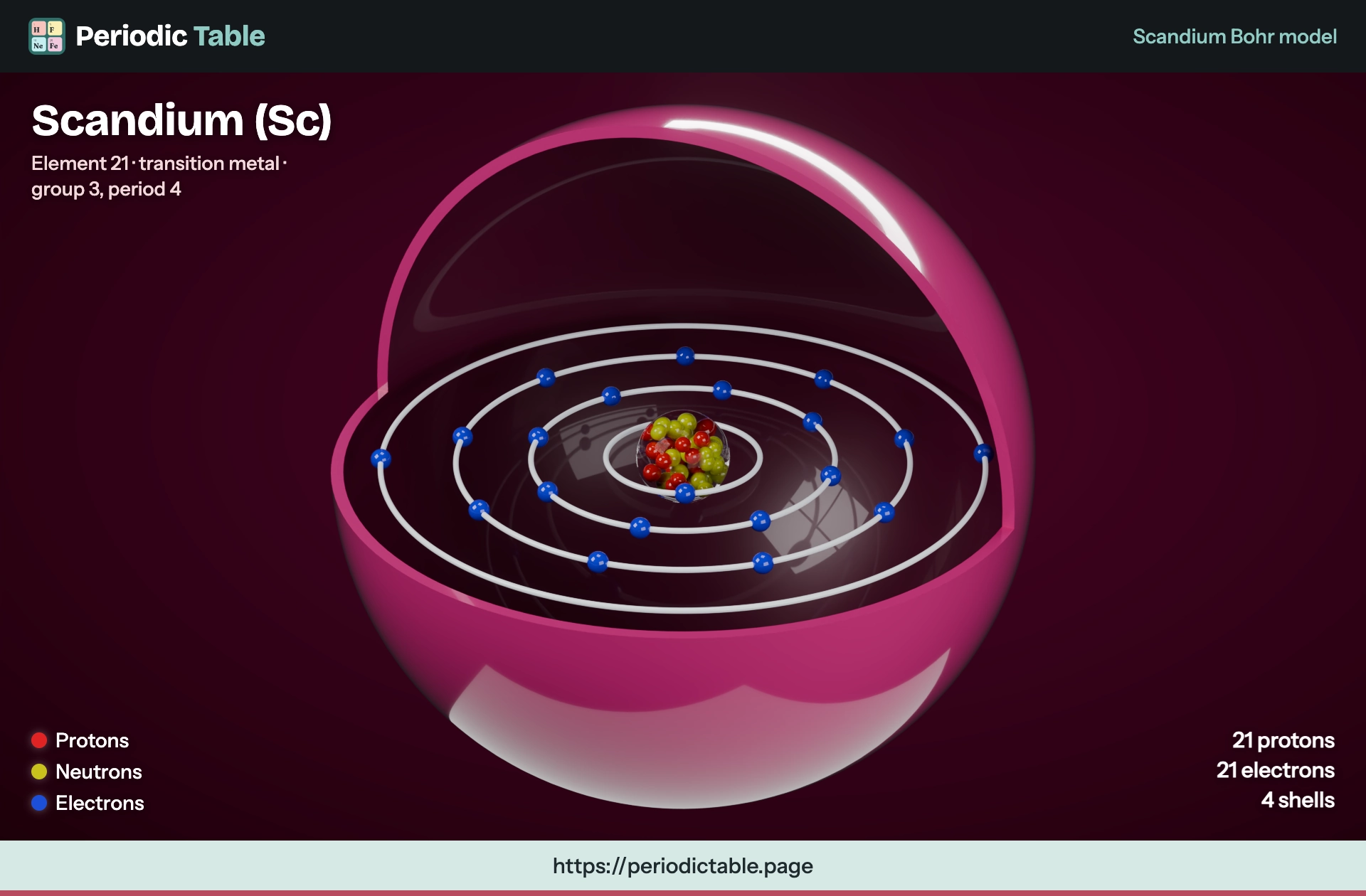
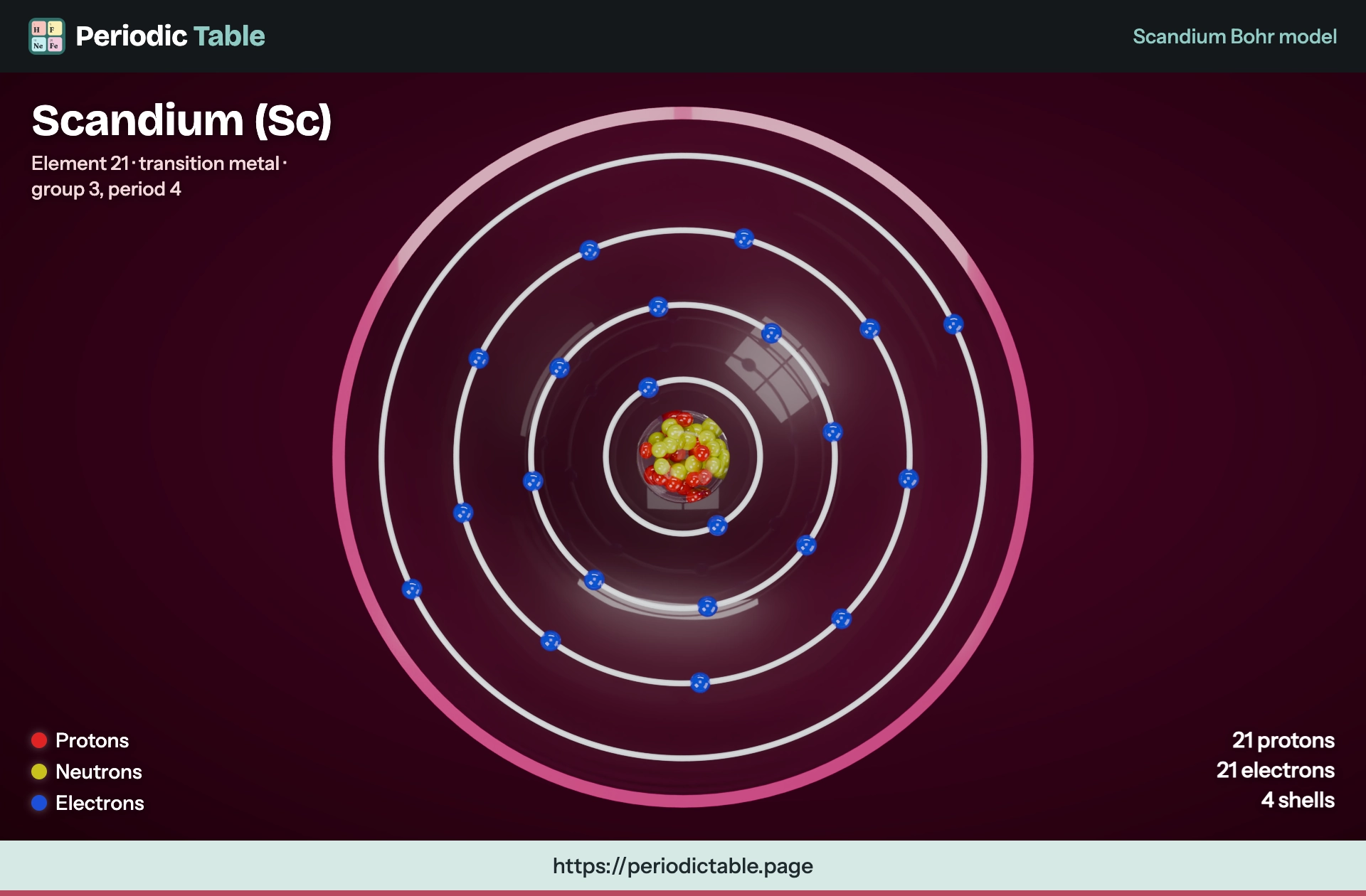
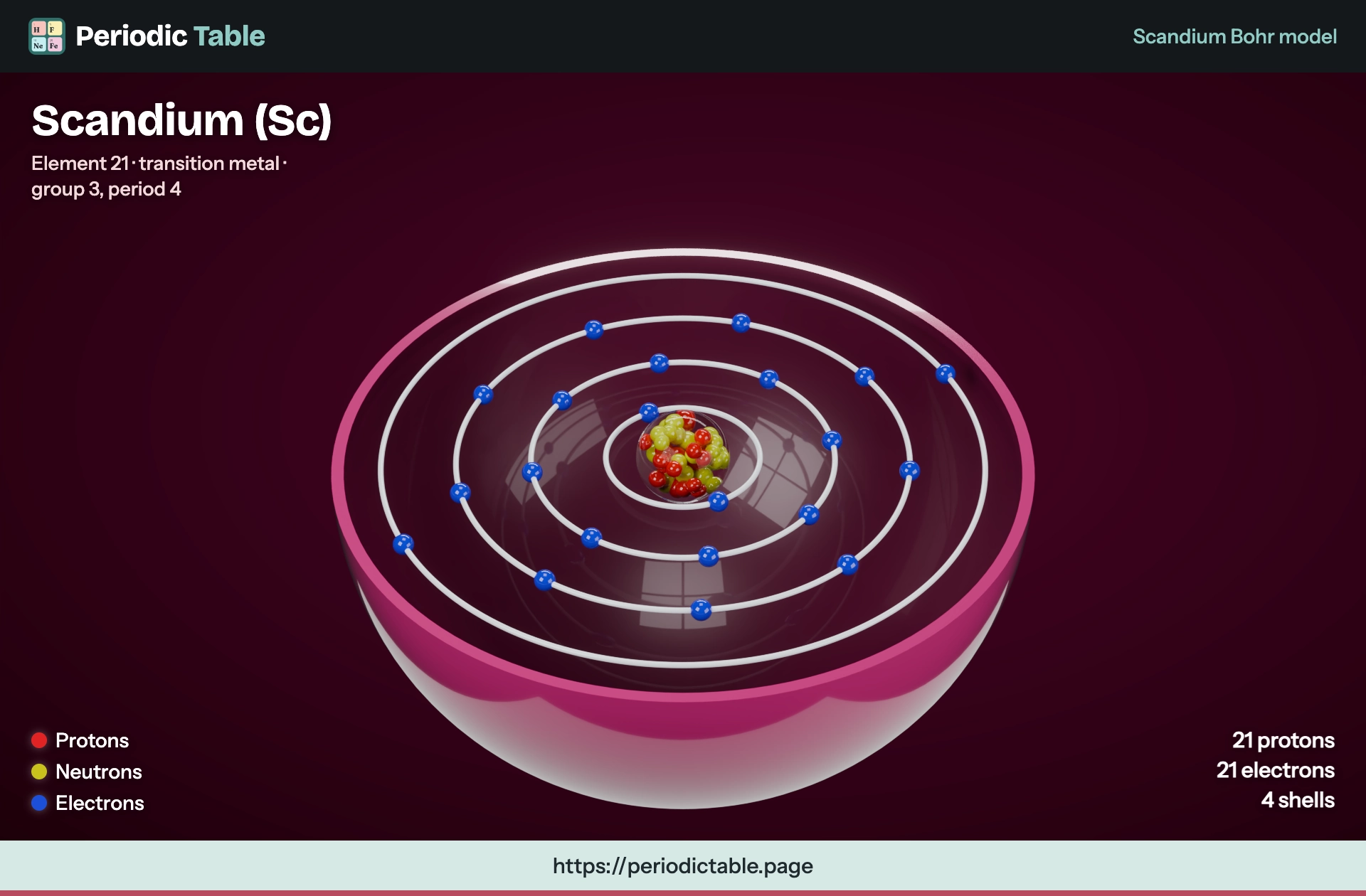
This is a Bohr model of scandium (Sc), a simplified picture of a single scandium atom. Its nucleus holds 21 protons, and a neutral scandium atom has 21 electrons, arranged around it in 4 shells (2 in shell K, 8 in shell L, 9 in shell M and 2 in shell N).
Scandium periodic table electron configuration
- Shorthand
- [Ar] 3d1 4s2
- Full
- 1s2 2s2 2p6 3s2 3p6 4s2 3d1
- Electrons per shell
- 2, 8, 9, 2
Scandium element properties and atomic data
- Atomic number
- 21
- Atomic mass
- 44.9559 u
- Phase at STP
- Solid
- Melting point
- 1540.85°C (1814 K)
- Boiling point
- 2835.85°C (3109 K)
- Density
- 2.985 g/cm³
- Electronegativity (Pauling)
- 1.36
- Period
- 4
- Group
- 3
- Block
- d-block
- Appearance
- Silvery white
- Discovery date
- 1879
- Discovered by
- Lars Fredrik Nilson
- Named by
- —
What is scandium? quick facts about the silvery-white metal
Scandium is a light, silvery-white solid that sits in group 3, period 4 and the d-block of the periodic table, at the head of the column that continues with Y and lutetium. Fresh surfaces look bright, but after time in air they pick up a faint yellowish or pinkish tint as a thin film forms. Scandium is lightweight for a refractory solid, only about a third as heavy as iron for the same volume. Across medicine, nutrition, electronics and construction, industry draws on the alkaline earth metal isotopes in many different ways.
Chemists usually list scandium with yttrium and the fifteen lanthanides as one of the seventeen rare earth elements, because it turns up in the same ore deposits and behaves in a similar +3 way. The table below gathers the reference values you are most likely to need.
| Property | Value |
|---|---|
| Symbol | Sc |
| Atomic number | 21 |
| Standard atomic weight | 44.955907 |
| Group, period, block | 3, 4, d |
| Electrons per shell | 2, 8, 9, 2 |
| Melting point | 1541 °C (1814 K) |
| Boiling point | 2836 °C (3109 K) |
| Density | 2.99 g/cm3 at 20 °C |
| Crystal structure | Hexagonal close-packed (hcp) |
| Electronegativity | 1.36 on the Pauling scale |
| CAS number | 7440-20-2 |
| Discovered | 1879, by Lars Fredrik Nilson |
- State at room temperature
- Solid, soft enough to cut with a hacksaw, ductile when pure.
- Natural form
- Never found native; it is always bound in silicates, phosphates and other host phases.
Atomic data: inside the Sc atom
Each atom carries 21 protons, and the only natural nucleus has 24 neutrons, which gives an atomic mass of just under 45 units. Those numbers explain almost everything the rest of this page describes. For radiocarbon dating questions, students checking carbon atoms will find carbon-12, carbon-13 and carbon-14 and their uses.
Electron configuration and ionization energies
The electron configuration is [Ar] 3d1 4s2: an argon core, two 4s electrons and a single 3d electron. That lone d electron makes scandium the first of the transition metals, yet it gives it up so easily that the d-shell is usually empty in compounds.
- First ionization: 633.1 kJ/mol
- Second ionization: 1235.0 kJ/mol
- Third ionization: 2388.6 kJ/mol
- Fourth ionization: 7090.6 kJ/mol
The jump of almost 4700 kJ/mol between the third and fourth steps is the whole story: removing three electrons reaches the stable argon core, and breaking into that core is prohibitively costly. This is why the +3 ion dominates.
Atomic radius and electronegativity
The empirical atomic radius is 162 pm, the covalent radius about 170 pm and the van der Waals radius 211 pm. With a Pauling value of 1.36, scandium is a fairly electropositive atom, so its bonds to oxygen and the halogens are strongly ionic. Its electron affinity is small, around 18 kJ/mol.
Physical properties of scandium metal
The physical properties of scandium combine a high melting temperature with a low weight, a pairing that few other structural candidates offer. Pure scandium is also surprisingly soft for a refractory solid.
Melting point, boiling point and density
Scandium melts at 1541 °C and boils at 2836 °C, both far above the 660 °C at which Al melts. Yet at 2.99 g/cm3 it is only about 10% heavier than Al and noticeably lighter than titanium at 4.51 g/cm3.
When molten it thins slightly, to about 2.80 g/cm3. That mix of heat tolerance and lightness is why engineers keep coming back to it despite the cost.
Crystal structure and mechanical data
At room temperature scandium atoms pack in a hexagonal close-packed lattice (α-Sc). Above roughly 1337 °C the lattice shifts to body-centred cubic β-Sc before melting.
- Young's modulus: 74.4 GPa
- Shear modulus: 29.1 GPa
- Bulk modulus: 56.6 GPa
- Specific heat capacity: 568 J/(kg·K)
- Thermal conductivity: 15.8 W/(m·K)
Scandium is weakly paramagnetic and conducts electricity moderately well, with a resistivity of about 562 nΩ·m.
Chemical properties of the transition metal
The chemical properties of scandium sit halfway between aluminium and the rare earths that follow it. It tarnishes slowly in air, dissolves in most dilute acids, and burns with a brilliant yellow flame when thin turnings are ignited. A 1:1 mix of nitric and hydrofluoric acid barely touches it, probably because a passive fluoride skin forms.
Both Sc2O3 and the hydroxide are amphoteric: they dissolve in strong acid as the hydrated cation and in strong base as the scandate ion. That dual behaviour is the reason it so often mirrors Al on a test bench, an amphoteric family trait.
Oxidation states and the trivalent ion
The common oxidation state is +3, and almost every known compound contains the trivalent Sc3+ ion. Its ionic radius of 74.5 pm is closer to yttrium's 90 pm than to Al's 53.5 pm, which is why it often travels with the lanthanides in ores. A diagonal relationship with magnesium also shows up in similar ionic sizes and salt solubilities.
Lower oxidation states (+2, +1 and even 0) do exist but are rare laboratory curiosities. The blue-black salt CsScCl3, with divalent centres bonded into sheets, is the simplest example.
Sc compounds: scandia, halides and organic derivatives
The most important compound is scandium oxide, Sc2O3, also called scandia. It is the form in which scandium is traded and the starting point for nearly everything else.
In water the ion precipitates as the hydroxide, Sc(OH)3. Scandium ends up thinly spread through rocks because its small +3 ion slips into the sites of iron and magnesium in common silicates instead of forming deposits of its own.
- Scandium fluoride (ScF3) is insoluble in water but dissolves in excess fluoride to form ScF63−; it also shrinks slightly when heated, an unusual negative thermal expansion.
- Scandium chloride, bromide and iodide are very soluble, and in all four halides the ion has a coordination number of 6.
- Scandium triflate is a water-tolerant Lewis acid used as a reusable catalyst in organic chemistry, for example in aldol and Friedel-Crafts reactions.
- Organometallic compounds with cyclopentadienyl rings, such as the chloride-bridged dimer (ScCp2Cl)2, resemble lanthanide complexes.
Borides and carbides are non-stoichiometric, as is typical for its neighbours.
Isotopes of the rare-Earth element
Nature supplies only one stable isotope, Sc-45, so every sample on Earth is 100% one nuclide, with a nuclear spin of 7/2 that makes it a sensitive NMR probe. Scientists have characterised isotopes from mass 37 to mass 63, and all but the natural one are radioisotopes.
| Nuclide | Half-life | Main decay | Product |
|---|---|---|---|
| Sc-43 | 3.89 hours | β+ / EC | Ca-43 |
| Sc-44 | 4.04 hours | β+ / EC | Ca-44 |
| Sc-46 | 83.8 days | β− | Ti-46 |
| Sc-47 | 3.35 days | β− | Ti-47 |
| Sc-48 | 43.7 hours | β− | Ti-48 |
The pattern is simple: nuclides lighter than 45 decay by electron capture or positron emission toward calcium, while heavier ones undergo beta emission toward titanium. Sc-46, with the longest half-life, serves as a tracer in oil refining, and the mass-44 and mass-47 pair is being studied for matched imaging and therapy in nuclear medicine.
Ekaboron: the discovery Mendeleev predicted
When Dmitri Mendeleev arranged his early periodic system, he left a gap between calcium and titanium and described the missing entry in detail. He called it ekaboron, "one beyond boron", and forecast an atomic weight near 44 and a sesquioxide with the formula Eb2O3.
Naming it after Scandinavia
In 1879 the Swedish chemist Lars Fredrik Nilson was working through the minerals euxenite and gadolinite in search of ytterbium when he isolated about 2 grams of a new, very pure oxide. Spectral analysis confirmed it was new.
He named it after Scandinavia, from its Latin name. Nilson apparently did not know about the prediction, but his colleague Per Teodor Cleve spotted the match and wrote to Mendeleev, turning the find into one of the strongest early proofs of the periodic law.
First isolation by electrolysis
Making metallic scandium took almost six more decades. In 1937 German researchers produced it by electrolysis of a molten potassium, lithium and scandium chloride mixture at 700-800 °C. The first pound of 99% pure material only appeared in 1960, and Al-Sc alloys followed in the early 1970s.
Abundance of scandium on Earth and in the stars
Scandium is not actually scarce. Its average abundance in Earth's crust is around 18-25 ppm, similar to cobalt and well above silver or mercury. The problem is distribution: it rarely concentrates, so most rock holds only a trace.
Beyond our planet it is relatively common. It ranks 23rd among the constituents of the Sun, it shows up in meteorites, and the stable nucleus is forged in supernovae and by cosmic-ray spallation of heavier iron-peak nuclei.
Minerals and ores that carry it
Thortveitite, (Sc,Y)2Si2O7, can hold up to 45% Sc2O3, but its only notable deposits are in southern Norway and Madagascar, and neither is mined at scale. Kolbeckite, a hydrated phosphate, is even richer but occurs only as small crystals. In practice the supply comes from low-grade sources that also yield other rare earths or uranium.
Production, price and supply risk of element scandium
World output is small, roughly 15-20 tonnes per year of scandium oxide, and in nearly every case it is a byproduct of extracting something else. Historic sources include uranium tailings in Ukraine, the Bayan Obo rare-earth operations in China, and apatite processing on the Kola Peninsula in Russia. Newer streams come from nickel laterite refining in the Philippines and from residues of TiO2 pigment and tungsten processing.
Recovery usually relies on solvent extraction from leach solutions, followed by precipitation and calcining to a white powder. To produce metallic scandium, the oxide is converted to the fluoride and then reduced:
$$\mathrm{Sc_2O_3 + 6\,HF \rightarrow 2\,ScF_3 + 3\,H_2O}$$
$$\mathrm{2\,ScF_3 + 3\,Ca \rightarrow 3\,CaF_2 + 2\,Sc}$$
Because mining is never aimed at scandium itself, the price stays high and volatile. US Geological Survey figures for 2015-2019 put small lots of ingot at roughly $107-134 per gram, against about $4-5 per gram for the oxide. The Royal Society of Chemistry rates its relative supply risk at 9.5 out of 10, with about 97% of production concentrated in one country and a recycling rate under 10%.
Uses of Sc in industry and technology
Despite tiny volumes, scandium punches above its weight across several branches of industry. Almost every application exploits one of two traits: it strengthens aluminium at very low loadings, or its ions improve the performance of light and energy technology.
Aluminium alloys for aerospace
The biggest use by weight is in aluminium alloys containing just 0.1-0.5% Sc. The addition forms a fine, coherent Al3Sc precipitate that pins grain boundaries, so the grain growth that normally weakens the heat zone of welded joints is held back.
The result is an alloy that is stronger, more heat-resistant and easier to weld than standard aluminum alloys. Soviet designers used it in aerospace parts for the MiG-21 and MiG-29 fighters, and it now appears in aircraft structures and additive-manufacturing powders, where every gram saved over standard aluminum counts.
Lighting with metal halide lamps
Adding scandium iodide and sodium iodide to mercury vapour lamps produces a spectrum close to natural sunlight. These high-intensity lamps are used for stadium floodlights, film sets and street lighting, where accurate colour rendering matters for broadcast cameras.
Solid oxide fuel cells and energy
Scandium-stabilised zirconia conducts oxygen ions better than the usual yttria-doped version, so it serves as a high-efficiency electrolyte in fuel cells that can run at lower temperatures. Gadolinium-scandium-gallium garnet (GSGG) crystals have also been used in high-power laser research.
Sports equipment
Scandium-Al tubing made its name in premium sports equipment: bicycle frames, baseball bats, lacrosse sticks and even handgun frames. Carbon fibre has since taken over the top end of cycling, but the material is still prized where a thin, stiff, weldable tube is needed.
Health and safety: is element 21 toxic?
On health and safety, the bulk solid is considered low in toxicity, and it has no known biological role in people or plants. Most toxicology data come from animal studies of soluble salts, where only large doses caused harm, and its chemistry is often compared with that of lanthanum salts.
The practical risks are mostly physical: fine powder and turnings can ignite in air, and inhaling dust from cutting or grinding should be avoided with local extraction and a suitable respirator. Treat solutions of its halides like other mild acids, since hydrolysis makes them acidic.