


Platinum element (Pt): platinum periodic table facts
Platinum periodic table facts: platinum (Pt) is element 78, a transition metal in group 10, period 6. If you have ever held a wedding band that felt heavier than it looked, you may have met platinum, the dense, silvery-white metal that Spanish explorers once dismissed as platina, or "little silver." Readers asking why Pu-239 powers reactors and weapons while Pu-238 heats spacecraft will like the plutonium on the periodic table page with details on each isotope and its half-life.
It is a malleable, ductile and remarkably unreactive chemical element, a precious metal and a transition metal at the same time. Below you get the numbers that define it, the chemistry behind its stubborn stability, and the reasons industry pays so much for it.
Rotate the 3D Bohr model of platinum
Drag to orbit, scroll to zoom.
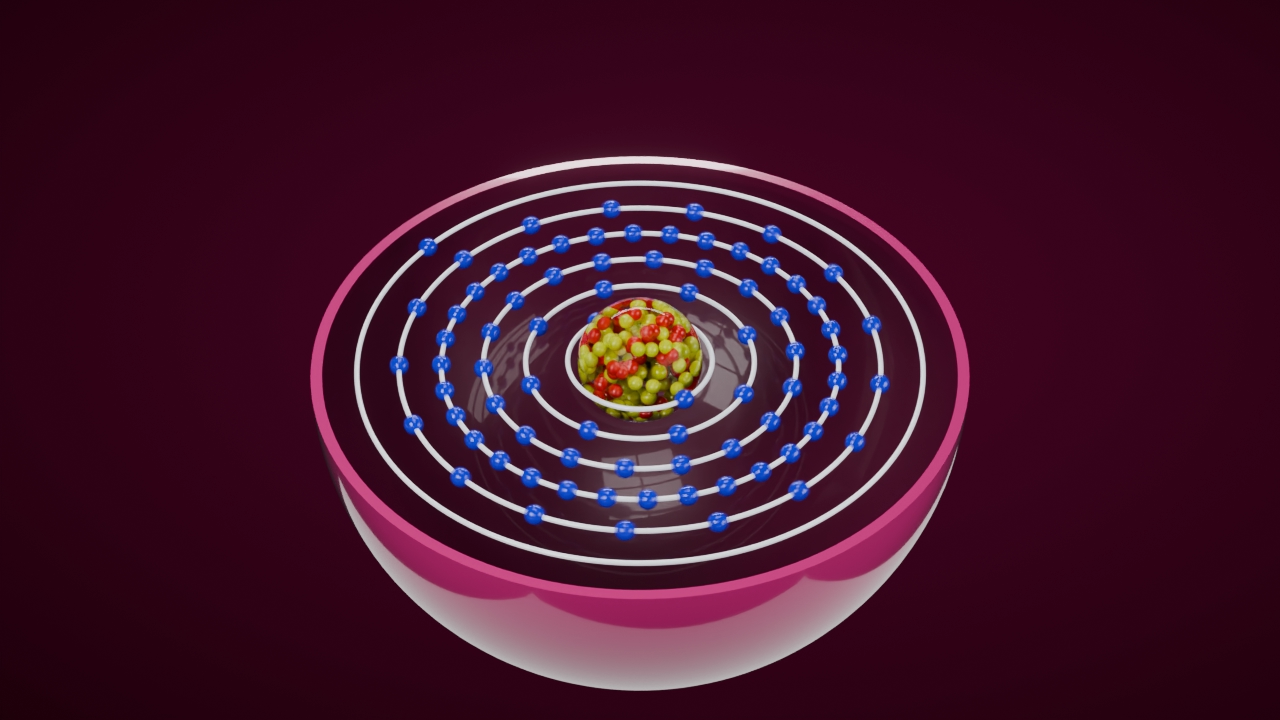
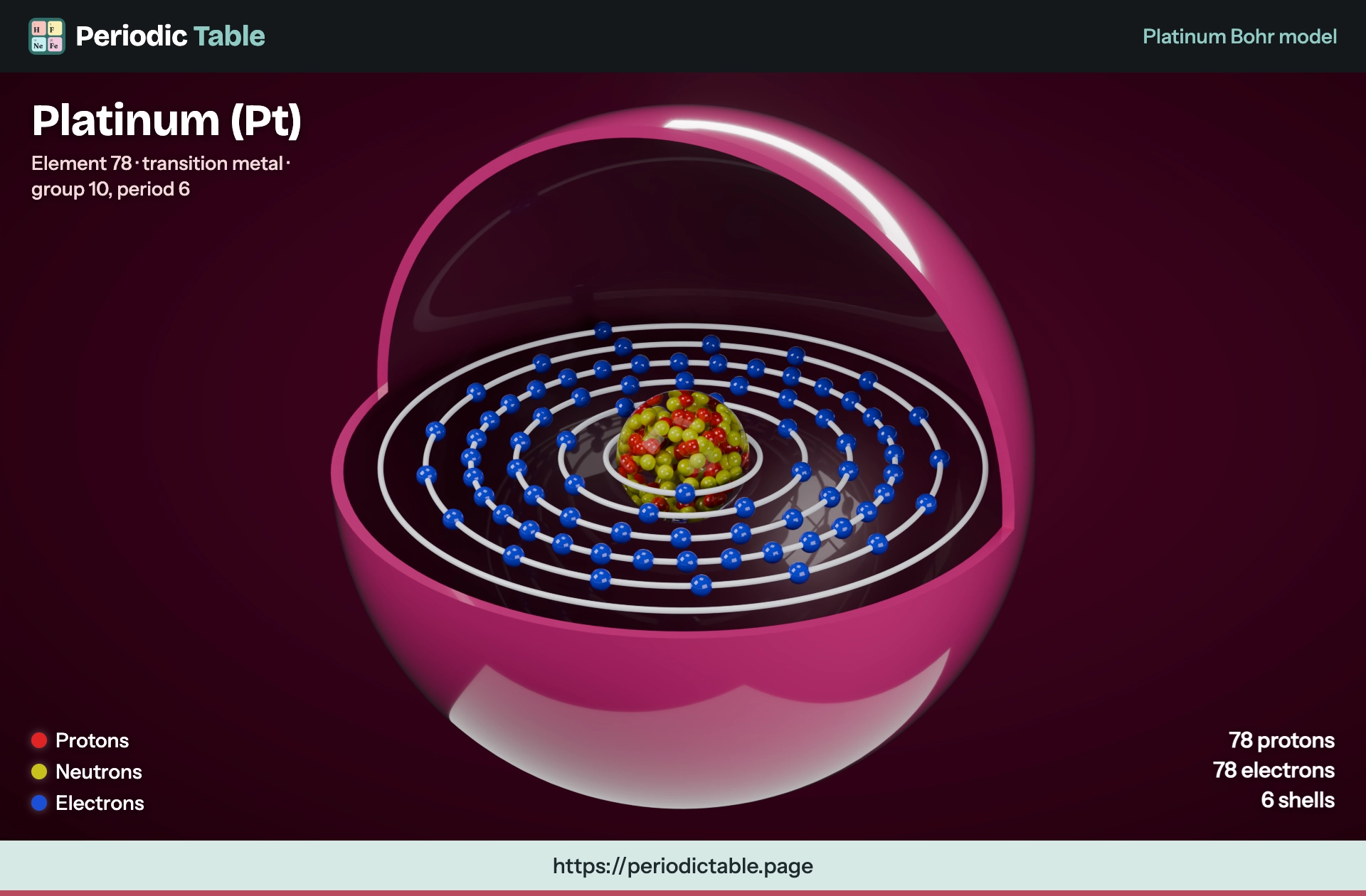
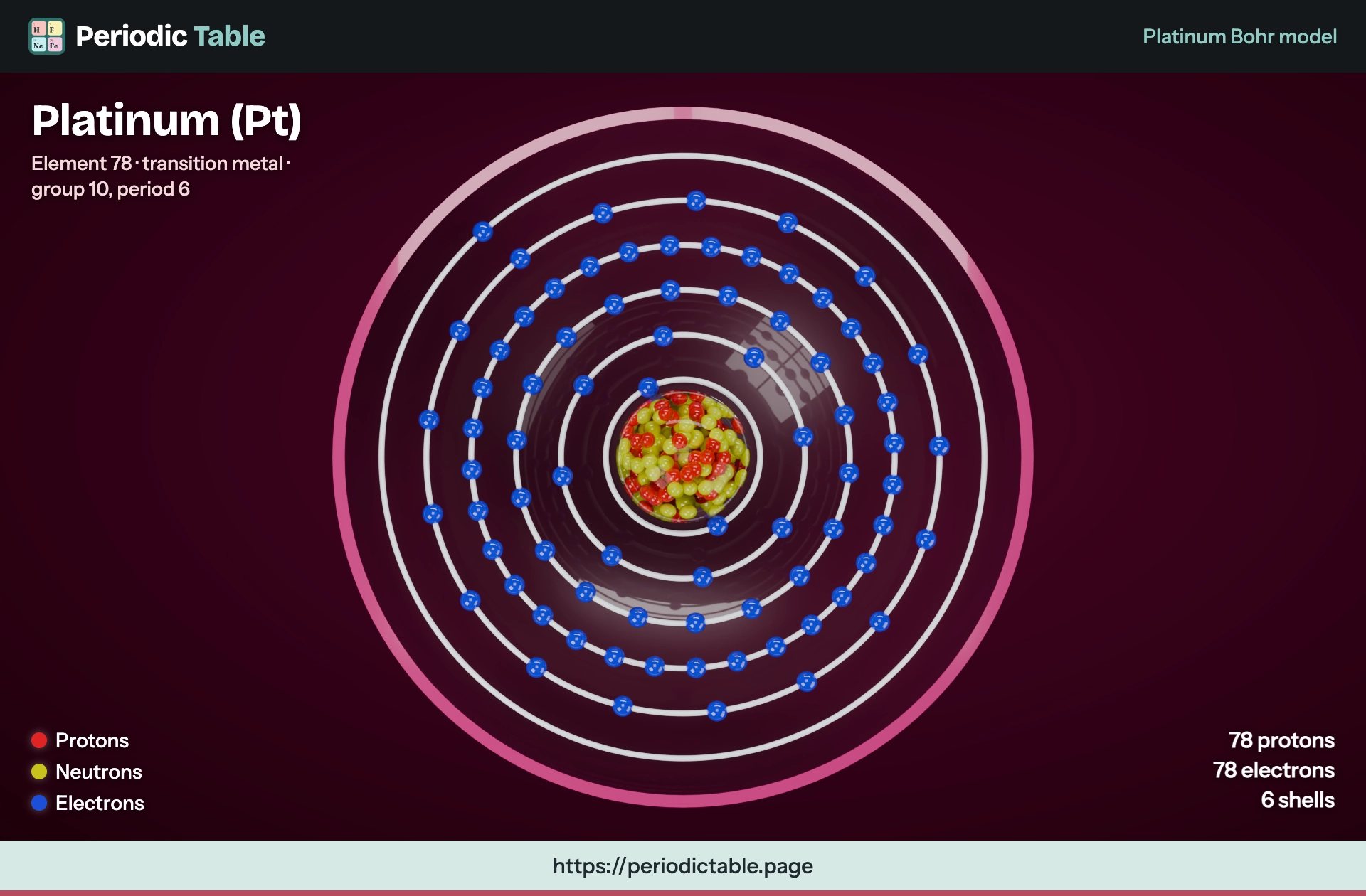
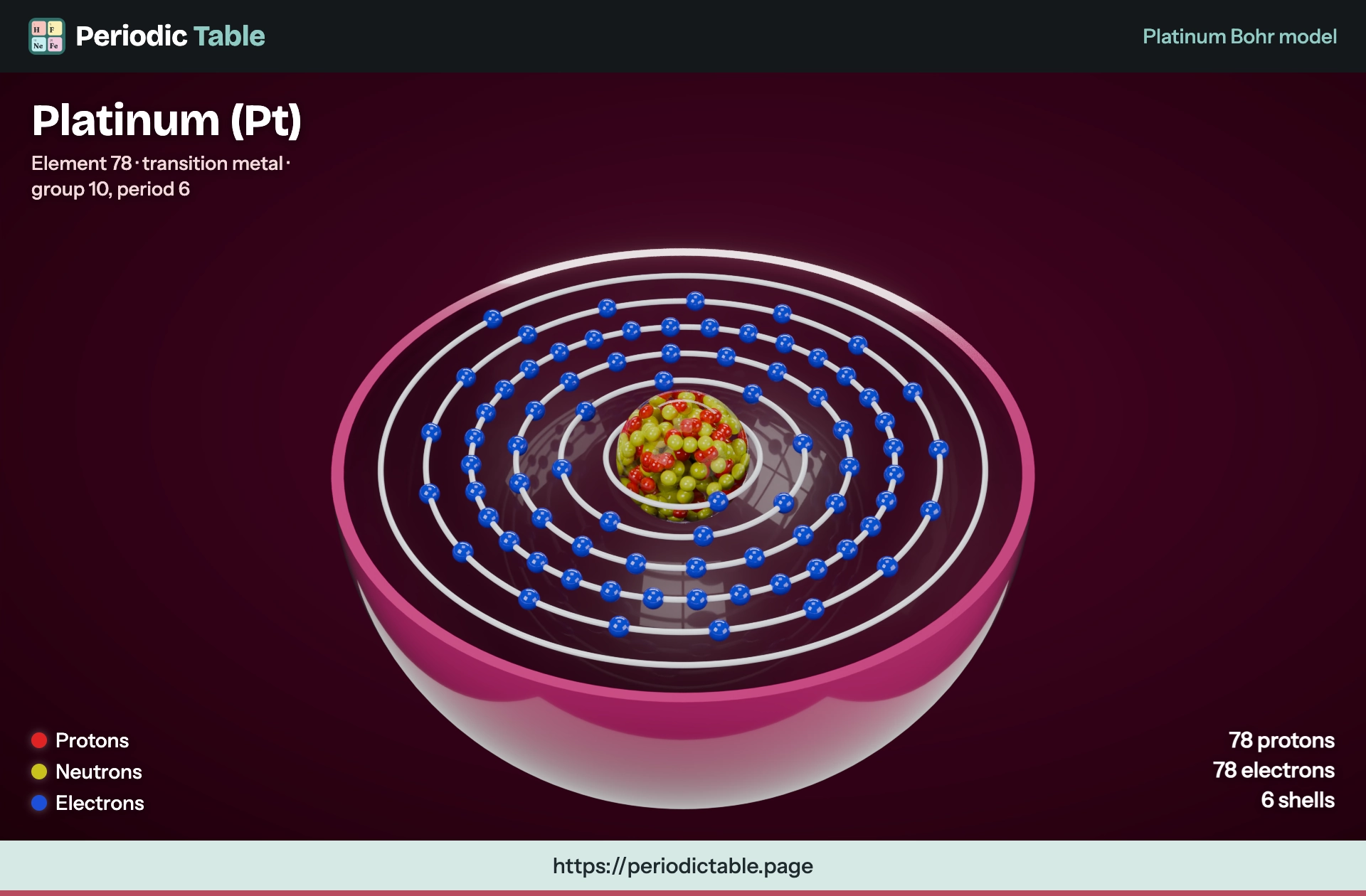
This is a Bohr model of platinum (Pt), a simplified picture of a single platinum atom. Its nucleus holds 78 protons, and a neutral platinum atom has 78 electrons, arranged around it in 6 shells (2 in shell K, 8 in shell L, 18 in shell M, 32 in shell N, 17 in shell O and 1 in shell P).
Platinum periodic table electron configuration
- Shorthand
- [Xe] 4f14 5d9 6s1
- Full
- 1s2 2s2 2p6 3s2 3p6 4s2 3d10 4p6 5s2 4d10 5p6 6s1 4f14 5d9
- Electrons per shell
- 2, 8, 18, 32, 17, 1
Platinum element properties and atomic data
- Atomic number
- 78
- Atomic mass
- 195.0849 u
- Phase at STP
- Solid
- Melting point
- 1768.25°C (2041.4 K)
- Boiling point
- 3824.85°C (4098 K)
- Density
- 21.45 g/cm³
- Electronegativity (Pauling)
- 2.28
- Period
- 6
- Group
- 10
- Block
- d-block
- Appearance
- Silvery white
- Discovery date
- 1735
- Discovered by
- Antonio de Ulloa
- Named by
- —
Platinum element facts at a glance
The platinum element sits in the lower middle of the periodic table, among the transition metals. Its symbol, Pt, comes from the Latinised name, and its identifying CAS number is 7440-06-4. The table below gathers the reference values most chemistry courses and data sheets quote for platinum (Pt). For the story of a name taken from the Japanese word Nihon and recognised by IUPAC in 2016, see the elemental nihonium for the background.
| Property | Value for Pt |
|---|---|
| Atomic number | 78 |
| Standard atomic mass | 195.084 u |
| Group / period / block | Group 10, period 6, d-block |
| Electron configuration | [Xe] 4f14 5d9 6s1 |
| Density at 20 °C | 21.45 g/cm3 |
| Melting point | 1768.3 °C (2041.4 K, 3214.9 °F) |
| Boiling point | 3825 °C (4098 K, 6917 °F) |
| State at room temperature | Solid |
| CAS number | 7440-06-4 |
Atomic number and atomic weight
Every Pt atom carries 78 protons, which is why chemists often shorten its name to element 78. Its standard atomic weight of 195.084 is an average across the naturally occurring isotope mix, weighted by how common each one is.
Neighbours help you place it: gold (79) sits to the right, and palladium directly above it in group 10. That position explains a lot of its chemistry, because the elements in this corner share filled or nearly filled d-orbitals that make them reluctant to give up electrons.
Platinum metal physical properties
Pure platinum metal is lustrous and silvery white, with a soft sheen that does not yellow or dull with age. Among the physical properties of platinum, three stand out: it is extraordinarily heavy, it melts only at furnace temperatures, and it is the most ductile of all pure metals, so a single gram can be drawn into wire far longer than the same mass of gold or copper allows. Medicine, industrial catalysts and technology all use the lanthanides, studied by chemists since the nucleus was understood.
Density, melting point and boiling point
At 21.45 g/cm3, platinum is the third densest element, behind only osmium and iridium. To put that in your hand: a one troy ounce bar (31.10 g) occupies just 1.45 cm3, and the same volume of gold would weigh about 28.0 g.
Platinum melts at 1768.3 °C, roughly 704 °C hotter than gold, and boils at 3825 °C. That gap is why it keeps its shape at high temperatures that would slump most jewellery alloys, and why early metalworkers struggled to cast it at all.
Crystal structure and mechanical data
Atoms pack into a face-centered cubic lattice, a tightly packed, symmetrical arrangement that gives the metal its easy workability. Platinum is weakly paramagnetic, so a magnet will not pick it up, a handy way to separate it from iron and nickel impurities.
| Mechanical or thermal property | Typical value |
|---|---|
| Mohs hardness | 3.5 |
| Young's modulus | 168 GPa |
| Thermal conductivity | 71.6 W/(m·K) |
| Electrical resistivity (20 °C) | 105 nΩ·m |
Atomic data and electron configuration of Pt
Platinum's ground-state electron configuration, [Xe] 4f14 5d9 6s1, is irregular: you might expect two electrons in the 6s orbital, but one moves into the 5d set. Relativistic effects, which matter for heavy atoms with fast inner electrons, contract the 6s orbital and pull it closer to the nucleus. The empirical atomic radius is about 139 pm, the covalent radius about 136 pm, and the van der Waals radius roughly 175 pm.
Electronegativity and ionization energies
On the Pauling scale, Pt has an electronegativity of about 2.28, unusually high for a metal. Its first two ionization energies are roughly 870 and 1791 kJ/mol.
That first ionisation energy sits well above palladium's, about 804 kJ/mol, even though that lighter neighbour sits directly above Pt in the table. Those high numbers are the atomic-level reason the metal holds onto its electrons and resists oxidation.
Chemical properties of platinum
The chemical properties of this element come down to one word: inertness. Bulk platinum will not oxidize in air at any temperature, water leaves it untouched, and most single acids do nothing to it. Yet that same surface is a superb meeting place for other molecules, which is why it speeds up so many reactions without being consumed.
Corrosion resistance and aqua regia
Platinum's corrosion resistance matches gold's, so it does not tarnish in everyday use. Platinum is insoluble in nitric acid or hydrochloric acid on their own, but a hot mixture of the two, called aqua regia, dissolves it to form chloroplatinic acid:
$$\mathrm{Pt} + 4\,\mathrm{HNO_3} + 6\,\mathrm{HCl} \rightarrow \mathrm{H_2PtCl_6} + 4\,\mathrm{NO_2} + 4\,\mathrm{H_2O}$$
Halogens and sulfur are the other weak points. Chlorine, bromine and sulfur attack it slowly, and fluorine reacts vigorously near 500 °C to give platinum tetrafluoride. Molten alkalis and cyanide solutions can also eat into it, which matters when you choose crucible materials for a lab.
Oxidation states of the noble metal
As a noble metal, Pt usually appears in compounds at +2 or +4. The +2 state tends to form flat, square planar complexes, while +4 complexes are usually octahedral. Rarer states run from about −3 up to +6, and the negative ones, seen in caesium and barium platinides, are unusual for any of the noble metals and again trace back to relativistic stabilisation of the 6s orbital.
Platinum isotopes and half-life
Natural platinum is a blend of six isotopes. Platinum-195 is the most abundant, and because it has a nuclear spin of ½ it is the one chemists use for NMR studies of Pt complexes.
Platinum-194 and platinum-196 together make up more than half of the rest, while platinum-198 is a smaller share. Only platinum-190 is radioactive: it undergoes alpha decay with a half-life of roughly 4.8 × 10¹¹ years, so slowly that a kilogram of natural metal shows only about 17 decays a second.
| Isotope | Natural abundance | Stability |
|---|---|---|
| Pt-190 | 0.012% | Alpha emitter, very long-lived |
| Pt-192 | 0.78% | Stable |
| Pt-194 | 32.9% | Stable |
| Pt-195 | 33.8% | Stable |
| Pt-196 | 25.2% | Stable |
| Pt-198 | 7.36% | Stable |
Dozens of synthetic radioisotopes have also been made. The longest-lived, Pt-193, lasts about 50 years before decaying by electron capture.
Platinum compounds from chloroplatinic acid to cisplatin
Most platinum compounds start from hexachloroplatinic acid, H2PtCl6, the product of the dissolving reaction above. Adding ammonium chloride precipitates ammonium hexachloroplatinate, and heating that salt returns pure metal, a route refiners still rely on. Heating the acid itself steps it down through PtCl4 and PtCl2 to the metal.
- Oxides: platinum(IV) oxide, PtO2, is the black powder known as Adams' catalyst, used to add hydrogen across double bonds.
- Finely divided metal: platinum black is a sooty, high-surface form prized for catalysis and electrodes.
- Organometallics: Zeise's salt, with an ethylene ligand bound to Pt, was one of the first organometallic compounds ever made.
- Drugs: cisplatin, carboplatin and oxaliplatin are square planar Pt(II) complexes that crosslink DNA in dividing cells.
Where native platinum occurs
Platinum is one of the scarcest metals in Earth's crust, at around 0.005 parts per million. Because it resists weathering, native platinum often survives as grains in river gravels, and the alluvial deposits of Colombia's Chocó region and Russia's Ural Mountains have been worked for centuries.
That rarity, combined with a few concentrated sources, is what keeps its scarcity in the headlines. In primary rock it hides in minerals such as sperrylite (platinum arsenide) and cooperite, a sulfide, so finding it is as much a matter of geology as of prospecting.
Platinum group metals in nickel and copper ores
Platinum rarely travels alone. It belongs to the platinum group metals with palladium, rhodium, ruthenium, osmium and iridium, and these elements turn up together in layered igneous intrusions.
The Merensky Reef inside South Africa's Bushveld complex holds most of the world's known reserves. The Sudbury Basin in Ontario and the Norilsk deposits in Siberia yield the platinum-group metals as by-products of nickel mining, and smaller sources include the Stillwater area of Montana.
Supply risk and top producing countries
The Royal Society of Chemistry rates platinum's supply risk as high because output is concentrated in very few places. Crustal abundance is tiny, but the recycling rate is above 30%, largely from scrapped autocatalysts. Recent mine output, rounded, looks like this:
| Country | Mine production (tonnes, 2024) | Share of world output |
|---|---|---|
| South Africa | 120 | 70.6% |
| Zimbabwe | 19 | 11.2% |
| Russia | 18 | 10.6% |
| Canada | 5.2 | 3.1% |
| United States | 2.0 | 1.2% |
How pure platinum is mined and refined
Getting pure platinum from rock is a long, multi-stage process, and it explains much of platinum's price. The steps run roughly in this order:
- Mining: ore is blasted underground or in open pits, then crushed and milled to a fine powder.
- Flotation: chemicals make the metal-bearing sulfide grains cling to air bubbles, concentrating them in a froth.
- Smelting: the concentrate is melted to a matte rich in nickel, copper and precious metals.
- Refining: the matte is dissolved and split into gold, silver and the individual platinum-group metals; in copper electrorefining the noble elements settle as "anode mud."
- Precipitation: gold is removed with iron(II) chloride, then Pt is dropped out as ammonium hexachloroplatinate and heated back to metal.
Each step trades on a property you met above: the metal's density, its non-magnetic behaviour, its very high melting temperature and its resistance to most acids all let impurities be stripped away while it stays put. Modern metallurgy can push purity beyond 99.95% for jewellery-grade and investment-grade metal.
Uses of platinum in industry, jewelry and medicine
The biggest platinum uses all draw on the same handful of traits: heat tolerance, corrosion immunity and an unmatched talent as a catalyst. Vehicle exhaust treatment, jewelry and chemical processing together account for most of each year's demand, with electronics and medical devices taking smaller but valuable slices.
Catalytic converters and fuel cells
In a catalytic converter, a thin coating of Pt helps turn carbon monoxide and unburned fuel into carbon dioxide and water, and works alongside rhodium against nitrogen oxides. Tighter rules on vehicle emissions drove decades of demand, and platinum-based catalytic converters remain standard on diesel engines. Refineries rely on the same surface behaviour for petroleum refining, especially catalytic reforming, which upgrades low-octane naphtha into petrol.
Looking ahead, fuel cells and electrolysers for green hydrogen use Pt electrodes in proton exchange membranes, so hydrogen fuel cells could make clean energy a larger market than exhaust control. Cutting tailpipe emissions and producing fuel without carbon both lean on oxygen-reduction chemistry that happens best on a platinum surface.
Jewelry, bullion and platinum as an investment
For jewelry, the metal's natural white colour means it needs no rhodium plating, unlike white gold, and it wears without losing mass. Watches from top Swiss makers use platinum for the same reason. As an investment, platinum trades under the currency code XPT as bullion: coins, bars and small ingots, usually .9995 fine.
The price of platinum swings more than the price of gold because so much demand is industrial, and it has traded both well above and well below the yellow metal. Because the element is so scarce, its name became shorthand for the top tier: "platinum" credit cards and platinum awards borrow the metal's rarity, not its reactivity. That same scarcity keeps it among the most valued precious metals.
Medicine, electronics and measurement standards
In medicine, Pt-based chemotherapy drugs, the anticancer drugs named above, treat testicular and ovarian tumours as well as lung cancer, while its biocompatibility suits pacemakers, stents and dental crowns. Electronics use it in spark plugs, thermocouples, platinum resistance thermometers, contact points and the coatings on hard disk drives. Platinum's high melting temperature and inertness also make crucibles and other laboratory equipment last, and the glass industry uses Pt-lined vessels because molten glass does not stick to it.
Platinum alloys even defined measurement itself: the international prototype meter and, until 2019, the kilogram were both made from a 90:10 platinum-iridium alloy. The standard hydrogen electrode, the zero point for electrode potentials, uses a platinized Pt surface.
History of the element platinum
People worked the element platinum long before anyone named it. Egyptian craftsmen left traces of it in gold objects from around the 7th century BCE, though they probably never knew it was there. Pre-Columbian metalsmiths in what is now Ecuador and Colombia went further, sintering platinum nuggets and grains with gold powder to make artifacts they could hammer into shape.
Europe's record starts in 1557, when the Italian humanist Julius Caesar Scaliger described a metal from Central America that no fire could melt. Spanish conquistadors saw it as an annoyance that spoiled their gold, and some even threw the grains back into rivers.
In 1735 Antonio de Ulloa examined the metal in South America and published his account in 1748. Meanwhile, the British metallurgist Charles Wood sent samples to William Brownrigg, who presented them to the Royal Society in 1750 as a new metal.
Chemists then raced to tame platinum. Henrik Scheffer fused it in 1752 with the help of arsenic, Lavoisier melted it with an oxygen-fed flame, and in 1786 Pierre-François Chabaneau, working in Spain, produced malleable ingots, opening the brief "platinum age" there.
Health effects of platinum and platinum salts
For your health, solid platinum is close to harmless. The bulk Pt metal is so unreactive that regulators reviewing its use in implants found no evidence of toxicity in the body. The concern is platinum salts, the soluble chlorides and similar substances found in refineries and catalyst plants:
- Short-term exposure can irritate the eyes, nose and throat.
- Repeated contact can cause allergic reactions of the skin and airways, a condition sometimes called platinosis.
- Pt-based drugs, by design, damage DNA, which is why they carry side effects such as nausea and hearing loss.
US workplace limits for soluble salts sit at 2 micrograms per cubic metre of air over an 8-hour shift, which shows how potent sensitisers they are.
Environmental effects of platinum
Platinum products seldom cause environmental problems directly, but traffic does spread fine particles: catalytic exhaust systems shed tiny amounts of metal onto roadsides, so levels are higher near busy roads, tunnels and garages. In the wider environment, plants take up platinum mainly through their roots, and soil microbes may convert it into more mobile forms. Research on long-term effects on wildlife is still limited, so most experts treat road dust and refinery sites as the places to watch.