


Zinc element (Zn): zinc periodic table facts
Zinc periodic table facts: zinc (Zn) is element 30, a transition metal in group 12, period 4. You handle zinc (Zn) more often than you might think: it coats the body panels of your car, powers the cells in your TV remote and helps your cells divide every day. Physics and chemistry teachers use element 94 to show neutron capture, beta decay and spontaneous fission side by side.
These facts about zinc start with the basics of this bluish-white metal, then walk you through its properties, where it is mined, how it is used and how much your body needs. If you want the short version about zinc first, the data table below covers it.
Rotate the 3D Bohr model of zinc
Drag to orbit, scroll to zoom.
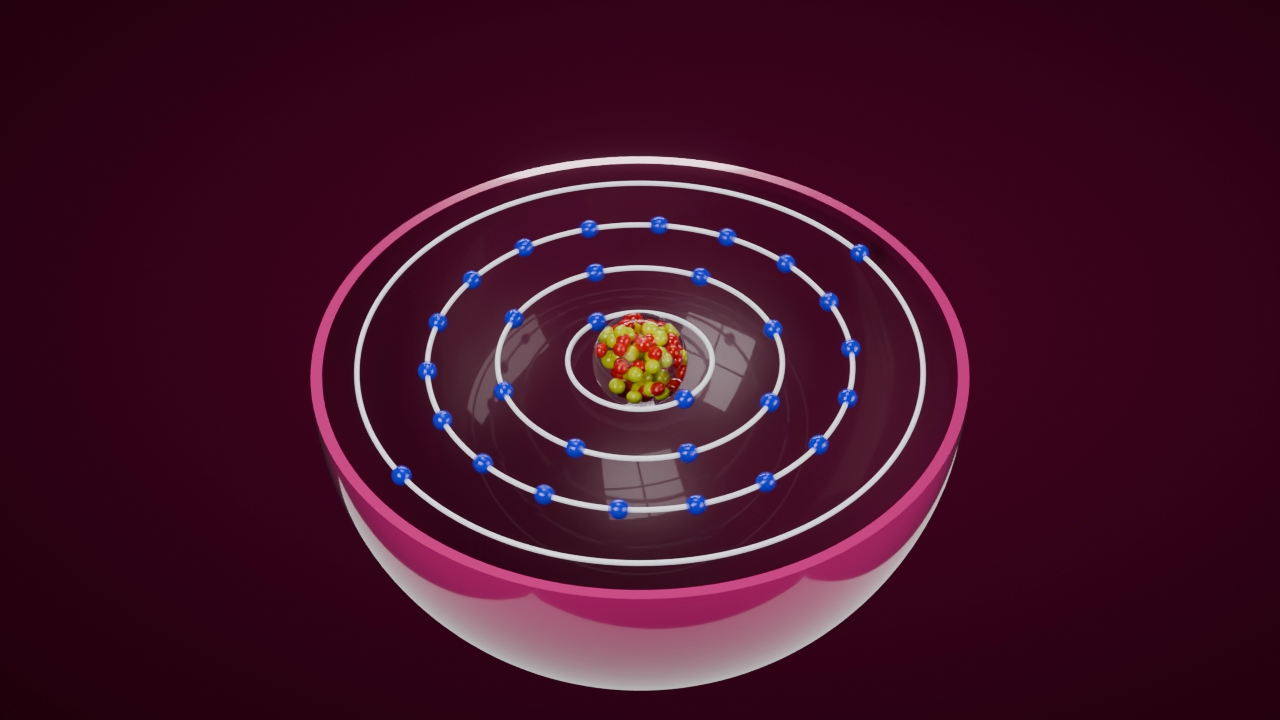
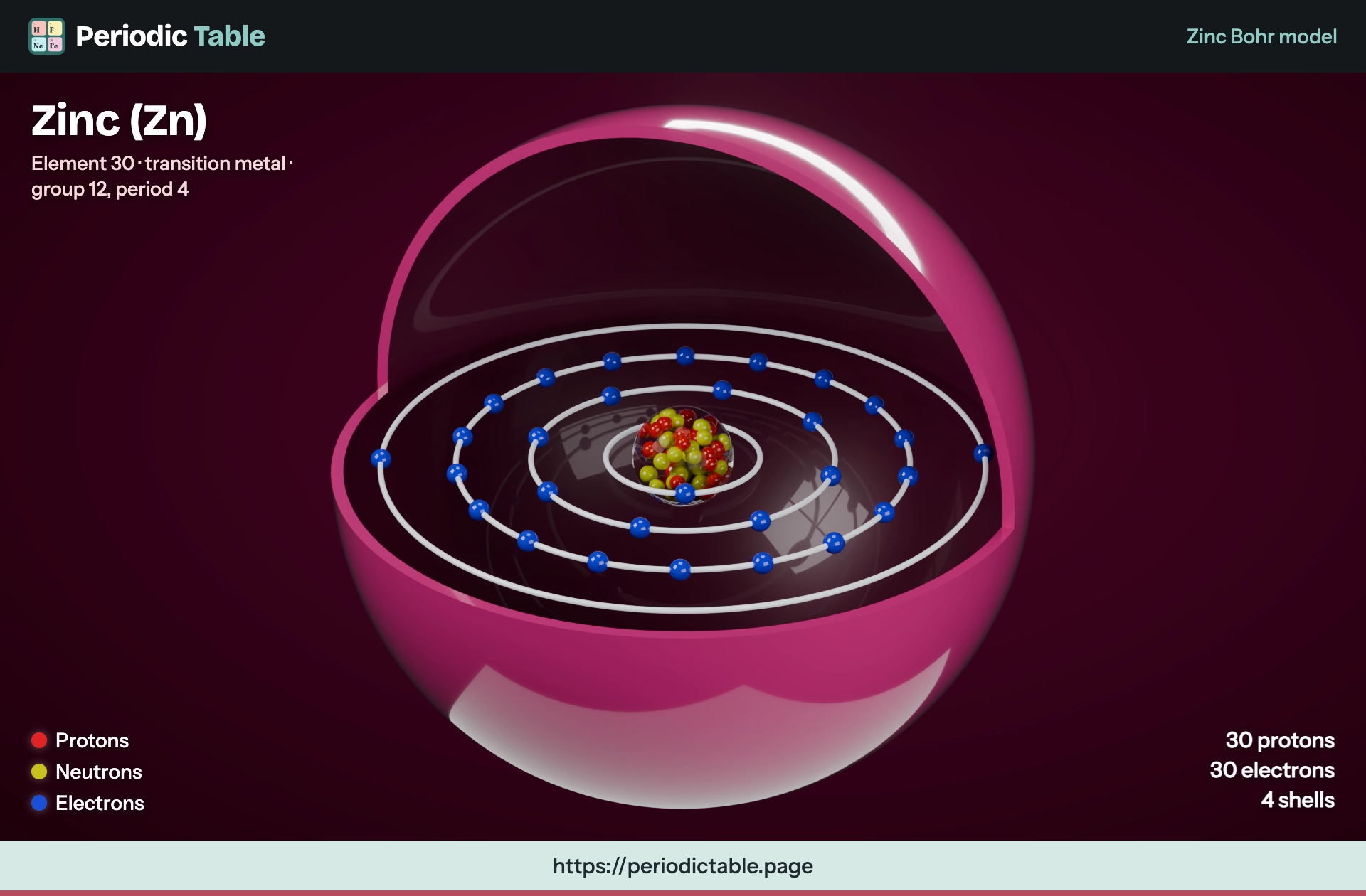
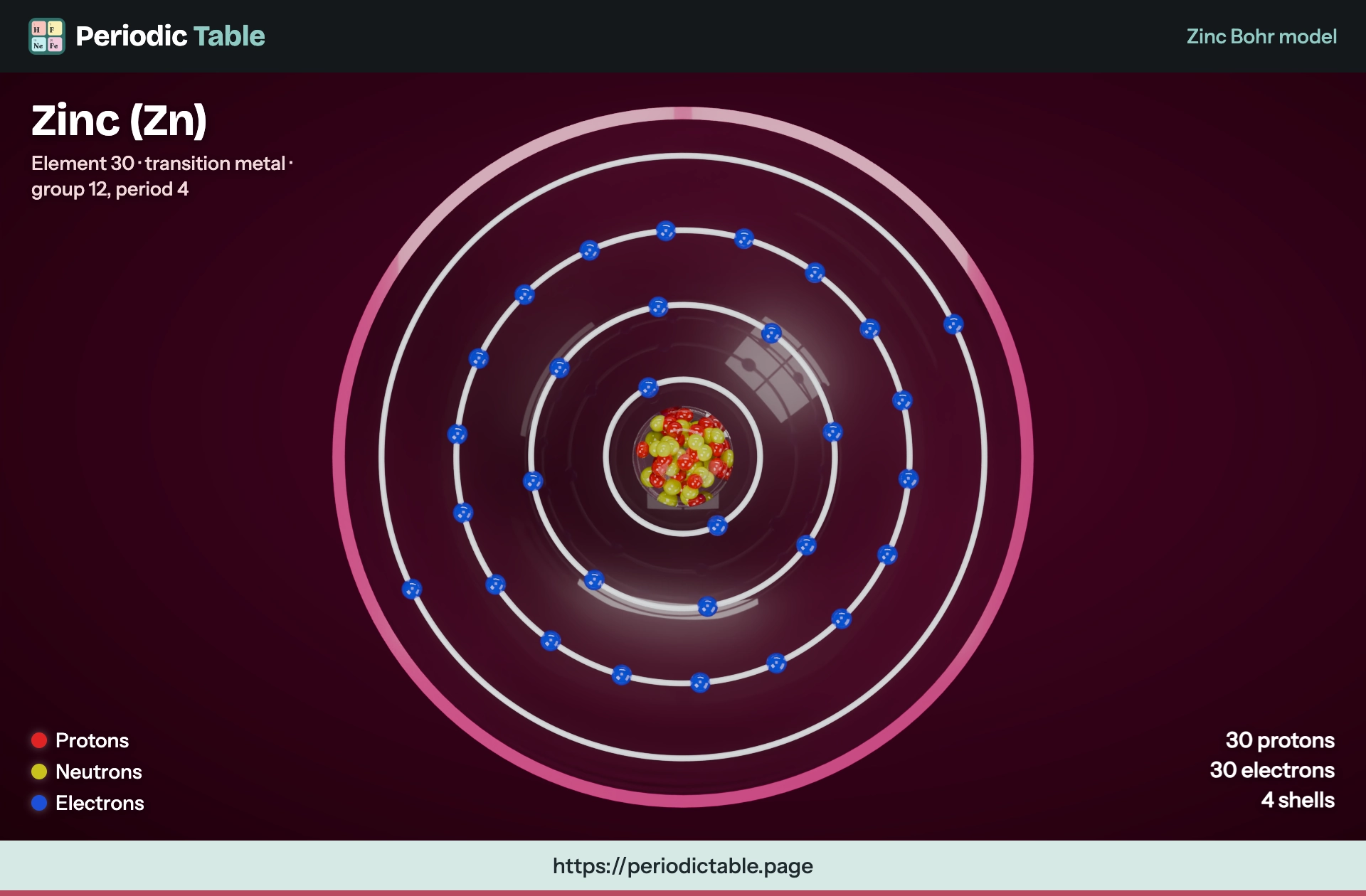
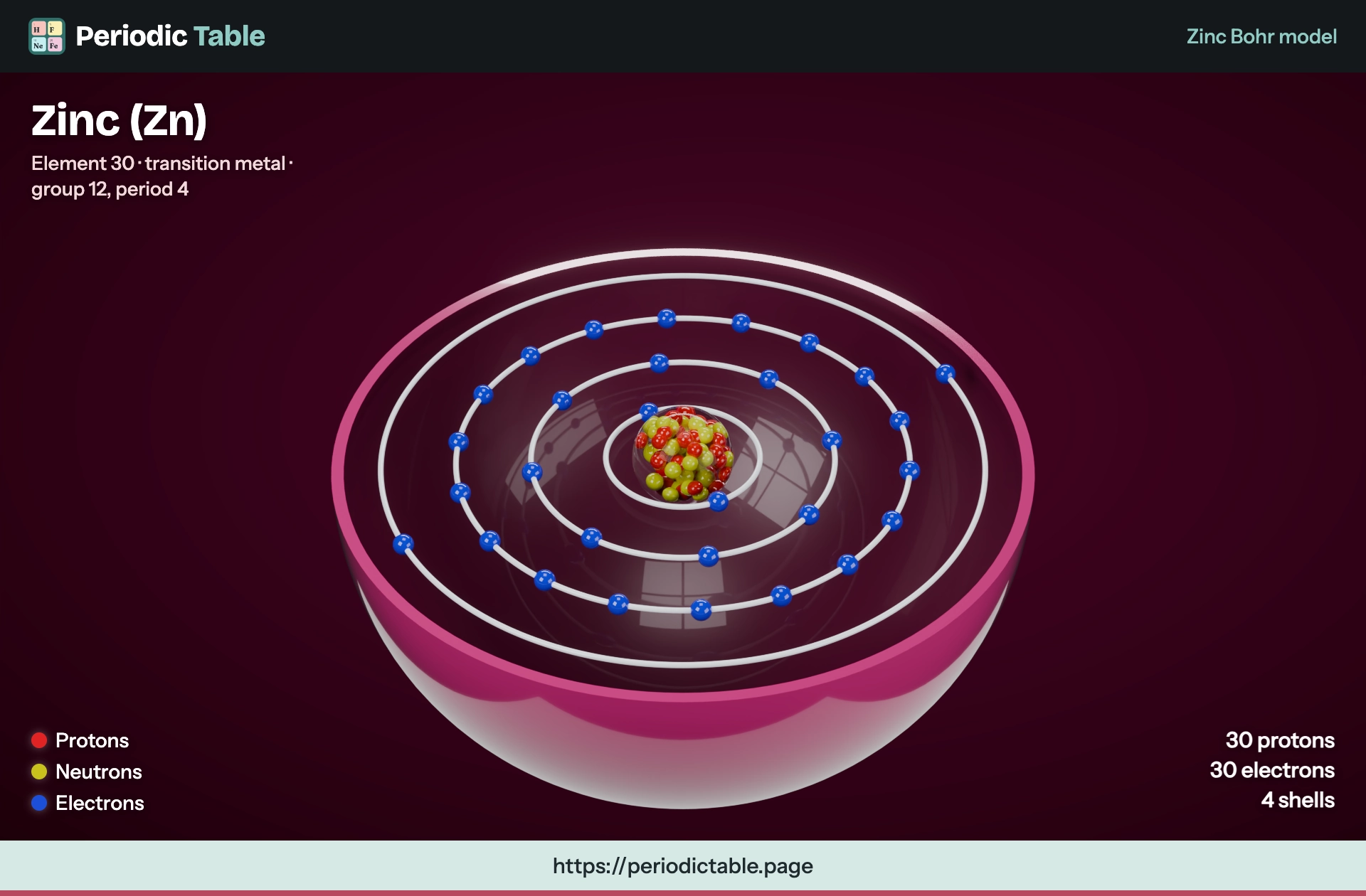
This is a Bohr model of zinc (Zn), a simplified picture of a single zinc atom. Its nucleus holds 30 protons, and a neutral zinc atom has 30 electrons, arranged around it in 4 shells (2 in shell K, 8 in shell L, 18 in shell M and 2 in shell N).
Zinc periodic table electron configuration
- Shorthand
- [Ar] 3d10 4s2
- Full
- 1s2 2s2 2p6 3s2 3p6 4s2 3d10
- Electrons per shell
- 2, 8, 18, 2
Zinc element properties and atomic data
- Atomic number
- 30
- Atomic mass
- 65.382 u
- Phase at STP
- Solid
- Melting point
- 419.53°C (692.68 K)
- Boiling point
- 906.85°C (1180 K)
- Density
- 7.14 g/cm³
- Electronegativity (Pauling)
- 1.65
- Period
- 4
- Group
- 12
- Block
- d-block
- Appearance
- Silver-gray
- Discovery date
- 1746
- Discovered by
- India
- Named by
- —
Zinc element at a glance: key data
Zinc carries the chemical symbol Zn, and its historic names include Zink and zincum. Chemists classify it as a transition metal in the d-block, although its full inner shell makes it behave much like the alkaline earth metals. The table gathers the values you are most likely to look up. In quantum research, see the notes on trapped-ion qubits, Yb:YAG dopant crystals and the 171 isotope at element 70 for more background reading.
| Property | Value |
|---|---|
| Symbol | Zn |
| Atomic number | 30 |
| Atomic weight | 65.38 u |
| Group, period, block | 12, 4, d |
| Electron configuration | [Ar] 3d10 4s2 |
| Melting point | 419.53 °C (692.68 K) |
| Boiling point | 907 °C (1,180 K) |
| Density | 7.14 g/cm3 at 20 °C |
| Electronegativity (Pauling) | 1.65 |
| Crystal structure | Hexagonal close-packed |
| Main oxidation state | +2 |
| First isolated | 1746, Andreas Marggraf |
| CAS number | 7440-66-6 |
Atomic number, atomic mass and electron configuration
Every Zn atom holds 30 protons and, when neutral, 30 electrons arranged 2, 8, 18, 2. The average atomic mass of 65.38 reflects a blend of five stable forms.
Written [Ar] 3d10 4s2, the electron arrangement shows a completely filled d subshell. The atomic radius is about 134 pm, the van der Waals radius 139 pm and the ionic radius of Zn2+ roughly 74 pm.
Group 12 position on the periodic table
On the periodic table, zinc heads group 12, above cadmium and mercury. Those three elements share a closed d10 shell, so they rarely show the colorful ions typical of other transition elements. In chemistry courses that is why some textbooks leave it out of the transition series altogether.
Zinc properties: physical and chemical behavior
Freshly cut, zinc is lustrous and bluish-white, sometimes described as silvery-white with a blue tinge. Left in air it dulls to grey as a thin carbonate film forms. The physical properties and chemical properties below explain most of the ways people use Zn. Medicine, plastics and electronics use the halogen group, found in the ocean and in minerals.
Melting point, boiling point and density
Melting at 419.53 °C, zinc is easy to cast, and boiling at 907 °C, it can be distilled straight out of a hot furnace. At 7.14 g/cm3 it weighs slightly less than tin. Other values worth knowing:
- Specific heat: 0.388 J/(g·K)
- Heat of fusion: 7.32 kJ/mol
- Thermal conductivity: 116 W/(m·K)
- Electrical resistivity: 59 nΩ·m at 20 °C
- Mohs hardness: 2.5
Oxidation states, electronegativity and ionization energy
Almost all zinc chemistry runs through the +2 state; the oxidation states +1 and 0 exist only in unusual compounds. A Pauling value of 1.65 and a first ionization energy of 906.4 kJ/mol (second: 1,733.3 kJ/mol) explain why it gives up two electrons readily. The standard potential of Zn2+/Zn is −0.76 V, so it reacts with dilute acids to release hydrogen:
$$\mathrm{Zn + 2HCl \rightarrow ZnCl_2 + H_2}$$
It burns in oxygen to form a white oxide, and that oxide is amphoteric, dissolving in strong bases as well as acids.
Hexagonal close-packed crystal structure
Zinc atoms stack in hexagonal layers, but with a stretched c-axis that makes zinc brittle at ordinary temperatures. Warm it to between 100 °C and 150 °C and it becomes malleable and ductile enough to roll into sheet or draw into wire.
Above about 210 °C it turns brittle again and can be ground to powder. It is also diamagnetic, so a magnet will not pick it up.
Zinc ores and deposits: where the metal comes from
Zinc makes up about 75 parts per million of the Earth's crust, ranking it roughly the 24th most abundant element. It never occurs native; zinc ores almost always appear alongside galena (lead sulfide), so lead-zinc mines recover both metals together, often with silver.
Large zinc deposits form either when warm brines move through limestone, as in Mississippi Valley-type bodies, or where seafloor hot springs leave volcanogenic massive sulfide layers. Canada's Pine Point and Kidd Creek and Alaska's Red Dog mine are well-known examples of zinc mining on both models.
Sphalerite and zinc blende
The main ore mineral is sphalerite, also called zinc blende, which is zinc sulfide (ZnS). Older British texts spell it zinc sulphide, the same way they write sulphur for sulfur.
Near the surface, rainwater oxidizes it and leaves secondary minerals behind: smithsonite (zinc carbonate) and hemimorphite, a hydrated silicate. Either can still be worked as a zinc ore where it is rich enough.
Zinc production, smelting and recycling
Concentrated sulfide is first roasted to drive off the sulfur and leave the oxide. Plants then take one of two routes: pyrometallurgy, where the oxide is reduced with carbon in a smelting furnace and zinc is boiled off and condensed, or electrowinning, where the oxide is dissolved in sulfuric acid and zinc is plated out with electricity.
Electrowinning now supplies most of the world's roughly 12 million tonnes a year. It is the fourth most commonly used metal after iron, aluminum and copper, and a widely used nonferrous metal, so recycling matters: about 30 percent of supply comes from scrap and plating residues.
History and discovery of zinc
People used zinc long before anyone recognized it as one of the chemical elements. Golden copper alloys from the second millennium BCE were most likely made by accident, when mixed ores rich in both metals were smelted together. By Roman times the alloy for coins was being made on purpose, by heating copper with calamine (an oxidized ore) so that the vapor soaked into it.
Isolating pure zinc was harder, because it boils at a temperature not far above the heat needed to free it from its ores. Metallurgists in India solved that by condensing the vapor in sealed retorts, and the Zawar works in Rajasthan were producing metallic zinc at scale by the 14th century. Chinese workshops followed, and shipments reached Europe from Asia.
In Europe, the German chemist Andreas Marggraf documented how to isolate zinc from calamine in 1746, which is why most histories credit him with its discovery in the West. William Champion had patented an industrial process in England a few years earlier. The name probably comes from the German Zinke, meaning a prong or tooth, a nod to the jagged crystals; the word was in use in Germany by the time Paracelsus wrote about it in the 16th century.
Uses of zinc in industry and everyday products
Industry consumes zinc metal in a handful of big ways and dozens of small ones. Roughly half goes into rust protection, with alloys, chemicals and power cells taking most of the rest.
Galvanizing steel against corrosion
Galvanizing is the single largest use. In hot-dip galvanization, cleaned parts are dipped into a bath of molten zinc at around 450 °C; thinner layers come from electroplating or zinc-rich paints. The zinc coating protects twice over.
It first reacts with air to form a tight carbonate layer that blocks corrosion. If it is scratched through, the coating acts as a sacrificial anode, corroding in place of the iron underneath.
The same idea, called cathodic protection, uses zinc blocks bolted to ship hulls and buried pipelines. Galvanized steel can last decades without maintenance, and architects also use rolled sheet for roofing and gutters.
Brass, pennies and other zinc alloys
Brass is the best-known alloy: copper with typically 5 to 45 percent added. It resists corrosion better than copper, machines cleanly and suits musical instruments.
Nickel silver adds nickel to the same pair, while zinc alloys with a few percent aluminum flow well enough for precision castings. Two familiar examples:
- A US penny minted since 1982 is 97.5 percent zinc with a thin copper plating.
- A classic school demonstration heats a copper penny in sodium hydroxide with zinc dust. Sodium zincate forms and plates the coin silver; a flame then fuses the layers into brass, and the penny turns gold.
Batteries, die casting and zinc compounds
Zinc forms the negative electrode in alkaline batteries and zinc-carbon cells, and zinc-air cells power hearing aids. Die casting turns alloys into door handles, locks and car parts. Among zinc compounds, zinc oxide is the standout: it activates the vulcanization of rubber, acts as a white pigment and is the mineral filter in many sunscreen formulas.
Zinc chloride is a soldering flux and wood preservative. You will also find Zn compounds in cosmetics, deodorants and dandruff shampoos. Zinc selenide and zinc telluride are II-VI semiconductors used in infrared optics, LED devices and some thin-film solar cells.
Zinc isotopes
Natural zinc isotopes come in five stable forms. Zn-64 is the most common, so the average atomic weight sits just above 65. Some 30 radioactive forms are also known, from Zn-54 to Zn-83; the longest-lived artificial one, Zn-65, has a half-life of about 244 days and is used as a tracer in alloy and biology research.
| Isotope | Natural abundance |
|---|---|
| Zn-64 | 49.17% |
| Zn-66 | 27.73% |
| Zn-67 | 4.04% |
| Zn-68 | 18.45% |
| Zn-70 | 0.61% |
Zinc as a trace element: health effects
Every cell needs zinc. Your human body holds about 2 to 3 grams in total, mostly in muscle and bone, and it is the second most common trace metal there after iron. Its main health effects come from more than 300 enzymes that depend on it to work, which ties zinc closely to growth, nutrition and how your body processes nutrients.
Daily intake and signs of deficiency
The US recommended daily allowance (RDA) is 11 mg for adult men and 8 mg for adult women, rising during pregnancy. Oysters, red meat, beans, nuts and whole grains are the richest food sources, and dietary supplements fill gaps. Too little shows up as:
- loss of appetite and a dulled sense of taste and smell
- slow wound healing and skin sores
- a weaker immune system and frequent infections
Zinc lozenges may shorten a common cold when started early, and a high-dose supplement formula from a large eye study slowed advanced macular degeneration.
Toxicity and metal fever from excess intake
Toxicity is uncommon from food but easy to reach with supplements. The upper limit for adults is 40 mg a day; going well beyond it can cause nausea, vomiting and stomach cramps, and over months it blocks copper absorption, which can lead to anaemia. Workers who breathe freshly formed oxide fumes while welding galvanized steel can develop metal fever, a flu-like illness that usually passes in a day or two.
Zinc safety and effects on the environment
A solid Zn ingot is low-hazard, so most safety guidance covers powder, fumes and releases to the environment.
Handling fine powder safely
Fine powder is a different matter. It reacts with water and acids to release flammable hydrogen, and dust clouds can ignite, which is why safety data sheets list it as a flammable solid.
Store it dry, keep it away from acids, and fight a powder fire with dry sand or a metal-fire extinguisher, never water. Safety glasses and dust control are enough for most lab work, and good ventilation keeps zinc concentrations in the air low.
Zinc in soil, water and the food chain
Some of it occurs naturally in soil, rivers and drinking water, but mining, refining, coal burning and sewage sludge spread on farmland raise local levels. Excess runoff can reach groundwater and harm fish, and it builds up through the food chain. Plants struggle on contaminated ground, and grazing animals can absorb harmful amounts from it.