


Ytterbium element (Yb): ytterbium periodic table facts
Ytterbium periodic table facts: ytterbium (Yb) is element 70, a lanthanide in period 6 of the f-block. If you have ever asked what is ytterbium and why a lab would care about it, here is the short answer: ytterbium is a soft, silvery, malleable rare earth metal that ends up inside some of the most precise instruments people build. Readers weighing nuclear energy against radiation risk will find balanced facts under the actinide plutonium in plain terms.
You will find it in industrial lasers, record-setting atomic clocks and grain-refined stainless steel, and it behaves differently from almost every neighbour on the periodic table. This guide walks you through its data, chemistry, history, sources and uses.
Rotate the 3D Bohr model of ytterbium
Drag to orbit, scroll to zoom.
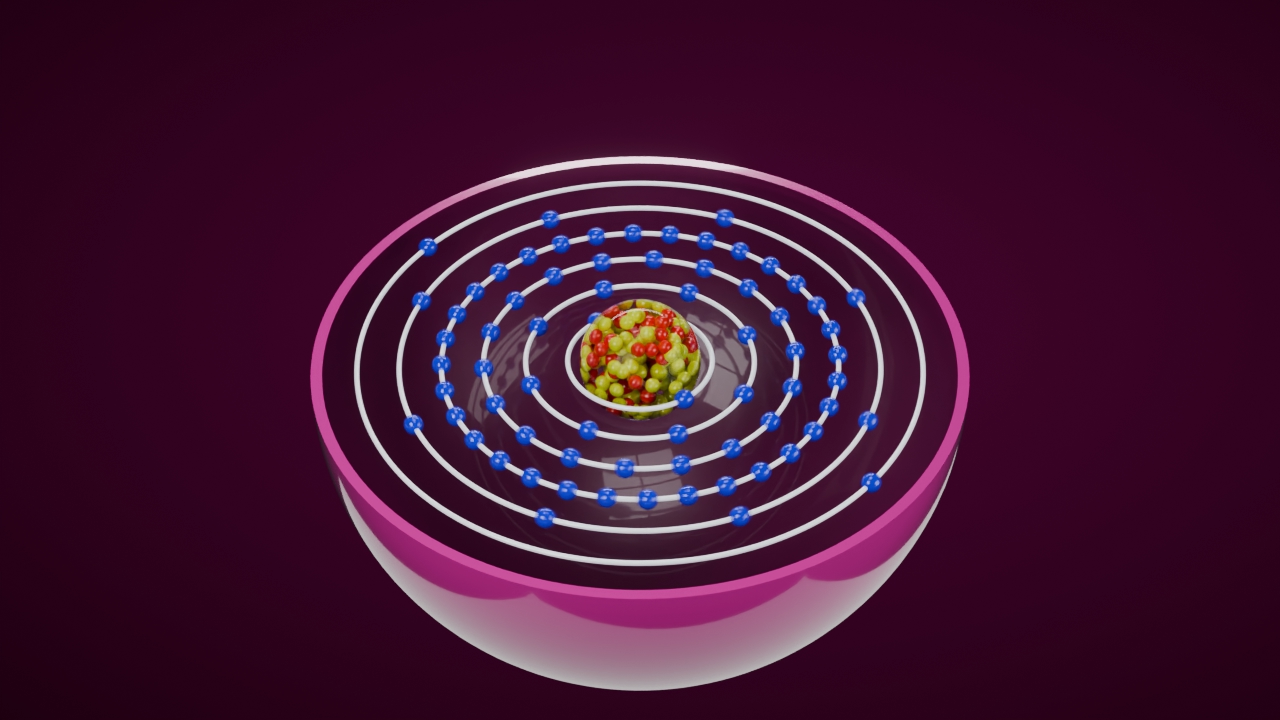
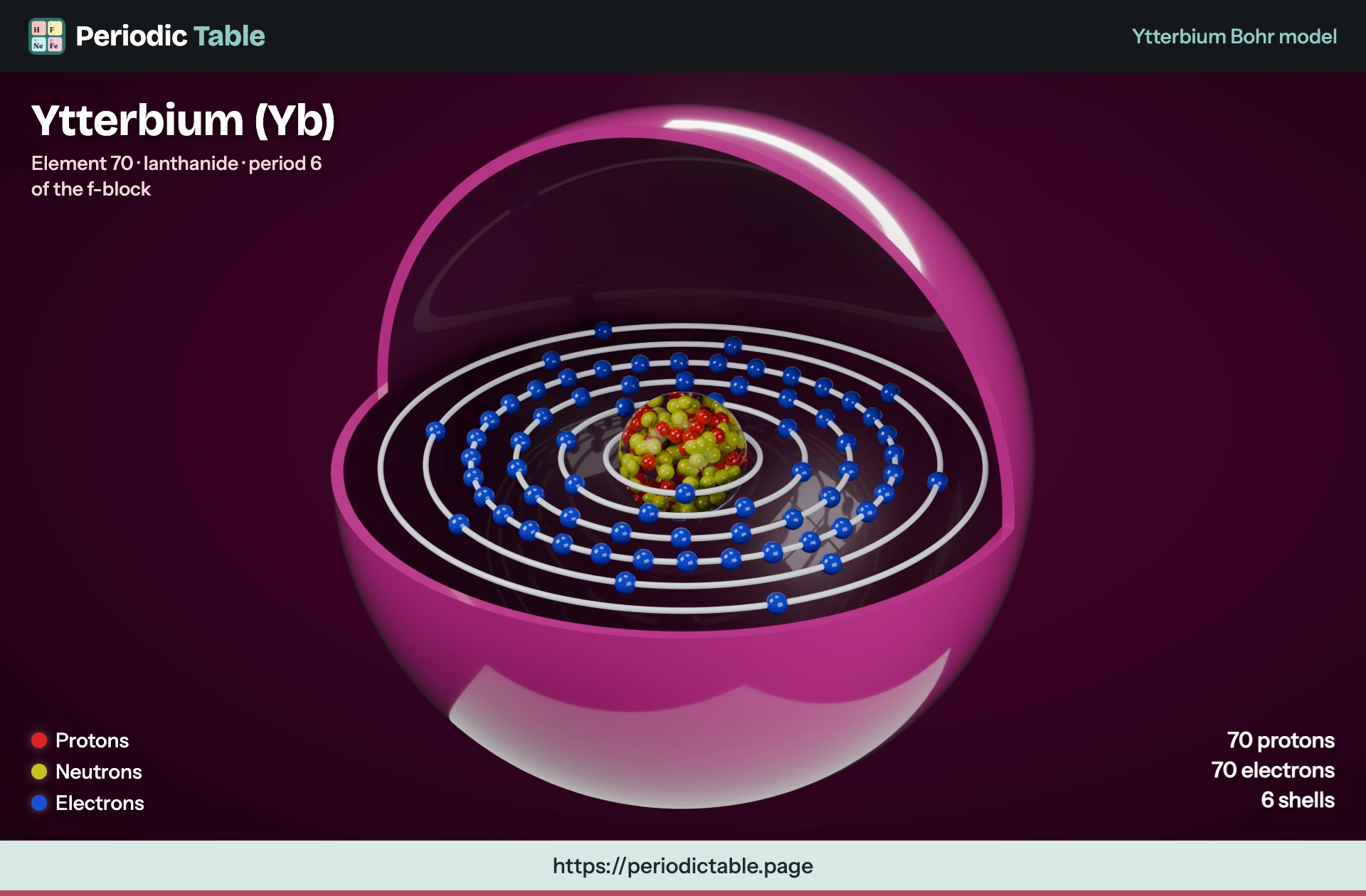
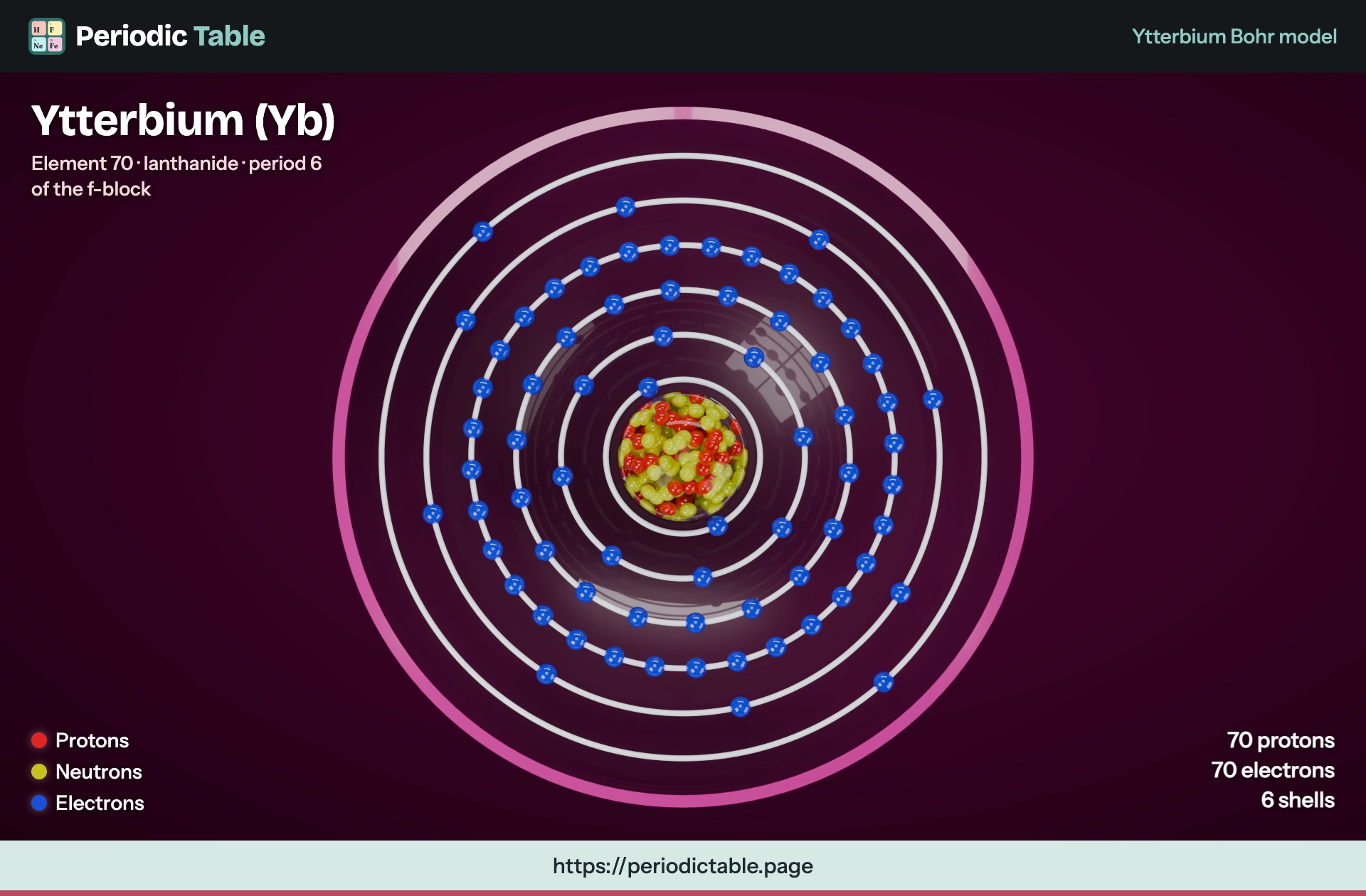
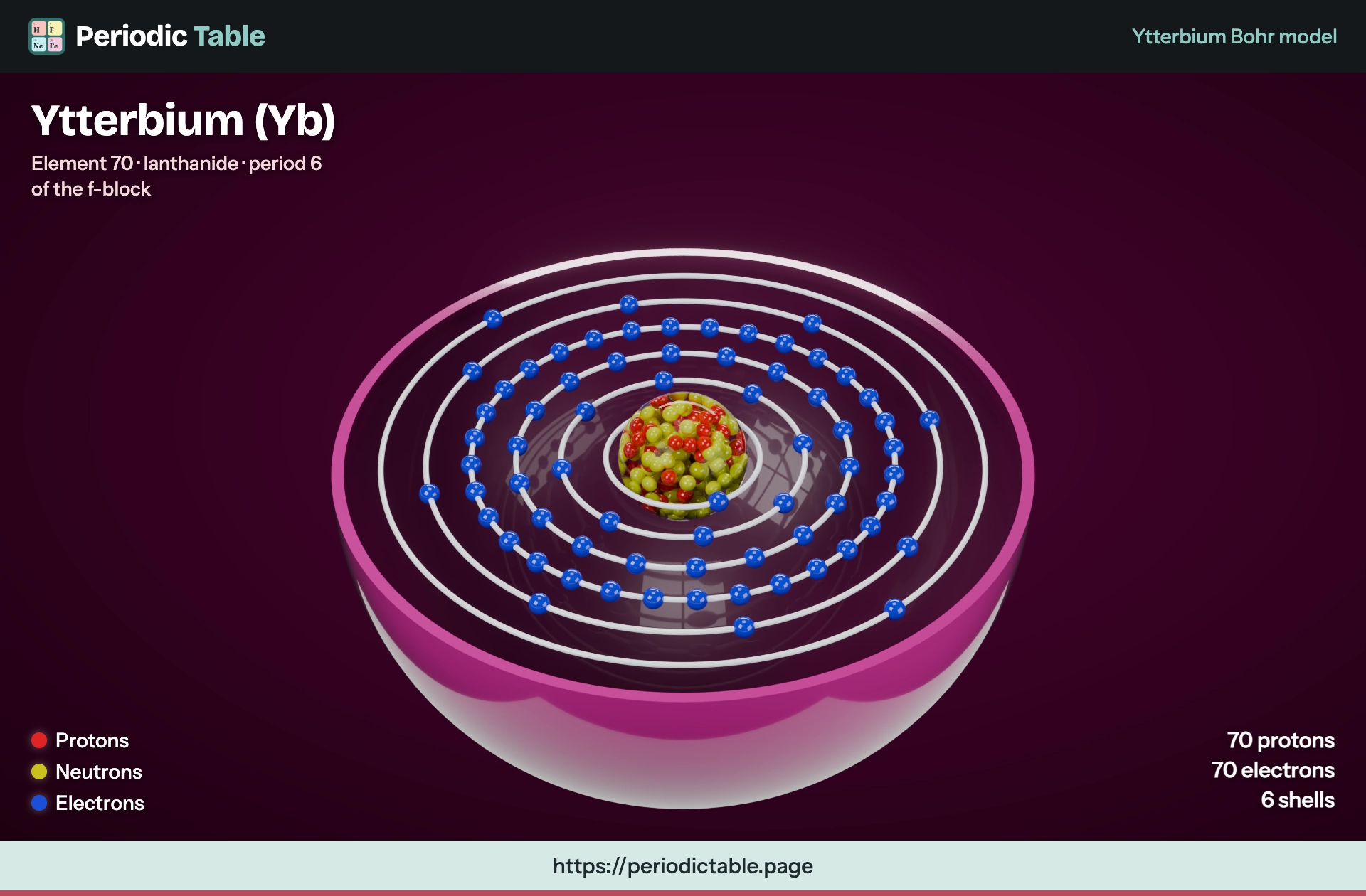
This is a Bohr model of ytterbium (Yb), a simplified picture of a single ytterbium atom. Its nucleus holds 70 protons, and a neutral ytterbium atom has 70 electrons, arranged around it in 6 shells (2 in shell K, 8 in shell L, 18 in shell M, 32 in shell N, 8 in shell O and 2 in shell P).
Ytterbium periodic table electron configuration
- Shorthand
- [Xe] 4f14 6s2
- Full
- 1s2 2s2 2p6 3s2 3p6 4s2 3d10 4p6 5s2 4d10 5p6 6s2 4f14
- Electrons per shell
- 2, 8, 18, 32, 8, 2
Ytterbium element properties and atomic data
- Atomic number
- 70
- Atomic mass
- 173.0451 u
- Phase at STP
- Solid
- Melting point
- 823.85°C (1097 K)
- Boiling point
- 1195.85°C (1469 K)
- Density
- 6.9 g/cm³
- Electronegativity (Pauling)
- 1.1
- Period
- 6
- Group
- —
- Block
- f-block
- Appearance
- Unknown
- Discovery date
- 1878
- Discovered by
- Jean Charles Galissard de Marignac
- Named by
- —
What is ytterbium? atomic number 70 in the lanthanide series
Ytterbium is a chemical element with the symbol Yb and atomic number 70. It is the fourteenth member of the lanthanide series, sits in period 6 of the f-block, and is usually grouped with the heavy rare earth elements alongside terbium and dysprosium. Like every lanthanide, it counts as a rare-earth element, although the name is misleading: the element ytterbium is more common in rocks than tin. Inorganic chemistry of the lanthanide compounds includes magnets, light emission and crystal salts.
The quick reference card below gives you the identifiers you need when you look the metal up in a database or a safety sheet.
| Property | Value |
|---|---|
| Symbol | Yb |
| Atomic number | 70 |
| Group | Lanthanide (f-block, no group number) |
| Period | 6 |
| State at 20 °C | Solid |
| CAS number | 7440-64-4 |
| Named after | Ytterby, Sweden |
Atomic mass and electron configuration of ytterbium (Yb)
The standard atomic mass of ytterbium (Yb) is 173.045. Its ground-state electron configuration is [Xe] 4f14 6s2, which means the 4f shell is completely full. That closed-shell arrangement is the key to nearly everything unusual about this element: only the two 6s electrons are free to join metallic bonding, while most lanthanides contribute three.
| Atomic data | Value |
|---|---|
| Atomic mass | 173.045 u |
| Electron configuration | [Xe] 4f14 6s2 |
| Electronegativity (Pauling scale) | 1.1 |
| Ionization energies (1st / 2nd / 3rd) | 603.4 / 1174.8 / 2417 kJ/mol |
| Atomic radius (empirical) | 176 pm |
| Covalent radius | 187 pm |
Notice the jump between the second and third ionization energies: removing a third electron means breaking into the stable 4f shell, which is why Yb can stop at a +2 charge when other rare earths cannot.
Physical properties of ytterbium
Freshly cut, the metal is bright and silvery with a faint yellow cast, and over time it turns golden or brown as the surface oxidizes. It is soft enough to cut with a knife and ductile enough to draw into wire. For atomic mass, electron configuration and isotopes, open the about zinc reference and read through the data tables.
Its mechanical numbers confirm how soft it is: a Young's modulus of 23.9 GPa, a shear modulus of 9.9 GPa and a bulk modulus of 30.5 GPa. The specific heat capacity is about 155 J/(kg·K).
Melting point, boiling point and density
Ytterbium melts and boils at far lower temperatures than the lanthanides around it, again because only two electrons per atom hold the lattice together.
| Constant | Celsius | Kelvin / other |
|---|---|---|
| Melting point | 824 °C | 1097 K |
| Boiling point | 1196 °C | 1469 K |
| Density (20 °C) | — | 6.97 g/cm³ |
Subtract one from the other and you get a liquid window of only 372 °C, the narrowest liquid range of any metal. The low figure of 6.97 g/cm³ also stands out against neighbours that sit well above 9 g/cm³.
Allotropes, crystal structure and magnetism
Ytterbium has three allotropes, each with its own crystal structure:
- Alpha — hexagonal, stable at low temperatures and diamagnetic.
- Beta — face-centered cubic, the form you meet at room temperature.
- Gamma — body-centered cubic, stable above roughly 795 °C.
The beta form is paramagnetic above 1 kelvin, unlike the many rare earths that order ferromagnetically or antiferromagnetically when cold. Pressure changes it dramatically: at about 1.6 GPa the metal turns into a semiconductor, and its electrical resistivity rises roughly tenfold near 3.9 GPa before falling sharply again just above 4 GPa.
Ytterbium chemistry and how the metal reacts
The chemistry of this metal is gentle compared with europium or the alkali metals, but it is still reactive. A bulk piece tarnishes slowly in air, while fine powder oxidizes quickly and can ignite. With water it reacts slowly when cold and briskly when hot, releasing hydrogen and forming ytterbium(III) hydroxide:
$$2\,\text{Yb} + 6\,\text{H}_2\text{O} \rightarrow 2\,\text{Yb(OH)}_3 + 3\,\text{H}_2$$
- It reacts with all the halogens to give white trihalides such as YbF3 and YbCl3.
- It dissolves readily in mineral acids; in dilute sulfuric acid it forms colourless nine-water complexes, [Yb(H2O)9]3+.
- It burns in oxygen to form the white oxide, and powdered metal mixed with fluorinated polymers burns with an emerald-green flame.
- Like europium, it dissolves in liquid ammonia to give deep blue solutions.
Why the +2 oxidation state is unusually stable
Most lanthanides are almost purely trivalent, and ytterbium's most common oxidation state is indeed +3. What makes it different is that it also forms divalent compounds with ease.
Losing only the two 6s electrons leaves a full 4f14 shell, so the +2 ion is energetically comfortable. Only samarium, europium and thulium show comparable behaviour.
The yellow-green Yb2+ ion is a strong reducing agent. It pulls oxygen out of water and releases hydrogen, which is why only the colourless Yb3+ ion survives in aqueous solution, while +2 compounds stay stable in the solid state.
Ytterbium compounds and their roles
Ytterbium compounds follow the usual lanthanide pattern, with most salts in the +3 state and almost colourless, because the ion absorbs in the near infrared rather than visible light. The +2 compounds tend to resemble alkaline earth salts.
Halides and Lewis acid catalysts
Ytterbium(III) chloride, YbCl3, is a mild Lewis acid that organic chemists use as a catalyst for aldol and Diels–Alder reactions. Ytterbium(II) iodide, YbI2, works as a reducing agent in coupling reactions, and the fluoride has been used in dental fillings that slowly release fluoride ions.
Oxide and dodecaboride
Ytterbium(III) oxide (Yb2O3) is a white powder with the cubic C-type rare-earth sesquioxide structure, and heating it with more metal reduces it to YbO. Ytterbium dodecaboride, YbB12, is a Kondo insulator: its bulk insulates while its surface conducts, which makes it a favourite test material in quantum materials research.
Isotopes of the rare-Earth element: seven stable isotopes
Natural ytterbium is a mixture of seven stable isotopes. Yb-174 is the most abundant, and Yb-171, with its simple nuclear spin of 1/2, is the isotope precision physics depends on.
| Isotope | Natural abundance |
|---|---|
| Yb-168 | 0.13% |
| Yb-170 | 3.0% |
| Yb-171 | 14.2% |
| Yb-172 | 21.8% |
| Yb-173 | 16.1% |
| Yb-174 | 31.9% |
| Yb-176 | 12.9% |
More than thirty radioisotopes have been made. The longest-lived is Yb-169, with a half-life of about 32 days; Yb-175 lasts about 4.2 days. An isotope lighter than Yb-174 usually decays by electron capture into thulium, and a heavier one by beta emission into lutetium.
Discovery of ytterbium in Ytterby, Sweden
The discovery story runs through one quarry village. Minerals from Ytterby, Sweden gave their names to four elements: yttrium, terbium, erbium and ytterbium.
In 1878 the Swiss chemist Jean Charles Galissard de Marignac heated erbium nitrate taken from erbia, an oxide extracted from gadolinite, and found a new oxide left behind. He called it ytterbia and named the element inside it ytterbium.
Marignac's oxide turned out to be a mixture. In 1907 the French chemist Georges Urbain split it into neoytterbia and lutecia.
At almost the same time, Carl Auer von Welsbach isolated the same pair and called them aldebaranium and cassiopeium, and the American chemist Charles James reached the same result. A 1909 commission gave Urbain priority, lutecia became lutetium, and neoytterbia went back to the name Marignac had chosen.
- 1878 — Marignac identifies ytterbia.
- 1907 — Urbain separates lutetium from it.
- 1936 — Wilhelm Klemm and Heinrich Bommer produce the first metallic sample.
- 1953 — a nearly pure metal is made by ion exchange, so reliable property data finally becomes possible.
Where the ytterbium metal comes from
Ytterbium metal is never found free in commercial deposits. It occurs mixed with other lanthanides in a handful of minerals, and in a few rare cases, such as xenotime-(Yb), it is the dominant rare earth in the mineral.
Crustal abundance and mining sources
Estimates of its crustal abundance vary by source. A widely quoted figure is about 3 ppm, or 3 parts per million of Earth's crust, while the RSC lists 0.3 ppm. Following the Oddo–Harkins rule, even-numbered ytterbium is more plentiful than its odd-numbered neighbours.
Most commercial material comes from monazite sand, which carries around 0.03% ytterbium, with smaller amounts from xenotime and euxenite. Mining for these ores happens mainly in China, with other sources in the United States, Brazil, India, Sri Lanka and Australia. World output is only about 50 tonnes a year.
Separating ytterbium from other rare earth elements
Because the rare earth elements are so chemically alike, separating ytterbium takes many steps. The ore is dissolved in acid, then ion exchange resins or solvent extraction stages pull the lanthanides apart by tiny differences in how strongly they bind.
An older route reduces Yb3+ with sodium amalgam. The purified oxalate is roasted to oxide, which is then reduced to metal with lanthanum in a vacuum and purified by sublimation.
Uses of ytterbium
Low tonnage does not mean low importance. Most uses of ytterbium exploit its optical and nuclear behaviour rather than its bulk, so a few grams can matter in high-value industry.
Ytterbium-doped fiber lasers and amplifiers
The biggest market is as a dopant in laser materials. In crystals such as Yb:YAG and in ytterbium-doped glass fibers, the ion is pumped at roughly 900 nm to 1 µm and emits between 1.03 and 1.12 µm. The gap between those wavelengths, the quantum defect, is very small, so little energy is lost as heat.
That is why ytterbium-doped fiber lasers dominate kilowatt-class metal cutting and welding and allow aggressive power scaling. The same doped fibers are used in fiber optic amplifiers for telecommunications. Concentration is kept low, because heavily doped fibers suffer photodarkening and lose efficiency, which is the main limit on how hard you can push each laser.
Atomic clocks and quantum computing
In 2013 a pair of NIST atomic clocks set a stability record. Each one used about 10,000 ytterbium atoms cooled to roughly 10 microkelvin and trapped in an optical lattice of laser light, then probed at about 518 THz. Their ticks agreed to within two parts in 1018, a level of precision that could redefine the second and push timekeeping and fundamental physics forward.
Ytterbium-171 also powers quantum computing. As a trapped-ion qubit, a single charged Yb-171 ion holds quantum information for long periods, and laser pulses link ions with gates such as the Mølmer–Sørensen gate.
Stainless steel and dental alloys
Used as a dopant in steel, small additions of ytterbium aid grain refinement, which raises strength and wear resistance. It has also appeared in a few dental alloys, though that use stays rare.
Gamma rays and portable X-ray sources
Neutron activation in a reactor turns natural metal into ytterbium-169, which emits gamma rays comparable to an X-ray tube running at 250 to 350 keV. A small capsule therefore acts as a portable X-ray source for checking welds or small parts where there is no power supply. The same radiation source has a role in nuclear medicine.
Other applications of the element
The pressure-sensitive resistivity of the metal is used in stress gauges that record ground deformation from earthquakes and explosions. Its oxide has a high emissivity in the infrared, so it is being studied as a replacement for magnesium in decoy flares. Ytterbium silicates are candidates for environmental barrier coatings on hot turbine parts, and ytterbium-based cuprates are among the studied high-temperature superconductors.
Ytterbium supply risk and critical mineral status
The RSC scores the relative supply risk of ytterbium at 9.5 out of 10, one of the highest values on its periodic table. You can see why from the underlying figures:
- Production concentration: about 97% comes from a single country, China.
- Recycling rate: below 10%.
- Substitutability: rated high, which softens the risk a little.
- Reserves: about one million tonnes worldwide.
It does not yet sit on every critical mineral list, because volumes are so small, but its role in lasers, clocks and quantum hardware has put it on several watch lists. Price history shows how narrow demand has been: the metal stayed near US$1,000 per kilogram between 1953 and 1998.
Ytterbium vs thulium, lutetium and other lanthanides
Put ytterbium next to its periodic table neighbours and the effect of the filled 4f shell becomes obvious. Its density is about 25% lower than thulium's and 29% lower than lutetium's, and it melts more than 700 °C below either of them.
| Element | Atomic number | Density (g/cm³) | Melting point (°C) | Common charges |
|---|---|---|---|---|
| Thulium (Tm) | 69 | 9.32 | 1545 | +3, some +2 |
| Ytterbium | 70 | 6.97 | 824 | +3 and +2 |
| Lutetium (Lu) | 71 | 9.84 | 1663 | +3 only |
Its stable divalent chemistry is shared with europium and samarium, while its uses sit in photonics, unlike magnet metals such as neodymium and dysprosium.
Ytterbium health and safety
Ytterbium has low toxicity by most measures, yet you should still handle its compounds as if they were toxic. The main hazards are practical:
- Irritant: dust and salts can irritate the skin and eyes.
- Fire risk: powdered metal can self-ignite in air.
- Storage: keep the metal in airtight containers under an inert atmosphere of dry nitrogen or argon, away from moisture.
Some studies suggest certain compounds may affect developing embryos, so research labs treat ytterbium with standard heavy-metal care.