


Holmium element (Ho): holmium periodic table facts
Holmium periodic table facts: holmium (Ho) is element 67, a lanthanide in period 6 of the f-block. If one number sums up holmium, it is 10.6: the strength, in Bohr magnetons, of the atomic moment that makes element holmium the most magnetic atom found in nature. It is a chemical element of the lanthanides, a soft, silvery white rare-earth element, and this guide gives you its data, reactions, isotopes, history and applications in one place, the way a chemistry student or engineer actually needs them. Where mining and minerals yield this metal as a by-product is described in bismuth isotopes, plus history and etymology.
Rotate the 3D Bohr model of holmium
Drag to orbit, scroll to zoom.
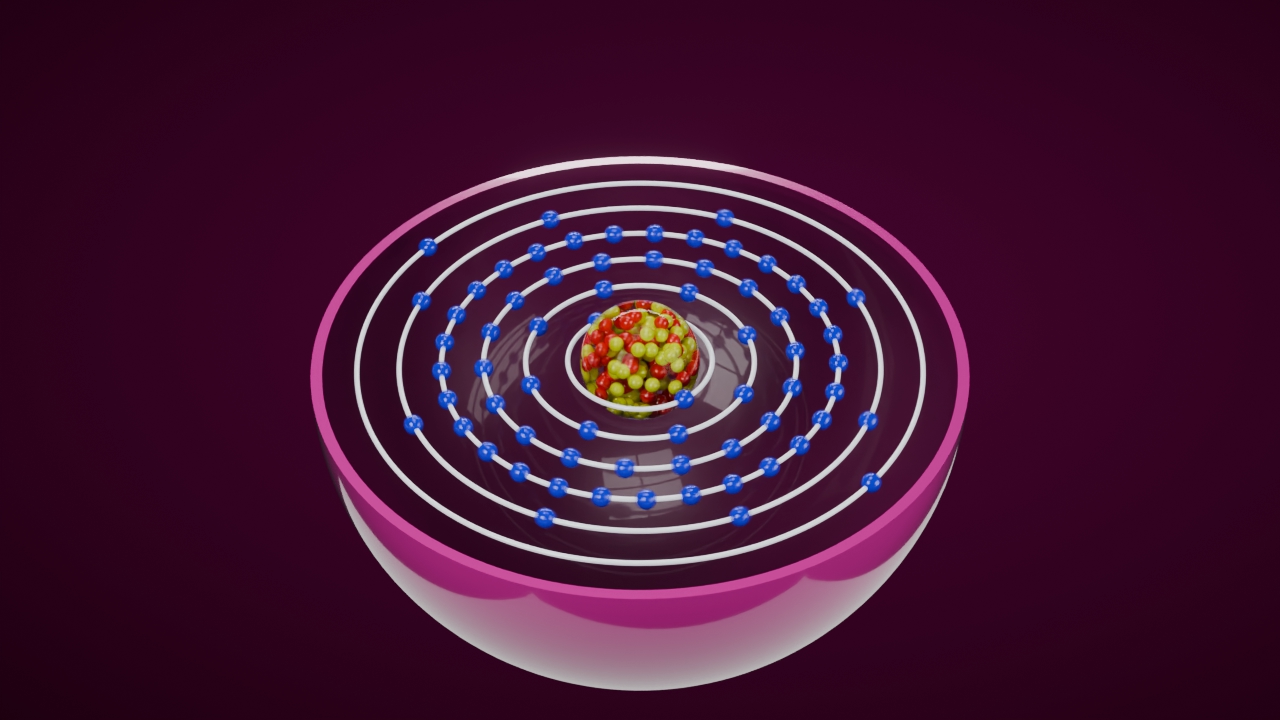
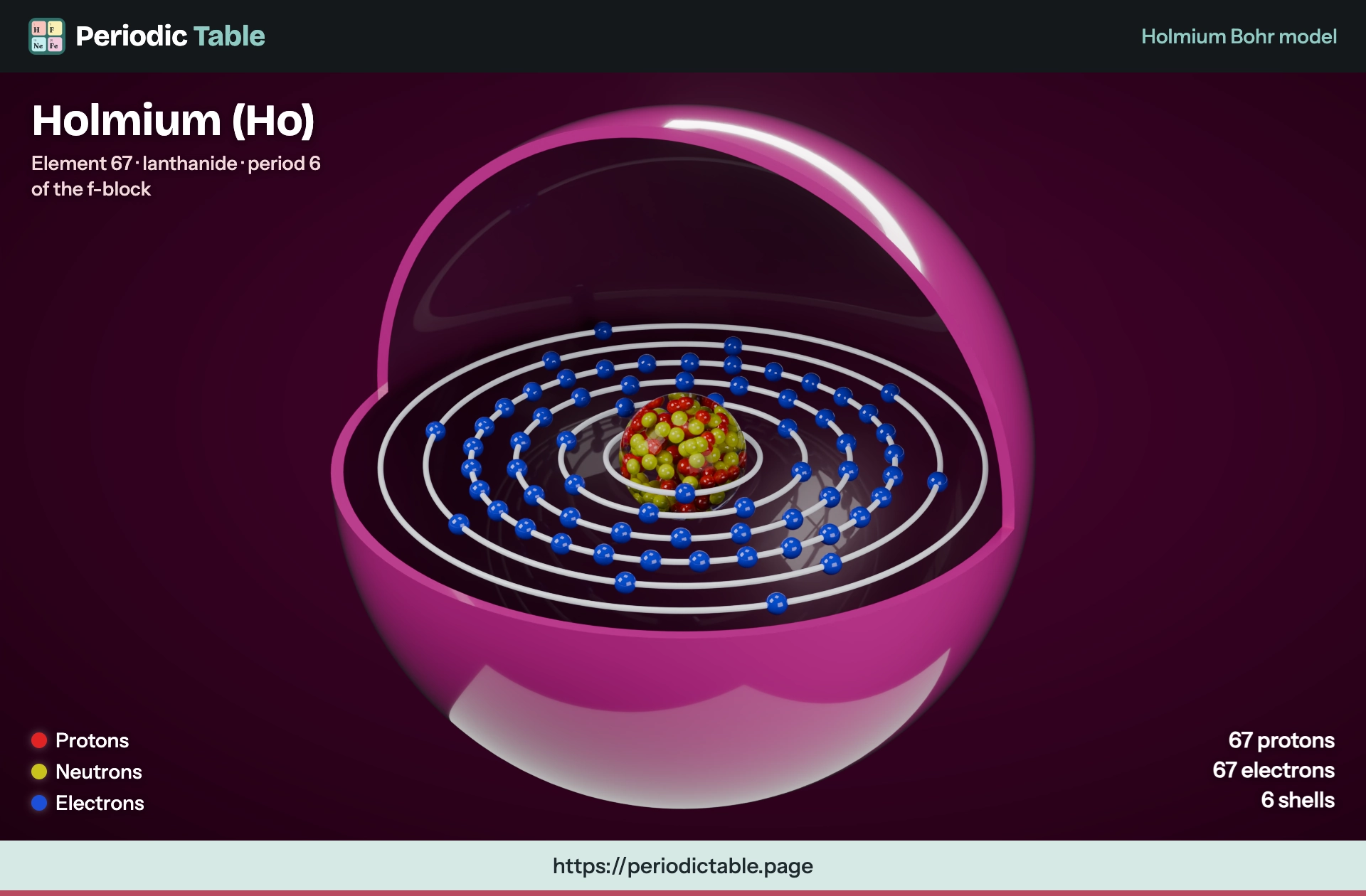
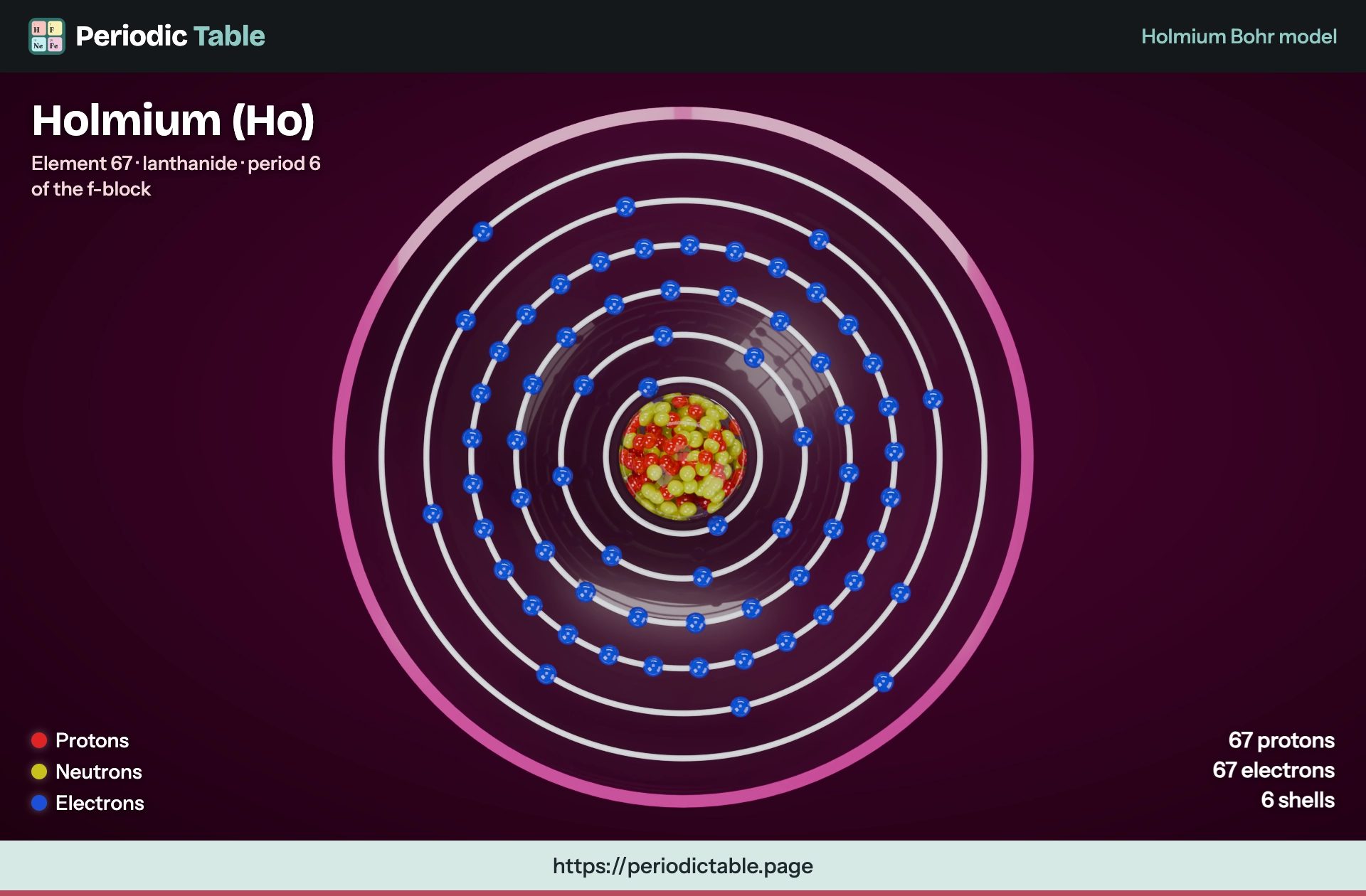
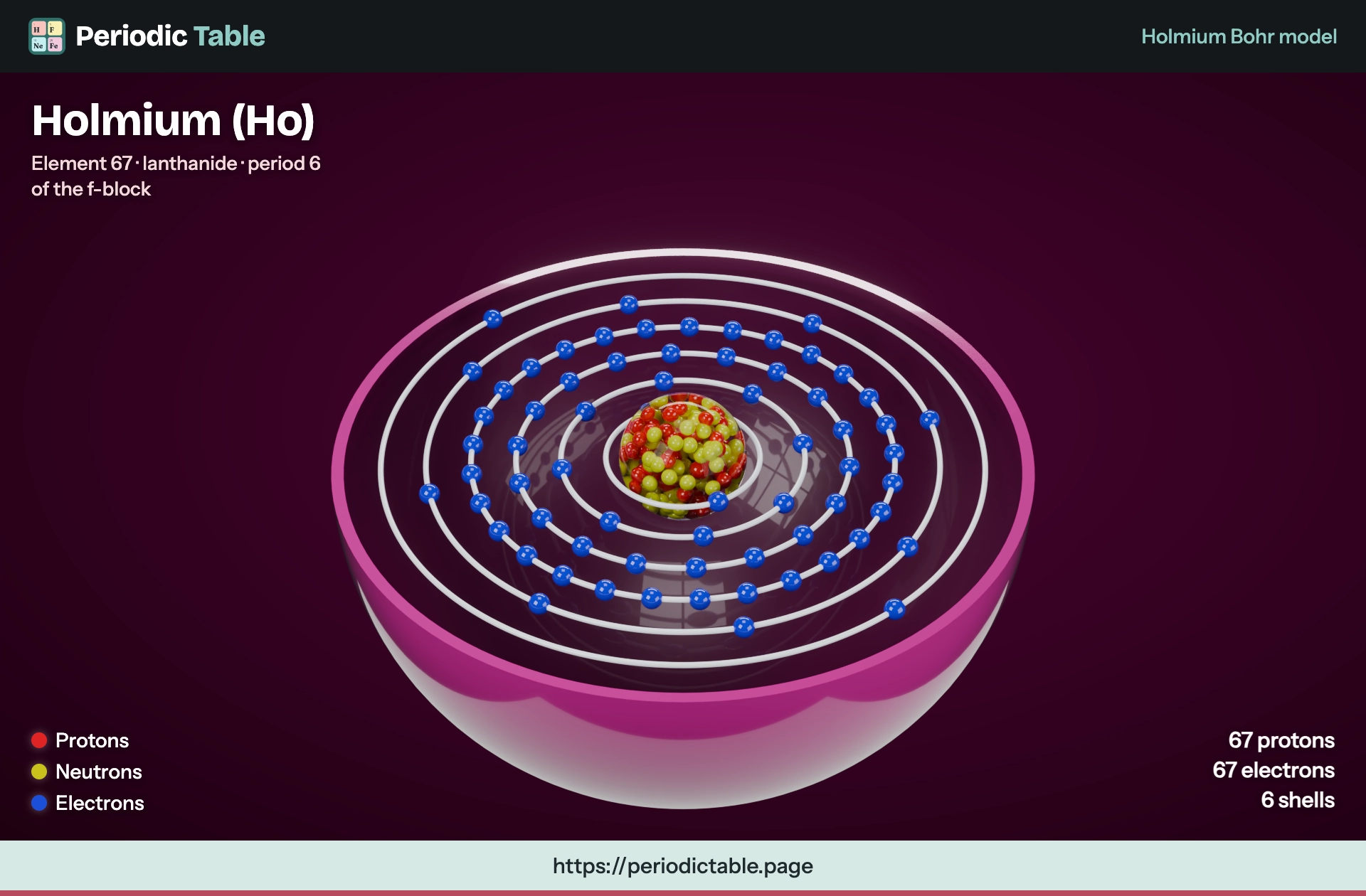
This is a Bohr model of holmium (Ho), a simplified picture of a single holmium atom. Its nucleus holds 67 protons, and a neutral holmium atom has 67 electrons, arranged around it in 6 shells (2 in shell K, 8 in shell L, 18 in shell M, 29 in shell N, 8 in shell O and 2 in shell P).
Holmium periodic table electron configuration
- Shorthand
- [Xe] 4f11 6s2
- Full
- 1s2 2s2 2p6 3s2 3p6 4s2 3d10 4p6 5s2 4d10 5p6 6s2 4f11
- Electrons per shell
- 2, 8, 18, 29, 8, 2
Holmium element properties and atomic data
- Atomic number
- 67
- Atomic mass
- 164.9303 u
- Phase at STP
- Solid
- Melting point
- 1460.85°C (1734 K)
- Boiling point
- 2599.85°C (2873 K)
- Density
- 8.79 g/cm³
- Electronegativity (Pauling)
- 1.23
- Period
- 6
- Group
- —
- Block
- f-block
- Appearance
- Silvery white
- Discovery date
- 1878
- Discovered by
- Marc Delafontaine
- Named by
- —
Holmium element facts: atomic weight, density and CAS number
Most reference tables agree on the core numbers below. Where sources differ slightly (melting and boiling points vary by a few kelvin between handbooks), the table uses the most widely cited value. At room temperature the metal is a solid with a hexagonal close-packed crystal structure. For chemistry notes on the alkaline earth metal, data on atomic number 20, electron configuration and melting point are gathered in the natural calcium for quick lookup.
| Property | Value |
|---|---|
| Symbol | Ho |
| Atomic number 67 | Lanthanide, f-block, period 6 |
| Standard atomic weight | 164.93 u |
| Density at 20 °C | 8.795 g/cm3 |
| Melting point | 1734 K (1461 °C) |
| Boiling point | 2873 K (2600 °C) |
| Electronegativity (Pauling scale) | 1.23 |
| Atomic radius / covalent radius | 176 pm / 192 pm |
| CAS number | 7440-60-0 |
Holmium on the periodic table and the lanthanide series
On the periodic table, Ho sits in the bottom f-block row as the eleventh member of the lanthanide series. Dysprosium lies to its left, erbium to its right, and the actinide einsteinium sits directly below it. Electronegativity and electron affinity are high for the reactive nonmetals on the periodic table, and the page tabulates them.
Like its neighbours, it fills the 4f subshell, which is why these metals behave so alike chemically and are so hard to separate. Its position among these elements explains most of what follows: a reactive, trivalent metal with unusually strong magnetism.
Physical properties of holmium metal
In pure form, the metal has a bright, silvery lustre. It is malleable (you can hammer it into shape) and ductile (you can draw it into wire), much like the other heavy rare earth metals.
Melting point and boiling point
Ho melts at 1734 K and boils at 2873 K, which still makes it one of the more volatile lanthanides. Its heat of fusion is 17.0 kJ/mol and its heat of vaporization is 251 kJ/mol. The specific heat capacity is about 165 J/(kg·K) and the thermal conductivity 16.2 W/(m·K).
Mechanically, the metal is fairly soft: Young's modulus is 64.8 GPa, shear modulus 26.3 GPa and bulk modulus 40.2 GPa. Its vapour pressure stays tiny until the temperature passes roughly 1,400 K.
Magnetic moment and magnetic properties
The magnetic properties are what make this metal stand out. Natural holmium has a magnetic moment of 10.6 μB, the highest of all naturally occurring elements, because its eleven 4f electrons leave several unpaired spins. At room temperature it is paramagnetic: a paramagnet only magnetises inside an applied field, but once inside one, Ho reaches a higher magnetic saturation than any other metal.
Below about 19 K it turns ferromagnetic. That mix of field strength and cryogenic magnetism is the basis for most of what engineers do with it.
Chemical properties of element 67
Chemically, the metal is electropositive and almost always trivalent, giving up three electrons from its atoms to form Ho3+ ions.
Electron configuration, electronegativity and ionization energies
The electron configuration is [Xe] 4f11 6s2, arranged 2, 8, 18, 29, 8, 2 by shell. Its value of 1.23 on the Pauling scale is low enough that the metal is easily oxidised. The first three ionization energies are 581.0, 1140 and 2204 kJ/mol; the steep jump to the fourth (about 4100 kJ/mol) is why a +3 charge is the stopping point.
How pure holmium reacts with air, water and acids
Pure holmium is fairly stable in dry air, but in moist air or when heated it tarnishes to a yellowish oxide that looks a little like rust, and it burns readily:
$$4\,\text{Ho} + 3\,\text{O}_2 \rightarrow 2\,\text{Ho}_2\text{O}_3$$
It reacts slowly with cold water and quickly with hot water, forming holmium(III) hydroxide and hydrogen gas:
$$2\,\text{Ho} + 6\,\text{H}_2\text{O} \rightarrow 2\,\text{Ho(OH)}_3 + 3\,\text{H}_2$$
It also reacts with all the stable halogens and dissolves in dilute sulfuric acid to give solutions of the hydrated \(\text{Ho}^{3+}\) ion.
Oxidation states of holmium ions
The dominant oxidation state is +3. Almost every compound you will meet, from holmium(III) chloride (HoCl3) to holmium(III) fluoride (HoF3), contains Ho3+.
In water, holmium ions sit inside a shell of nine water molecules. Lower oxidation states (+2, +1 and 0) exist only in specialised organometallic complexes made in research labs.
Holmium isotopes and their half-life
Like many odd-numbered elements, it has only one isotope in nature, so natural samples are monoisotopic and primordial. Researchers have made more than 30 synthetic radioisotopes, and their half-lives range from thousands of years down to fractions of a second. In theory the stable isotope could undergo alpha decay to terbium-161, but no one has ever observed it.
| Isotope | Status | Half-life |
|---|---|---|
| Holmium-165 | Stable, 100% of natural samples | None (stable) |
| Holmium-163 | Radioactive, longest-lived | 4570 years |
| Holmium-166m1 | Metastable isomer | 1133 years |
| Holmium-166 | Beta emitter | 26.8 hours |
Stable holmium-165 and medical holmium-166
Every natural sample consists of that single stable nuclide. The short-lived ground state of the 166 isotope emits beta radiation and is studied for targeted therapy of liver cancer, where tiny radioactive microspheres treat tumours from the inside. Its long-lived isomer emits a rich spectrum of gamma ray lines, which makes it a reference source for calibrating gamma-ray spectrometers.
Holmium compounds and their colours
Nearly all holmium compounds are Ho(III) salts, and many of them change colour depending on the light you see them under.
Holmium oxide and its colour shift
Holmium oxide, more formally holmium(III) oxide (Ho2O3), is the only oxide known. It looks yellowish in daylight but orange-red under trichromatic light, and pink under a fluorescent tube, almost matching erbium oxide in the same lighting. The shift comes from the sharp emission lines of Ho3+, which act like built-in red phosphors.
Halides and organoholmium chemistry
All four trihalides are known. Holmium fluoride (HoF3) is a yellowish powder, while the chloride, bromide and iodide form crystal solids by direct reaction of the metal with the halogen.
Most holmium salts that dissolve in water give pale yellow solutions. Organometallic chemistry of the metal is limited, as with other lanthanides, to mostly ionic cyclopentadienides and simple alkyls and aryls.
History and discovery of the rare earth element
The discovery of element 67 came out of the long effort to split the oxides found in minerals near Ytterby, Sweden, which had already yielded yttria and elements such as terbium and ytterbium. In 1878 the Swiss chemists Jacques-Louis Soret and Marc Delafontaine saw unexpected spectrographic bands, an absorption spectrum that did not belong to erbium, and called the unknown substance "element X". Working independently in Uppsala, the Swedish chemist Per Teodor Cleve (often spelled Per Theodor Cleve) purified erbia using the method of Carl Gustaf Mosander and got two new materials: a brown one he named holmia and a green one he named thulia.
The brown material turned out to be the oxide of the new metal, and thulia that of thulium. The story is a good example of how one mineral source fed the discovery of several neighbouring lanthanides.
From Stockholm to isolated holmium metal
The name comes from Holmia, the Latin name for Stockholm, Cleve's home city. A pure sample was only obtained in 1911, and Heinrich Bommer isolated the metal in 1939. In between, the physicist Henry Moseley assigned it atomic number 66 in his famous X-ray physics work, because his sample was mostly dysprosium.
Occurrence of holmium in the Earth's crust
As with every rare earth metal, Ho never occurs free in nature. Its occurrence in the Earth's crust is about 1.3 parts per million by mass, though published estimates range from roughly 0.3 to 1.4 ppm. It obeys the Oddo–Harkins rule: as an odd-numbered element it is scarcer than the neighbouring even-numbered elements dysprosium and erbium.
No mineral is dominated by it. It turns up in monazite (around 0.05%), gadolinite, xenotime and bastnäsite ores, alongside yttrium and the other rare earths. Today the main commercial source is the ion-adsorption clays of southern China, where it makes up roughly 1.5% of the rare-earth content.
How holmium is produced and refined
Commercial production starts with mining monazite or similar minerals, then breaking them down with sodium hydroxide, hydrochloric acid or sulfuric acid. The rare earths are then separated by ion exchange chromatography or solvent extraction, the same ion-exchange route used for its neighbours. To get the metal, the anhydrous chloride or fluoride is reduced with calcium metal:
$$2\,\text{HoF}_3 + 3\,\text{Ca} \rightarrow 2\,\text{Ho} + 3\,\text{CaF}_2$$
World output of the metal is only around ten tonnes a year. By rare-earth standards its price is moderate.
Supply risk and global reserves
The Royal Society of Chemistry rates its relative supply risk at 9.5 out of 10. China controls about 97% of production, followed by Russia and Malaysia, and also holds the largest reserves.
Less than 10% is recycled. Its crustal abundance is modest, but the real constraint is geographic concentration.
Holmium uses and applications
The metal has few uses by tonnage, but its applications are specialised and hard to substitute.
Holmium lasers in medicine
Yttrium iron garnet (YIG) and yttrium lithium fluoride crystals doped with this rare earth are the active media in solid-state lasers that emit at 2.1 micrometres. A holmium laser at that wavelength is absorbed strongly by water, so it cuts and vaporises tissue with very little surrounding tissue damage.
That makes it standard in laser surgery for breaking up a kidney stone (or several kidney stones at once) and for enucleation of the prostate, and it is also used in dental and other medical procedures. In imaging, Ho compounds are being tested as an MRI contrast agent.
Magnetic fields, nuclear reactors and calibration
Because of its record magnetic saturation, Ho is machined into pole pieces for high-field electromagnets: each magnetic pole piece, also called a magnetic flux concentrator, focuses the field to create the strongest static magnets and the highest artificial magnetic fields. It also goes into some permanent magnets. Its nuclei absorb neutrons well, so it serves as a burnable poison and neutron absorber in nuclear control rods.
Optical filters doped with Ho2O3, or a solution of it in perchloric acid, has sharp absorption peaks between 200 and 900 nm, which makes it a calibration standard for spectrophotometers used in spectroscopy. Ho-doped garnets also appear in optical isolators and microwave equipment.
Colorant for glass, cubic zirconia and quantum data
As a colorant, the oxide tints cubic zirconia pink and glass yellow-orange. At the other extreme, in 2017 IBM stored one bit of data on a single holmium atom set on magnesium oxide, and research suggests this kind of control could help build quantum computers.
Holmium toxicity and biological role
This metal has no known biological role in people, although its salts can stimulate metabolism. You take in roughly a milligram a year from food. Its toxicity is low: soluble salts are slightly toxic if swallowed, while insoluble ones are nontoxic.
Large doses inhaled, swallowed or injected can still cause harm. Finely divided metal dust is a fire and explosion hazard, so handle powder under inert gas, away from ignition sources.