


Calcium element (Ca): calcium periodic table facts
Calcium periodic table facts: calcium (Ca) is element 20, an alkaline earth metal in group 2, period 4. Chalk, cement, a glass of milk and the skeleton holding you upright all share one ingredient: calcium (Ca), a soft, reactive alkaline earth metal with atomic number 20. Low toxicity and lead replacement in alloys are discussed in the bismuth on the periodic table, including supply risk.
It is the fifth most abundant element in Earth's crust and the most plentiful metallic element in the human body, yet you will never find calcium lying around in nature in pure form. This guide walks you through the chemical element calcium from its atomic structure to its isotopes, minerals, uses and biological role, so you can read any calcium data table with confidence.
Rotate the 3D Bohr model of calcium
Drag to orbit, scroll to zoom.
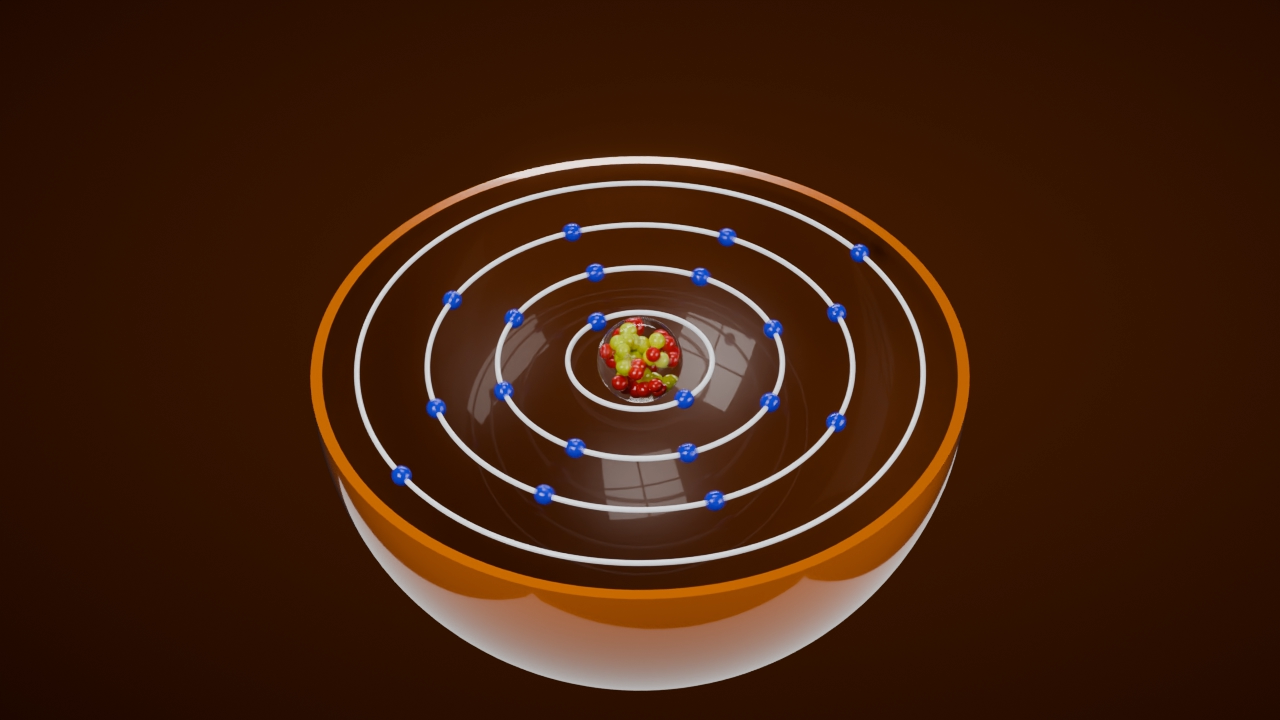
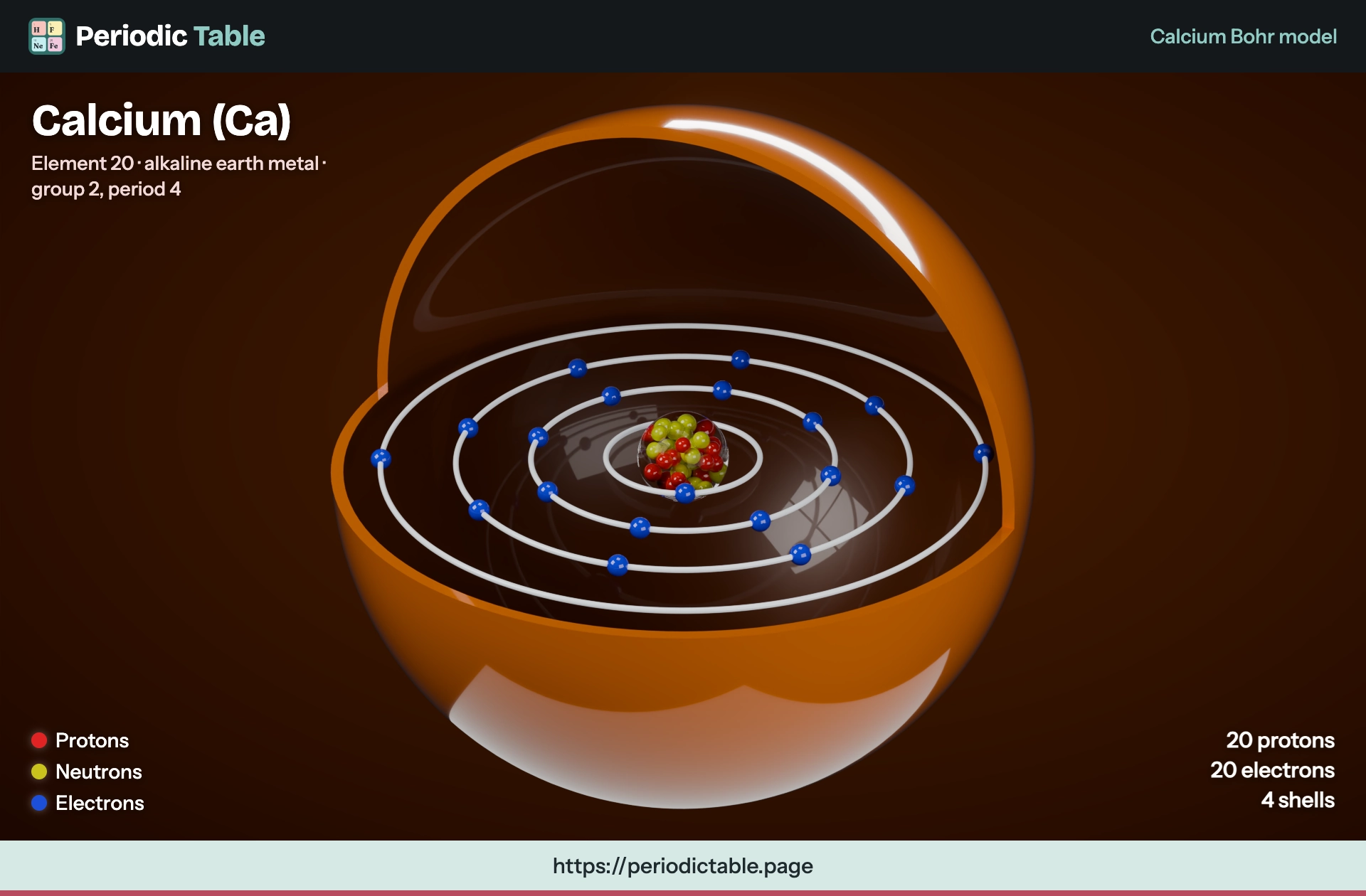
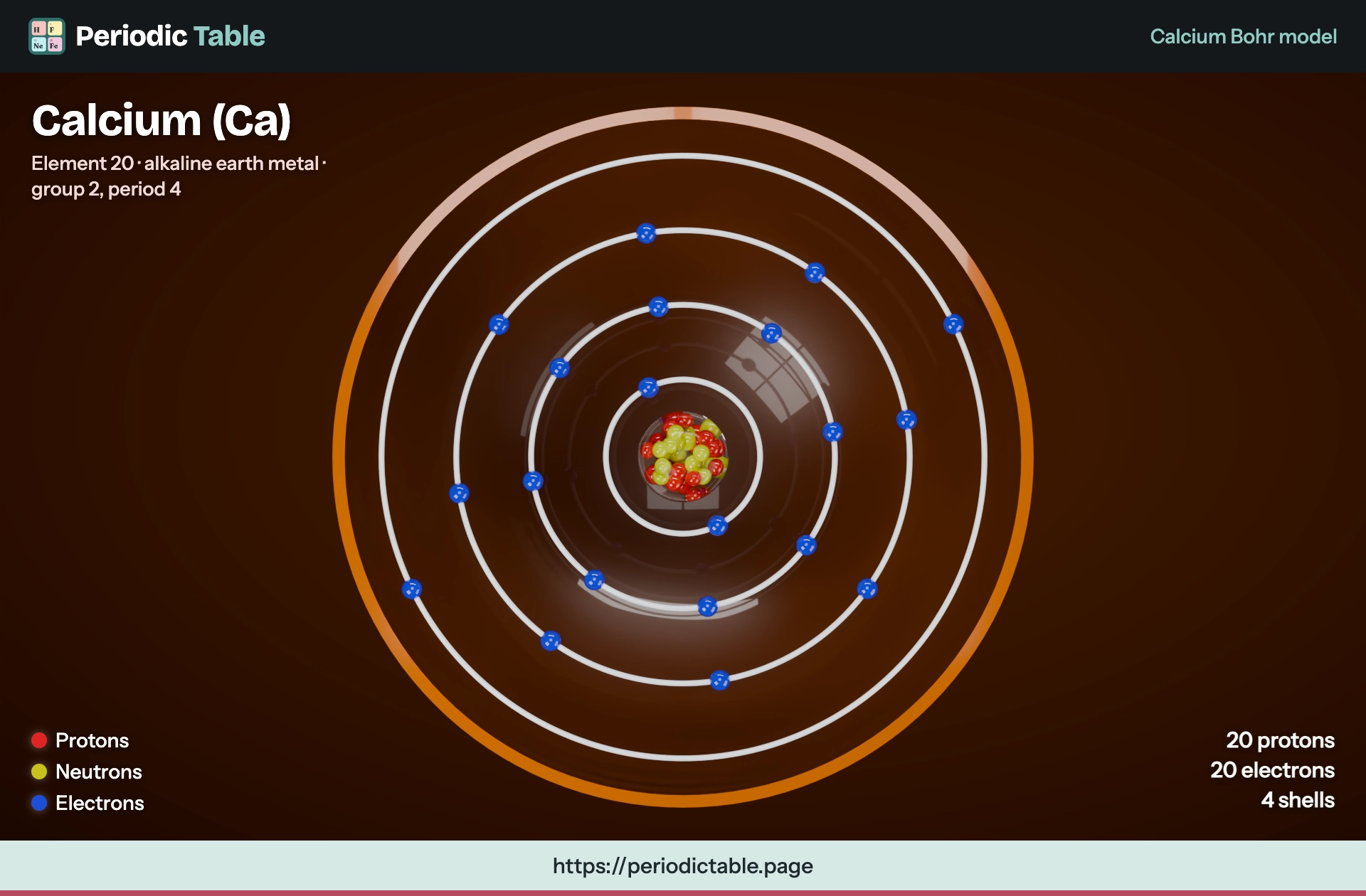
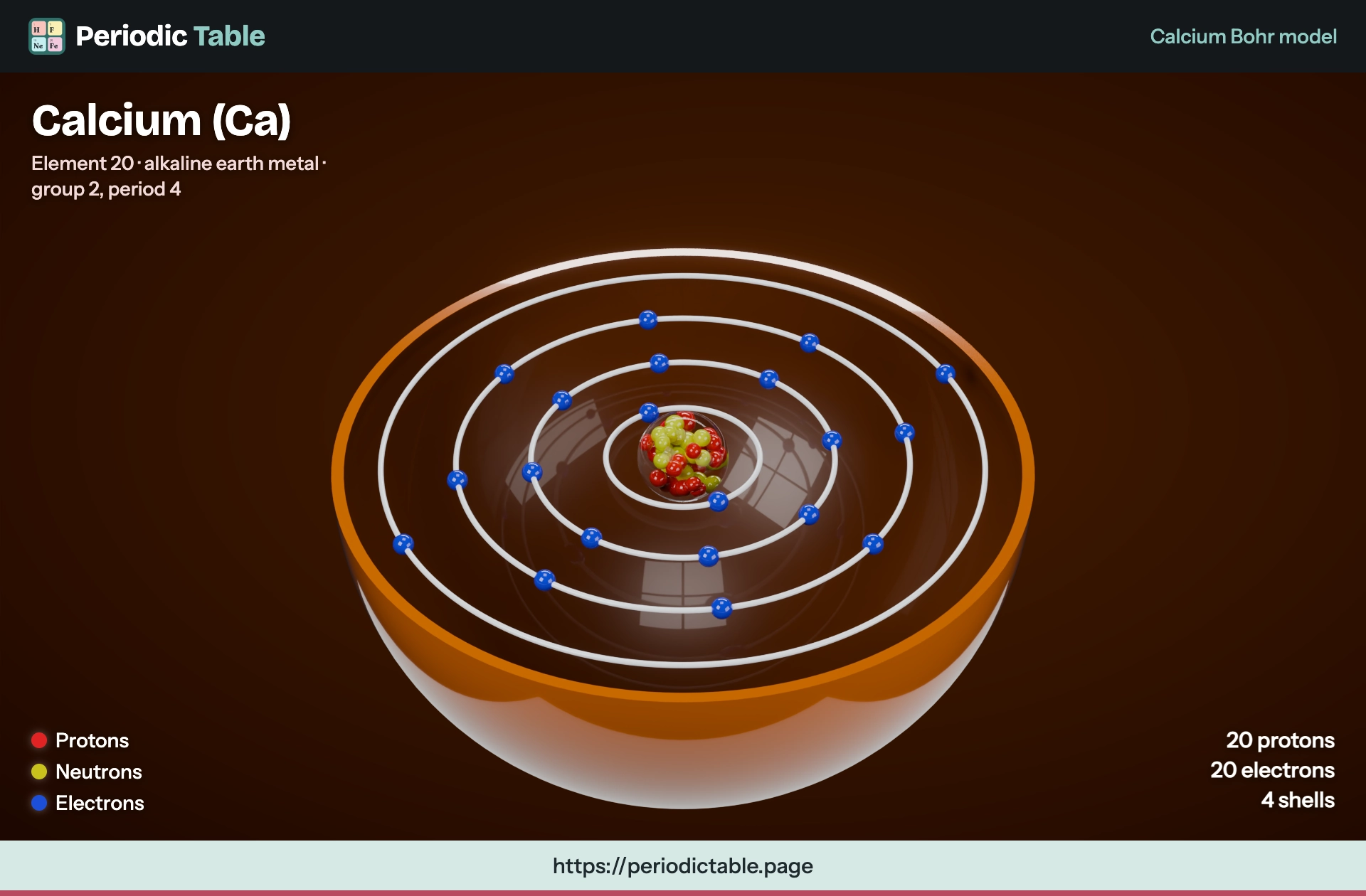
This is a Bohr model of calcium (Ca), a simplified picture of a single calcium atom. Its nucleus holds 20 protons, and a neutral calcium atom has 20 electrons, arranged around it in 4 shells (2 in shell K, 8 in shell L, 8 in shell M and 2 in shell N).
Calcium periodic table electron configuration
- Shorthand
- [Ar] 4s2
- Full
- 1s2 2s2 2p6 3s2 3p6 4s2
- Electrons per shell
- 2, 8, 8, 2
Calcium element properties and atomic data
- Atomic number
- 20
- Atomic mass
- 40.0784 u
- Phase at STP
- Solid
- Melting point
- 841.85°C (1115 K)
- Boiling point
- 1483.85°C (1757 K)
- Density
- 1.55 g/cm³
- Electronegativity (Pauling)
- 1
- Period
- 4
- Group
- 2
- Block
- s-block
- Appearance
- Unknown
- Discovery date
- 1808
- Discovered by
- Humphry Davy
- Named by
- —
Calcium element fact sheet
The table below collects the core numbers for element 20 in one place. Values are standard reference data at room temperature and normal pressure unless noted, so you can use them for homework, lab prep or quick comparisons with neighbouring elements. Questions about reactor use and safety are answered in the actinide chemistry, which also shows how radiation shapes laboratory work on these metals.
| Property | Value for calcium |
|---|---|
| Symbol | Ca |
| Atomic number | 20 |
| Standard atomic weight | 40.078 |
| Electron configuration | [Ar] 4s2 (2, 8, 8, 2) |
| Melting point | 842 °C (1,548 °F; 1,115 K) |
| Boiling point | 1,484 °C (2,703 °F; 1,757 K) |
| Density at 20 °C | 1.55 g/cm3 |
| Electronegativity (Pauling) | 1.00 |
| First three ionisation energies (kJ/mol) | 589.8 · 1,145.4 · 4,912.4 |
| Atomic radius (empirical) | 197 pm |
| Phase at 20 °C | Solid, silvery-white |
| Discovered | 1808, Humphry Davy |
Two facts explain most of what follows: calcium gives up its two outermost charges readily, and it is remarkably light, one of the least dense metals on the chart. Most of calcium's chemistry flows from the first fact.
Atomic number, atomic mass and electron configuration
Element 20 means every calcium atom carries 20 protons and, when neutral, a matching set of negative charges arranged 2, 8, 8, 2. The inner 18 copy the shell structure of the noble gas argon, which is why chemists write the configuration in shorthand as [Ar] 4s2. The two valence electrons in the 4s orbital sit far from the nucleus and leave easily.
The figure printed on most charts, 40.078, is a weighted average of the six natural isotopes rather than the mass of any single atom. You can check it yourself by multiplying each isotope's mass by its natural abundance and adding the results:
$$A_r(\text{Ca}) = \sum_i m_i \times x_i \approx 39.9626(0.96941) + 43.9555(0.02086) + \dots \approx 40.078$$
Running all six terms gives 40.0780, matching the published value to four decimal places, and showing how heavily the lightest isotope dominates.
Melting point, boiling point and density
Calcium melts at 842 °C and boils at 1,484 °C, both higher than its lighter neighbour magnesium and its heavier neighbour strontium. At 1.55 g/cm3, a 10 cm cube of calcium would weigh only about 1.55 kg, far lighter than the same cube of iron (about 7.9 kg). Its vapour pressure stays negligible below roughly 800 K, then climbs quickly as the liquid nears its boiling point, which matters when molten calcium is distilled during refining.
Where calcium sits on the periodic table
Every property in the fact sheet follows from position. The periodic table places Ca directly below magnesium and above strontium, between potassium on its left and scandium on its right. Read the element calcium as the point where the fourth row starts filling with reactive, two-electron metals before the transition metals begin. When you need atomic mass, atomic weight and electron configuration for this lanthanide, holmium isotopes lists every value you expect.
Group 2, period 4 and the s-block
Group 2 collects the elements with two particles in their outermost s orbital. Period 4 tells you calcium's outer shell is the fourth, and the s-block label means the last electron added went into an s orbital. Together these three tags predict that Ca forms ions with a 2+ charge, burns readily, and builds ionic solids with non-metals such as oxygen, chlorine and fluorine.
How calcium compares with other alkaline-Earth metals
Strictly speaking, calcium, strontium, barium and radium form the classic alkaline earth group; beryllium and magnesium are often included but behave more like aluminium and zinc. Calcium is the lightest true alkaline-earth metal under that narrow definition, and its numbers sit in the middle of a clear trend:
| Element | Z | Melts at (°C) | g/cm3 | Behaviour in cold water |
|---|---|---|---|---|
| Beryllium | 4 | 1,287 | 1.85 | None |
| Magnesium | 12 | 650 | 1.74 | Very slow |
| Calcium | 20 | 842 | 1.55 | Steady fizzing |
| Strontium | 38 | 777 | 2.64 | Fast |
| Barium | 56 | 727 | 3.51 | Vigorous |
| Radium | 88 | 700 | 5.5 | Vigorous (radioactive) |
Reactivity climbs down the group because the outer shell sits further from the nucleus. Calcium is the lightest member of its group, an odd dip you can spot immediately in the fourth column.
Physical properties of calcium metal
Freshly cut calcium metal is silvery with a faint pale-yellow tint. It is soft enough to cut with a steel knife (Mohs hardness about 1.75), yet harder than lead, and it is ductile and malleable, so it can be drawn into wire or rolled into sheet. The bright surface tarnishes within minutes in moist air, dulling to grey as an oxide-nitride film forms.
- Good electrical conductor; by mass it outperforms copper and aluminium because it is so light
- Thermal conductivity around 200 W/(m·K)
- Diamagnetic, with no permanent magnetic ordering
- Stored under mineral oil in the lab to keep air and moisture off the surface
These physical properties make calcium attractive on paper, but its reactivity keeps it out of everyday wiring and structures.
Crystal structure and specific gravity
At room temperature calcium adopts a face-centred cubic crystal structure, the same packing seen in aluminium and copper. Above about 443 °C it rearranges into a body-centred cubic form, a phase change that metallurgists account for when they heat it for alloying. Its specific gravity of about 1.55 at 20 °C means it is barely one and a half times as heavy as the same volume of water, which is unusual among structural elements and part of why it floats in molten salt baths during production.
Chemical properties of calcium
The chemical properties of calcium come down to how easily it parts with two electrons. Each calcium atom that loses both becomes a small, doubly charged ion, Ca2+, which then pairs with anions to make a stable ionic compound.
That habit makes calcium a strong reducing agent, able to strip oxygen or halogens from oxides and fluorides of uranium, thorium and zirconium. Its chemistry closely resembles that of strontium and barium, only somewhat gentler, and calcium chemistry is taught as the textbook model for the whole group.
Oxidation states, electronegativity and ionisation energies
Calcium is almost always divalent. Its only common oxidation state is +2; a +1 state has been seen solely in exotic organometallic complexes, so for practical purposes you can treat the oxidation states of Ca as just one.
The reason shows up in its ionisation energies: removing the first two costs 589.8 and 1,145.4 per mole, but pulling a third from the argon-like core jumps to 4,912.4, a fourfold leap that no ordinary reaction can pay. A Pauling value of 1.00 confirms that calcium gives charge away rather than sharing it.
How calcium reacts with water, oxygen and nitrogen
Drop a piece into cold water and it sinks, then streams bubbles as it reacts with water to form calcium hydroxide and hydrogen gas:
$$\text{Ca} + 2\,\text{H}_2\text{O} \rightarrow \text{Ca(OH)}_2 + \text{H}_2$$
The change is steady rather than explosive. As a check on the stoichiometry, 3.25 g of calcium is 0.0811 mol, which releases 0.0811 mol of H2, roughly 1.98 litres at 25 °C, and leaves about 6.01 g of hydroxide in the beaker. In air calcium slowly combines with oxygen to give calcium oxide (CaO) and with nitrogen to give calcium nitride (Ca3N2); finely divided powder can ignite and burn with a brick-red flame, the same colour calcium salts give in a flame test, a classic piece of analytical chemistry.
Calcium isotopes and half-life
Natural calcium is a mixture of six isotopes, five of them stable and one so long-lived it might as well be. Each has the same nuclear charge; only the neutron count changes. Calcium is the lightest element with six naturally occurring isotopes, and the abundances below are the same ones used in the atomic mass check earlier.
| Isotope | N | Natural abundance (%) | Stability |
|---|---|---|---|
| Ca-40 | 20 | 96.941 | Stable |
| Ca-42 | 22 | 0.647 | Stable |
| Ca-43 | 23 | 0.135 | Stable |
| Ca-44 | 24 | 2.086 | Stable |
| Ca-46 | 26 | 0.004 | Stable (decay never observed) |
| Ca-48 | 28 | 0.187 | Half-life about 5.6 × 10¹⁹ years |
Trace amounts of radioactive Ca-41 (half-life about 99,400 years) form when cosmic rays strike Ca-40 in surface rocks, and geologists use it for dating bone and rock exposure.
Why calcium-40 and calcium-48 are doubly magic
Nuclear energy levels close at "magic" counts of 2, 8, 20, 28, 50 and above. Calcium-40 has 20 protons and 20 neutrons, while calcium-48 carries 28 of the latter, so both are doubly magic and unusually tightly bound.
That is why calcium-48 survives despite its large neutron excess: ordinary beta decay is blocked, leaving only double beta decay to titanium-48, which is so slow that nearly all of it formed in ancient supernovae is still here. Physicists fire Ca-48 beams at heavy targets to build new superheavy elements for exactly this reason.
History of calcium: from calx to Humphry Davy
The history of calcium begins long before anyone knew it was an element. Builders burned limestone into lime as early as 7000 BCE, and Roman engineers mixed it into mortar that still stands. The Romans called lime calx, and the element's name comes straight from that Latin word.
- 1789: Antoine Lavoisier listed lime among the "earths" he suspected were oxides of an unknown metal.
- 1808, early: Jöns Jakob Berzelius and Magnus Pontin electrolysed lime in the presence of mercury and produced a calcium amalgam.
- 1808, later: Humphry Davy at the Royal Institution electrolysed a moist mixture of lime and mercuric oxide, then boiled away the mercury to leave the first sample of pure calcium.
- 1904: industrial electrolysis of molten calcium chloride made the metal commercially for the first time.
- 1940s: wartime uranium refining demanded far more Ca, and producers switched to reducing quicklime with aluminium.
Davy's yield was tiny and impure, but his method proved that lime was an oxide of a new element, closing a question chemists had argued over for twenty years.
Occurrence of natural calcium
Because it reacts so readily, calcium never occurs uncombined. It is bound up instead in rocks, soils, fresh water, seawater and living tissue, making up about 4.1 percent of the crust by mass. In caves, rainwater carrying dissolved carbon dioxide turns carbonate rock into soluble calcium bicarbonate, and when that water drips and loses its CO2, the carbonate comes back out of solution to grow stalactites and stalagmites.
The same dissolved calcium is what makes hard water leave scale in kettles. Living things concentrate it too, in eggshells, coral reefs, pearls and the shells of molluscs.
Calcium minerals: limestone, gypsum and fluorite
Most of the planet's calcium sits in a handful of minerals, led by calcium carbonate and calcium sulfate:
- Calcium carbonate (CaCO3), as calcite or aragonite, forms limestone, chalk and marble
- Dolomite, CaMg(CO3)2, forms where magnesium replaces part of the Ca in limestone
- Gypsum and anhydrite, the hydrated and dry forms of calcium sulfate, precipitate as seawater evaporates
- Fluorite is calcium fluoride, CaF2, found in igneous veins
- Apatite, a calcium phosphate mineral, is the main source of phosphate rock
Chalk is made almost entirely of calcite skeletons of microscopic plankton, while marble is limestone recrystallised by heat and pressure. Each calcium mineral holds a different share of the element by mass, which you can compute from its formula:
$$\%\,\text{Ca} = \frac{n \times 40.078}{M_{\text{compound}}} \times 100$$
| Compound | Formula | Molar mass (g/mol) | Ca by mass (%) |
|---|---|---|---|
| Calcium oxide (quicklime) | CaO | 56.08 | 71.47 |
| Calcium hydroxide | Ca(OH)2 | 74.09 | 54.09 |
| Calcium fluoride | CaF2 | 78.07 | 51.33 |
| Calcium carbonate | CaCO3 | 100.09 | 40.04 |
| Hydroxyapatite | Ca5(PO4)3OH | 502.31 | 39.89 |
| Gypsum | CaSO4·2H2O | 172.16 | 23.28 |
How calcium metal is produced
Modern producers use the aluminothermic process. Limestone is roasted to drive off carbon dioxide, leaving lime; the lime is ground, mixed with aluminium powder and heated to about 1,200 °C under vacuum.
Aluminium pulls the oxygen away, and the freed calcium vaporises and condenses in a cooler zone of the retort. China is by far the largest producer, followed by the United States and India.
Uses of calcium and calcium compounds
Pure calcium has a short list of uses because it reacts so quickly with air, but calcium compounds are some of the highest-volume chemicals in industry. Lime and limestone alone are produced in the hundreds of millions of tonnes each year.
Uses of elemental calcium in steelmaking and alloys
Elemental calcium earns its place where its appetite for oxygen and sulfur is useful:
- Steelmaking: Ca wire fed into molten steel acts as a deoxidizer and removes sulfur, turning sharp inclusions into rounded ones that improve toughness
- Alloying agent: about 0.04 to 0.1 percent Ca hardens lead for maintenance-free battery grids and cable sheathing; small additions also strengthen aluminium and magnesium alloys
- Metal refining: reduces uranium, thorium and zirconium oxides to metal, and removes bismuth from lead
- Vacuum tubes: used as a getter to soak up stray gases
Calcium compounds in construction and agriculture
Construction is the biggest consumer by far. Heating limestone gives calcium oxide, and every tonne of carbonate yields about 0.56 tonnes of CaO; add water and you get slaked lime for mortar and plaster. Limestone is the main raw material for portland cement, which binds sand and gravel into concrete, and gypsum becomes plasterboard.
In agriculture, ground limestone and lime raise the pH of acidic soil, while gypsum improves soil structure without changing pH. Other compounds each fill a niche:
- Calcium carbide (CaC2), made from lime and carbon in an electric furnace, releases acetylene for welding when wetted
- Calcium cyanamide, made from carbide and nitrogen, serves as a slow-release fertilizer
- Calcium chloride melts ice on roads and controls dust on gravel tracks
- Calcium hypochlorite disinfects swimming pools and drinking water
- Calcium nitrate speeds the setting of cement mixes and feeds greenhouse crops
Calcium ions in the human body
An adult body holds roughly 1 to 1.2 kg of calcium, and about 99 percent of it is locked into bones and teeth as hydroxyapatite, a form of calcium phosphate that pairs the metal with phosphorus. The remaining 1 percent does the busy work.
Dissolved calcium ions act as electrolytes and as a second messenger inside cells, triggering muscle contraction, the release of neurotransmitters at nerve endings, blood clotting and the beat of the heart. Blood levels are held in a tight band of about 8.5 to 10.5 mg/dL by parathyroid hormone and calcitonin, drawing on the skeleton as a reserve when intake falls short.
Nutrition, vitamin D and calcium supplements
Good nutrition supplies around 1,000 mg a day for most adults, rising to 1,200 mg for women over 50 and men over 70. Milk, cheese, yogurt and other dairy foods are the richest sources, followed by sardines and canned salmon with bones, tofu set with calcium salts, and leafy greens such as kale. Your gut can only absorb it efficiently with enough vitamin D.
When diet falls short, supplements fill the gap, and the label figure is not what you absorb. Using the mass percentages above, a 900 mg calcium carbonate tablet delivers about 360 mg of usable calcium, while 900 mg of calcium citrate gives only about 217 mg. For overall health, total intake from food and pills should stay under roughly 2,000 to 2,500 mg a day.
Low and high blood calcium levels
Too little calcium or vitamin D in childhood causes rickets, soft and bowed bones, and a long-term calcium shortfall in adults speeds bone loss toward osteoporosis. Very low blood levels of the mineral (hypocalcaemia) cause tingling and muscle spasms called tetany. Too much (hypercalcaemia), usually from overactive parathyroid glands or excessive supplements, can lead to kidney stones, fatigue and heart rhythm problems.