


Element 33 · Arsenic (As)
Arsenic Bohr model: diagram and electrons per shell
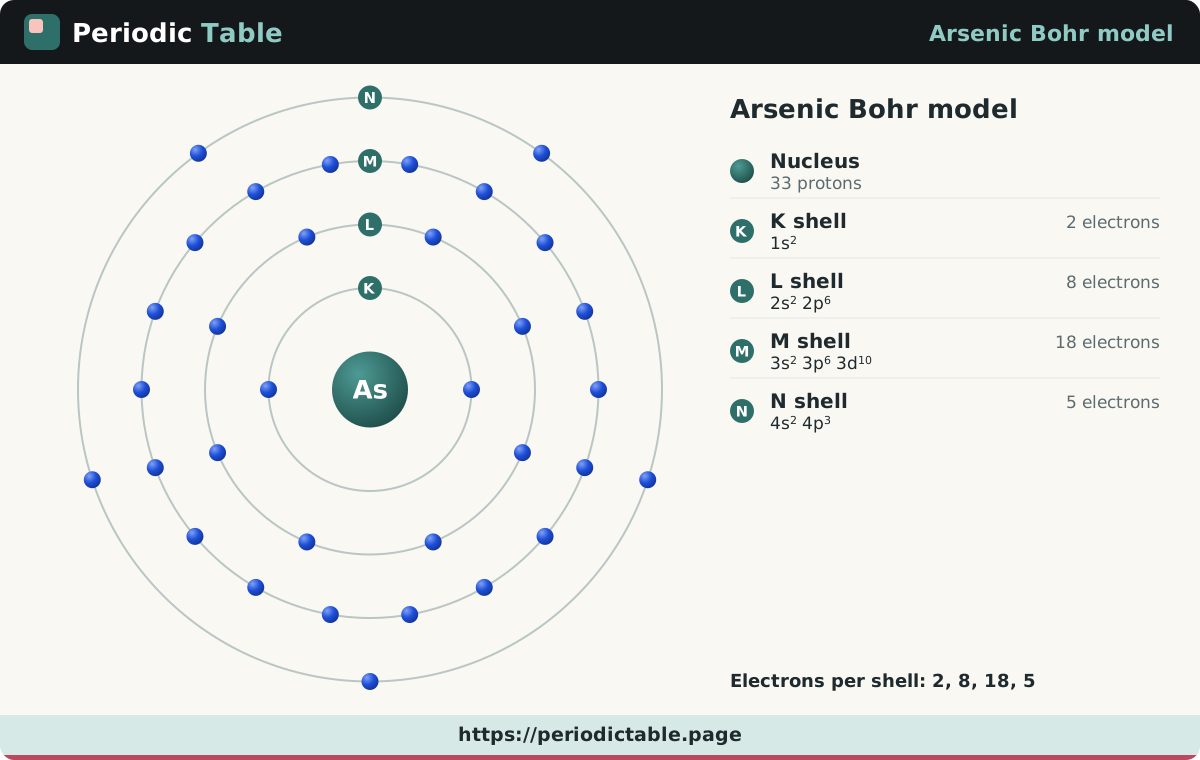
The arsenic Bohr model shows a arsenic atom (As) as a small nucleus with its electrons circling it in 4 shells: 2 in shell K, 8 in shell L, 18 in shell M and 5 in shell N. This page has a rotating 3D arsenic Bohr model, a flat diagram, a table of the electrons in each shell and the steps to draw it yourself.
Rotate the arsenic Bohr model in 3D
Drag to orbit, scroll to zoom.
This is a Bohr model of arsenic (As), a simplified picture of a single arsenic atom. Its nucleus holds 33 protons, and a neutral arsenic atom has 33 electrons, arranged around it in 4 shells (2 in shell K, 8 in shell L, 18 in shell M and 5 in shell N).
Arsenic Bohr model diagram
Arsenic electrons per shell
A neutral arsenic atom has 33 electrons, one for each of its 33 protons. They fill the shells from the nucleus outwards: 2 in shell K, 8 in shell L, 18 in shell M and 5 in shell N.
| Shell | Shell number (n) | Electrons | Most it can hold (2n²) | Subshells |
|---|---|---|---|---|
| K | 1 | 2 | 2 | 1s2 |
| L | 2 | 8 | 8 | 2s2 2p6 |
| M | 3 | 18 | 18 | 3s2 3p6 3d10 |
| N | 4 | 5 | 32 | 4s2 4p3 |
How the arsenic Bohr model builds up, shell by shell
Watch the arsenic Bohr model come together: the nucleus first, then each shell in turn, from the innermost outwards, with its electrons joining the ring. The legend names every shell and counts its electrons, so you can read off the arrangement (2 in shell K, 8 in shell L, 18 in shell M and 5 in shell N) as it forms.
How to draw the arsenic Bohr model
- Find the atomic number. Arsenic has atomic number 33, so a neutral atom has 33 protons and 33 electrons.
- Draw the nucleus. Put a circle in the centre and write As in it. The 33 protons sit there with the neutrons.
- Draw the shells. Sketch 4 shells as rings around the nucleus. A shell holds at most 2n² electrons: 2 in the first, 8 in the second, 18 in the third and 32 in the fourth.
- Place the electrons. Fill from the inside out: 2 in shell K, 8 in shell L, 18 in shell M and 5 in shell N.
- Check the total. 2 + 8 + 18 + 5 = 33, the atomic number, so every electron is accounted for.
Atomic data for the arsenic Bohr model
The numbers behind the arsenic Bohr model, grouped by topic. Radii are in picometres (pm) and energies in kilojoules per mole (kJ/mol).
Identity
- Symbol
- As
- Atomic number
- 33
- Atomic mass
- 74.9216 u
- Family
- Metalloids
- Position
- group 15, period 4
- Block
- p-block
Electron configuration
- Full
- 1s2 2s2 2p6 3s2 3p6 4s2 3d10 4p3
- Shorthand
- [Ar] 3d10 4s2 4p3
- Electrons per shell
- 2, 8, 18, 5
- Outer-shell electrons
- 5 in shell N
Ionisation energies
- I₁
- 947
- I₂
- 1798
- I₃
- 2735
- I₄
- 4837
- I₅
- 6043
- I₆
- 12310
Energy to remove each electron in turn (kJ/mol). A sharp jump means the next electron comes from an inner shell.
Atomic radii
- Calculated (pm)
- 114
- Empirical (pm)
- 115
- Covalent (pm)
- 121
- Van der Waals (pm)
- 185
Electronegativity and electron affinity
- Electronegativity (Pauling)
- 2.18
- Electron affinity (kJ/mol)
- 77.65
Oxidation states
−3 +3 +5
Charges the element commonly takes in compounds.
Physical properties, abundance and history of arsenic
Bulk properties of arsenic, how common it is, who discovered it and some of its compounds.
Physical properties
- Phase at room conditions
- Solid
- Appearance
- Metallic grey
- Melting point
- 816.85°C (1090 K)
- Density
- 5.727 g/cm³
- Specific heat (J/g·K)
- 0.329
- Molar heat capacity (J/mol·K)
- 24.64
- Heat of vaporisation (kJ/mol)
- 32.4
Abundance
- Earth's crust (mg/kg)
- 1.8
- Oceans (mg/L)
- 0.004
Discovery
- Discovered by
- Bronze Age
- Year
- 1250
Common compounds
- Arsenic As
- Arsanilic Acid C6H8AsNO3
- Dimethylarsinic Acid C2H7AsO2
- Sodium Arsenite AsNaO2
- Arsenic Acid AsH3O4
- Gallium arsenide AsGa
- Arsenic chloride (AsCl3) AsCl3
- Phenylarsine Oxide C6H5AsO
Compounds listed in the PubChem database.
Main isotopes of arsenic
Isotopes of arsenic share the same 33 protons but differ in neutrons. Natural isotopes come first, then the longest-lived others.
| Mass number | Natural abundance | Half-life | Decay |
|---|---|---|---|
| 71 | – | 65.3 h | β⁺ |
| 73 | – | 80.3 d | EC |
| 74 | – | 17.77 d | β⁺, β⁻ |
| 75 | 100 % | stable | – |
| 76 | – | 1.093 d | β⁻ |
| 77 | – | 38.79 h | β⁻ |
α = alpha decay, β⁻ = beta-minus, β⁺ = beta-plus, EC = electron capture, SF = spontaneous fission, p / n = proton / neutron emission.
More about arsenic
- Arsenic on the periodic table – properties, isotopes, uses and the full arsenic page.
- Metalloids – all metalloid elements and their trends.
- Bohr model of every element – the Bohr model of all 118 elements.